Half-Breed to Metis – My Return from a ‘Savage’ Wilderness; PART 2

 Click here to read part one – How I acquired the title of dirty Indian…

Aside from having to dream up a name to match any exotic ancestry I could claim, my real family history was more colourful than that anyway. We were the stereotypes of typical Indigenous life. Those lives scorned without understanding of the history behind the creation of those stereotypes.

It was a life loaded with issues around unsteady work, alcohol abuse, abuses under every heading, police visits, child apprehension, foster homes and a single mother on welfare. We moved a lot – always new towns, new friends, new crosses to bear.

So, by the time I could think a little for myself, I couldn’t wait to move on.  At nearly 16 yrs. I did move – onto a grown-up job and night school to get a better job, all in the name of getting as far away as possible from my childhood hurts.

Several years later my life had taken shape in a measure of success and definitely I thought I’d finally escaped being a poor and dirty little Indian. It seemed like I’d escaped the legacy of that drama. As it turned out, despite education and job titles, that wasn’t exactly the case. The various abuses never really ended regardless of the dressing I put up around them. I became even more desperate for a sense of value, meaning and peace. 

It was a bit incredible and maybe even miraculous from where the answers to my prayerful pleading would begin – searching the internet for a history project.

While I was doing that search, I stumbled across some family tidbits in the history records. It was astounding to me to see names I knew connected to others I’d never known about. Inexplicably I began to hear the call of my grandmothers in them and I quickly became obsessed with genealogy. Something was being filled in me that I’d been completely unconscious about missing.  I found the past. I continued in my search for years, able to trace my family back to the 1700s.

The uncovered voices of my ancestors undid the pain of my childhood humiliations.  Unlike the shame-based history the old input and my fearful imagination had originally filled in for me, I learned that we came from fiercely able, independent, inspiring Peoples.  I learned, in addition to Cree and Metis, my people were also Mohawk, among other nations.

I learned my ancestors were skillful and adept providers who worked the land, and they were warriors – from the Louis Riel uprising, to World Wars 1 and 2, and the Korean War.   They were explorers and guides for famous European explorers; they were leaders and treaty witnesses.

They were exactly what one might dream their forbearers are.  It was breathtaking discovery for me, but I later realized that, as wonderful as it was to feel the pride of their accomplishments, they didn’t need to be all that for me to feel found.

It would have been just as healing simply to find where I came from; to learn who my people were as a people, not as the butt of the jokes so common then on the western prairies.  Not as the people we learned about in school who were so low that even as kids, when we played cowboys and Indians, none of us wanted to be the Indians.

Fast forward some decades to when my son and I were going to a western-themed party.  We got all geared up in our cowboy boots and hats, jeans and checked shirts.  When we got home, my son was a little miffed.  His history lessons have been quite different from mine. He wanted to know why we hadn’t instead dressed up as Indigenous.  It was a good question, but I couldn’t find a good answer.

Although I’d identified as my Metis and First Nations ancestry for several years by then, I began to feel I was falling too short on the allegiance that my grandmothers deserved. Especially with the amount of public misinformation about the Indigenous still the norm in general.

However, despite the longing, I still had one foot out the door, just in case.  Old fears take a very long time to heal, if they ever do.  When I finally decided to stand up and be counted, I applied for a Metis citizenship card.

I’d like to set the record straight about how one goes about claiming that card.  Many comments in those newspaper and social media arenas revolve around thoughts like “well, pretty much everyone in Canada can claim some kind of Indigenous status now”.  No, they can’t.  You can’t just make a call and say, “Hello Government, I’m part-native, send me a card, thanks, and can I get free gas now like that Beiber kid”?

The application process took several months.  Actually, it took years counting the time it took to accumulate the various required records. I had to provide a genealogical history of 5 immediate generations of Indigenous ancestry with proof that included birth, baptismal, and marriage certificates.  It included scrip records, Hudson Bay Company work records, and other various historical records.  At a minimum, I had to link my direct ancestors to records known in western Canada at approximately 1860. Then all of this had to be verified by the society historians.

So that’s what I did, and now when I look into my mother’s eyes, I proudly see my history for thousands of years.  When my son looks in mine, he will see his own.  I turned away from that all those years ago when I thought I was meant to disown my heritage.

We talk a lot about how much the entire continent needs the true education on its own history, and that is absolute fact, but that’s just as true for many, if not most, of the Indigenous too.  We had our history taken from us long before we were even born and we know how terribly that changed us.

I can only feel sadness for that walk in the wilderness now, mine and all my relations of the last 5 generations who actually had our culture taken and even made illegal.  I know it doesn’t do any good to wonder about things that might have been, but sometimes I do.  I still have far too much to learn about them, and our ways.

On the day I received my official stamped Metis citizenship card, I stared at it and cried.  It was real, it was done, I’d stood up.  I really didn’t know then or even now, what difference in my life this official recognition will make.  I only know how I feel in those old wounded places in my heart.  I feel my grandmothers surrounding me now. My grandmothers called for PiPiSiw and I’ve come home.
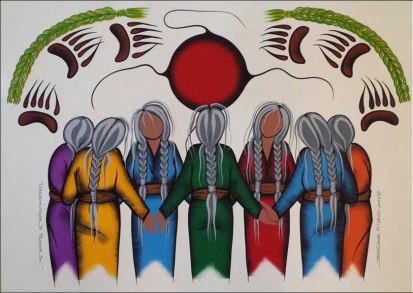
Grandmothers

kakiyaw niwākomākanak
(All My Relations)

RL

I want to add a little thank you so, so much to the people who have emailed me to tell me how glad they are for any of us able to speak out. You are a huge part of what makes these efforts meaningful. You are the people who allow my heart to feel full and worthwhile.
Hiy hiy….

With great gratitude to Dick Garneau, whose years of work compiling centuries of First Nations & Metis journal entries led me to more family discoveries than I ever dreamed I’d find. Hiy hiy, Dick. Thank you for your amazing work and generosity. May many others be as blessed as my family was with his work.  http://metis-history.info

21 things you may not know about the Indian Act – The Indian Act has been in place for 140 years:
http://www.cbc.ca/news/aboriginal/21-things-you-may-not-know-about-the-indian-act-1.3533613

Artwork credit, with permission: Grandmother’s Prayers:
Simone Mcleod, http://www.fisherstarcreations.com/simonemcleod-acrylics Facebook: https://www.facebook.com/anishinaabepaintersimonemcleod/info/?tab=page_info
Half-Breed to Metis – My Return from a ‘Savage’ Wilderness; PART 1

(Originally partially posted in 2013 and revised 2016)

My name is Pipisiw.  That’s what my grandmother called me. I’ve loved her, all my life, even though she died when I was three yrs. old.  I sometimes imagine I can remember hearing her call out to me… “Pi-piiii-siww”.

Now it makes me smile, but after she died, when I grew a little older, I came to hate that name.  I hated when my mother or uncles would call me by it. It came to represent all that was shameful to me about myself.

metis-bear blue-edged2That shame was really about my childhood and it was deep and even subconscious. I blamed most of it on the fact that I had been born of “Indian” ancestry.
Whether or not being Indigenous actually was the overall reason for the issues didn’t really matter because it was what was driven home to me as a child. Whatever bad that happened, was mostly because of that, regardless of where we were.

Neighbours, strangers and even friends reinforced that belief by at times calling me racist names or treating me with a certain disdain reserved for those considered lesser. I overheard countless comments on the general uselessness of Indians.

As an adult, it was astounding to hear occasional comments in my business world that continued those views. I’d thought the more educated could be held to a higher standard of decency in general.

Although communications was always a major role in my jobs, and most definitely, a full-on accusation as a child, I never spoke up when anyone said anything like that.  Along with the shame I carried was a belief that, for the most part, those comments were true. I’d come to believe we were lesser and despite innate defensiveness, my heart still carried it.

It took decades and a long look back for me to heal enough from those wounds to feel like I could truly stand up in recognition of my history and my own people.  I made that recognition statement by applying for Metis recognition.  I didn’t have a home band to call my own for the Cree/Nehiyaw side of our family, but I did I qualify for our Metis recognition.

My decision to apply was partly spurred by much of what I’d read in the papers and on social media over the last decade on how Indigenous issues are somehow an old idea and we should all be over it by now.  I’d hear a voice in the back of my head saying, that’s complete bullshit; no one tells anyone to get over the Jewish holocaust, what about ours? And why then, does this continent still have government departments to oversee the ‘Indians’? Then that voice asked, so where’s your voice in this?

There was a burning anger building in me and it fueled me to face my fears and delve into my past to answer that question. When I did, I still got butterflies that a broad, official declaration, ‘I am Cree, I am Metis’, would somehow affect me negatively.  In the end, the sense of injustice overwhelmed the fear; if anyone were to come for me and my boy, I’d rather go with that than live in shame any more.  Mostly though, I was able to stand up with pride by finally learning I did not come from some shame-filled abyss. None of us did.

It’s true that there are many issues that need attending to in Indigenous communities, the road of healing from the consequences of long-term colonialist oppression is still too long. Part of that healing needs far more awareness by most North Americans that those same oppressive systems are still in place today.

On the personal side of it, I really wonder if any community can truly fully grow if its foundation is unintentionally made flimsy by too many of us that feel like I did, sub-par and lost in a kind of black hole.

It took that long trek into the past to climb out of that hole.  I had no idea that walk would be over three centuries long and the first steps began with some of my earliest memories of being an “indian” child.

Those earliest recollections of being told what I was, not by family, but other people who were around us was normal and many of those lessons were taught in school. In class, among the typical stories and songs we all regularly sang were things like, “One Little, Two Little, Three Little Indians”, (apparently still popular with the uninformed). Right up there with Three Blind Mice. Hard to imagine that changed to 10 little Irish or Jewish boys.

At around Grade 5, at 10 yrs old, I remember being more conscious of learning about how those Indians who kept getting in the way of the settlers were really quite awful. It was that year that my relationship to those awful Indians was cemented after an incident with a non-Indigenous friend.  It’s here where I really started my journey back to the beginning…

“Get out of here, you filthy little Indian”!  The echo of those words screeched at me when I was 10 yrs. old never left the recesses of my heart. I was chased out of the home of my best friend by her mother, who accused me of doing something to dirty her home. I don’t remember the exact details of the crime, but I remember being very confused; I remember being made to feel dirty and small.

I ran from her and with each step my humiliation and devastation deepened.  Her words continued to boom loudly behind me as I raced up the street.  She made sure that everyone knew what I really was. She very nearly made sure I’d know what I was for the rest of my life.

It wasn’t the first time I’d been called some pejorative statement about my ancestry.   I heard them before I even began school: half-breed, squaw, redskin, savage…  The incidences lessened around 11 or 12 yrs. of age.  By then we’d learned to call each other squaw and savages anyway.

The name calling decreased more when I was about 15 yrs. old.  I’m guessing it was because it was becoming more largely politically incorrect in the late 1970’s. It wasn’t a daily or even weekly event anymore, but I wouldn’t be completely free of it at any time in my life, so far.

As I aged people would often ask me what I was and in return I would ask, what do you think?  They would give me all kinds of guesses, usually something Mediterranean, sometimes Eastern European, or even Eurasian when I moved to the coast.  I would always tell them, yes, that is correct – good guess!

One time someone asked me if I was Greek.  Of course, I said.  Well, what’s your name then?  Oh great, I had to come up with a Greek name.  I just barely found out what tzatziki was!  My panicking wit managed to squeeze out, “Athena” – that goddess of love kind of thing.   “Athena what”?  Oh, good grief!   “Acropolis, I am Athena Acropolis”!

I’m pretty sure it was then that he knew I was lying, but I just kept eating my tzatziki and pita as though it had been the first solid food fed to me as a baby by my definitely Greek parents…

Click here to read Part 2 – …What a search through history solved and  finally gave me… and it didn’t include a Greek anything…

RL

With great gratitude to Dick Garneau, whose years of work compiling centuries of First Nations & Metis journal entries led me to more family discoveries than I ever dreamed I’d find. Hiy hiy, Dick. Thank you for your amazing work and generosity. May many others be as blessed as my family was with his work.  http://metis-history.info

A short note just to add some context to how the Stereotypes began:
21 things you may not know about the Indian Act – The Indian Act has been in place for 140 years:
http://www.cbc.ca/news/aboriginal/21-things-you-may-not-know-about-the-indian-act-1.3533613

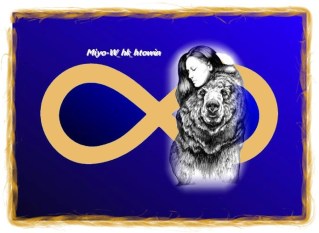
Artwork credit: Bear/Woman portion- Bear: Clan Mother, 2012  Jordan Thompson, mohawk-art-design.com;  Metis addition – Robyn Lawson

“I Will Never”…

It’s a rare occurrence for me to re-blog, but sometimes someone speaks so eloquently from their hearts, that I feel compelled to share those strongly felt thoughts.  They can be in the form of a beautiful poem, a touching story, or as is the one I am about to share – words from a heart-felt voice who speaks out in recognition of their privilege in life. She is speaking of her view of life for those of Indigenous ancestry from the other side their experiences.  I found it very touching on many levels , and I was grateful for her generosity of spirit.

I’ve also attached a link to a video from a “white redneck” who says “take responsibility white people”.  His is a rather saltier version, but it’s no less compelling.

The first story begins here, but you will have to click the link following for the finish…

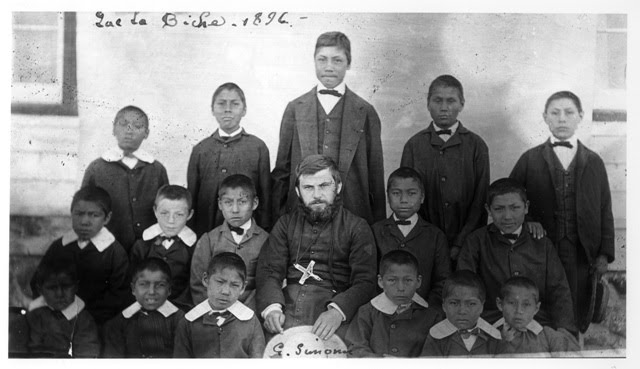
lac-la-biche-mission-1896“It would be another 100 years before the last residential school was closed in Canada — 1996. I graduated high school in 1996. I was preparing for my freshman year at college. I was under the impression that residential schools all looked like the picture above: black and white, old and grainy, things of the past, sad but irrevocable pieces of history.

Today I’m sitting in a cafe that’s live-streaming Edmonton’s Truth & Reconciliation Events. Due to the crazy traffic and parking fiasco I went through, I wasn’t able to make it physically to The Shaw Conference Centre today. Live-streaming is the next best thing, I guess.

What am I to think?

I’m white.

I’m Christian.

The whites.

The Christians.

We were the haters, the oppressors, the mongerers, the rapers, the abusers, the greedy mouths that took away almost everything from you… dear First Peoples of Turtle Island.

No, I’m not trying to impress you with my terminology. I am trying in my small broken way to address you with the respect you deserve. As I sip on my tea, I’m pondering: “What now?” The TRC cannot be both the beginning and the end. Surely not! But still”…

“I WILL NEVER” – A LETTER FROM A WHITE CHRISTIAN AT THE TRC

And,  now for a word from a self-described white redneck.  If you have an extra 5 minutes,  here is a great video from a white redneck who says, “take responsibility”. The language is rough in some spots, but his point is only underlined by it:  https://www.youtube.com/watch?v=JGJt0JXX05M

Two Years for Me! And the Irish Celebrate the Indigenous!

Two years of dedication to informing, amusing, irritating, or boring! I know how to perform to expectation.  At least, I think so, but considering this is the day of green beer again, I won’t guarantee anything through a lens of verdant bubbles.

For 24 months as of today, I have loved meeting new you’s and the pals who’ve stuck around long enough for me to able to call them friend.  I am so pleased, honored, and humbled by that; you are the quality of life. You have no idea how you’ve shaped my world, but you have and for the better. Thank you for everything you’ve shared in your own amazing words of wisdom, your creativity, and most definitely your humor.

I’ve also used this past year to write more from time to time about my Indigenous ancestry and the issues that surround it.  Yesterday, I came across a story I had no idea about and I doubt many do, but  it couldn’t have made a more perfectly timed appearance in my newsfeed.  It is about a March 1847 effort by the Choctaw people in Scullyville, Oklahoma, who gathered funds and provisions to help the Irish during their great famine.

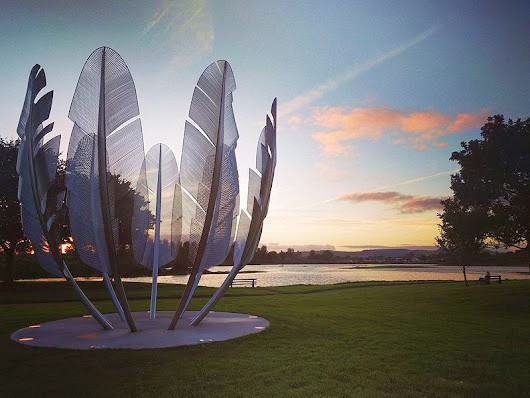
This effort was a mere 17 years after the Choctow were among those made to walk the Trail of Tears to great desperation and decimation themselves. This year an Irish town will erect a pretty poignantly designed sculpture in gratitude to those Choctow.  It’s quite a story and you can read about it here at Irish Central (March 6):  Irish town builds memorial to thank Native Americans who helped during Famine

Irish Memorial to Choctaw

Memorial sculpture of eagle feathers in Cork, Ireland in thanks to the Choctaw Nation

Happy Green, Happy St. Paddy’s Day, and Happy 2 Awesome Years with Y’all!

Irish road

RL

Pathetic and Dense; You HAVE To Be an Indian

There comes those moments when you sit back and assess why you do what you do.  I’ve done this recently in response to the reactions on my posts and comments about Indigenous Peoples based issues.

I originally started writing to throw out my views on general life events.  I worked around what I might write and I settled on the concept that my son would know his mother as a multi-dimensional being.  For the day that he realizes I am an actual person, I want him to know what I stood for outside of “dinner’s ready and is your homework done”?  I want him to know what I learned about the entire human experience.

I wanted to fill in as much of his background for him, in order to spare him and other children in our family, any moment of the emptiness I felt while growing up. There was little knowledge of my family history beyond the shame of what we experienced and what was said to define us.  A number of those experiences were based in the fact that I was born an Indigenous person.

I’ve written about some of my childhood and what it was like to grow up facing some of the ugliness of people who had no desire to hide their disdain for Indigenous anything.  I was called names that I knew were about disparagement of my culture before I had any idea about the concept of racism.  I was only about four or five years old when I first recall being called some of those names:  savage, squaw, filthy redskin, whatever it was, I knew enough to know it wasn’t good.

That was far from the last time I’d be called those sorts of names and treated with equal disdain.  Those overt efforts to denigrate me didn’t end until I was in my teens.  It was most likely the fact that public awareness was growing around the concepts of political awareness and correctness.

It would be three decades before the same kind of voices and sneers would come at me again.  I suppose I could count my last posted column to be the first instance of the return events – which caused a loss of some followers of my blog and my Twitter account. The most recent occasion was this past weekend.   I wasn’t called a savage, dirty redskin or a filthy Indian this time; they went for my intelligence and mental stability levels before they finished off with a reference to my ancestry.

This foray back into the dark happened while I was engaged in an online conversation.  It was within the comments of a national newspaper about the current call for an inquiry into Canada’s missing and murdered Aboriginal women.  The comments began mostly as denials for any need for inquiry, because the recently published RCMP report seemed to have all the answers already, despite the many calls showing the disproportionate numbers of Aboriginal women as victims overall.

The reasons for denying an inquiry have been solidly reported already, so I won’t repeat them, but it didn’t take long for the conversation to move from that topic to how it was about time for First Nations to take control of their own lives, to get over the past, and to get off the backs of taxpayers.

In defense, I began in earnest to answer the questions and reply to the statements of derision as quickly as they were being posted.  With each question, I would get another question or asked about something completely unrelated – the old, deflect to another point to avoid having to admit first point trumped – tactic.

With every answer I gave came the demand for proof, and when I provided reference links to support my statements, I was hit with personal aspersions.  Four people at various points each let me know that I was unaware of what planet I lived on, that I was “dense”,  “dumb”, “pathetic”, a “nutter”, and finally in  summation:  “You HAVE to be an Indian”.

National Post  Missing Women Sept 18 2014-3aNow, I don’t have a problem with being “an Indian”, even the sort that man was insinuating; I don’t deny my moments of mental densities, but I survived the years four, ten, twelve and the three plus decades with heart and soul intact.

While, I mostly repelled the sting of those arrows, they did make me question whether or not I was subjecting myself and possibly my son to potential harm down the road. Was I going to lose more people within my friendship and supporter circles?

I am prepared for any lack of interest or opposition to my views, but I can still be surprised by who those contradictions may come from.  It is painful to find out that people you thought gave a damn about you actually didn’t.  It is saddening to learn that people you counted on didn’t really have a backbone of their own, let alone your back, and that even people you admired can walk away with each step feeling like a slap to the face.

Here’s the thing about that stronger constitution I now own – it takes a lot less time to get over the hurt of crossing paths with those sorts of people.  Now I realize I am losing nothing except future moments of wasted time.  Whatever our purpose was to that point, it was served and now, time to move on, God bless.

I wrote a while ago that this was my tap dance, and part of the song is my ancestry.  The fact that my ancestry happens to be tied to very real and important issues for my country matters.

I will continue to write of human experiences, of my own triumphs and failures; I will write about what I find humorous, and I will continue to write about affairs Indigenous.

In fact, my next post is going to be about the answers I gave that caused those biting heads to explode in that online discussion. The part about how taxpayers do not support First Nations people and in fact, why taxpayers should be saying a hell of a lot of thanks instead.

I hope you’ll stay tuned.

RL