(Originally partially posted in 2013 and revised 2016)
My name is Pipisiw. That’s what my grandmother called me. I’ve loved her, all my life, even though she died when I was three yrs. old. I sometimes imagine I can remember hearing her call out to me… “Pi-piiii-siww”.
Now it makes me smile, but after she died, when I grew a little older, I came to hate that name. I hated when my mother or uncles would call me by it. It came to represent all that was shameful to me about myself.
 That shame was really about my childhood and it was deep and even subconscious. I blamed most of it on the fact that I had been born of “Indian” ancestry.
Whether or not being Indigenous actually was the overall reason for the issues didn’t really matter because it was what was driven home to me as a child. Whatever bad that happened, was mostly because of that, regardless of where we were.
Neighbours, strangers and even friends reinforced that belief by at times calling me racist names or treating me with a certain disdain reserved for those considered lesser. I overheard countless comments on the general uselessness of Indians.
As an adult, it was astounding to hear occasional comments in my business world that continued those views. I’d thought the more educated could be held to a higher standard of decency in general.
Although communications was always a major role in my jobs, and most definitely, a full-on accusation as a child, I never spoke up when anyone said anything like that. Along with the shame I carried was a belief that, for the most part, those comments were true. I’d come to believe we were lesser and despite innate defensiveness, my heart still carried it.
It took decades and a long look back for me to heal enough from those wounds to feel like I could truly stand up in recognition of my history and my own people. I made that recognition statement by applying for Metis recognition. I didn’t have a home band to call my own for the Cree/Nehiyaw side of our family, but I did I qualify for our Metis recognition.
My decision to apply was partly spurred by much of what I’d read in the papers and on social media over the last decade on how Indigenous issues are somehow an old idea and we should all be over it by now. I’d hear a voice in the back of my head saying, that’s complete bullshit; no one tells anyone to get over the Jewish holocaust, what about ours? And why then, does this continent still have government departments to oversee the ‘Indians’? Then that voice asked, so where’s your voice in this?
There was a burning anger building in me and it fueled me to face my fears and delve into my past to answer that question. When I did, I still got butterflies that a broad, official declaration, ‘I am Cree, I am Metis’, would somehow affect me negatively. In the end, the sense of injustice overwhelmed the fear; if anyone were to come for me and my boy, I’d rather go with that than live in shame any more. Mostly though, I was able to stand up with pride by finally learning I did not come from some shame-filled abyss. None of us did.
It’s true that there are many issues that need attending to in Indigenous communities, the road of healing from the consequences of long-term colonialist oppression is still too long. Part of that healing needs far more awareness by most North Americans that those same oppressive systems are still in place today.
On the personal side of it, I really wonder if any community can truly fully grow if its foundation is unintentionally made flimsy by too many of us that feel like I did, sub-par and lost in a kind of black hole.
It took that long trek into the past to climb out of that hole. I had no idea that walk would be over three centuries long and the first steps began with some of my earliest memories of being an “indian” child.
Those earliest recollections of being told what I was, not by family, but other people who were around us was normal and many of those lessons were taught in school. In class, among the typical stories and songs we all regularly sang were things like, “One Little, Two Little, Three Little Indians”, (apparently still popular with the uninformed). Right up there with Three Blind Mice. Hard to imagine that changed to 10 little Irish or Jewish boys.
At around Grade 5, at 10 yrs old, I remember being more conscious of learning about how those Indians who kept getting in the way of the settlers were really quite awful. It was that year that my relationship to those awful Indians was cemented after an incident with a non-Indigenous friend. It’s here where I really started my journey back to the beginning…
“Get out of here, you filthy little Indian”! The echo of those words screeched at me when I was 10 yrs. old never left the recesses of my heart. I was chased out of the home of my best friend by her mother, who accused me of doing something to dirty her home. I don’t remember the exact details of the crime, but I remember being very confused; I remember being made to feel dirty and small.
I ran from her and with each step my humiliation and devastation deepened. Her words continued to boom loudly behind me as I raced up the street. She made sure that everyone knew what I really was. She very nearly made sure I’d know what I was for the rest of my life.
It wasn’t the first time I’d been called some pejorative statement about my ancestry. I heard them before I even began school: half-breed, squaw, redskin, savage… The incidences lessened around 11 or 12 yrs. of age. By then we’d learned to call each other squaw and savages anyway.
The name calling decreased more when I was about 15 yrs. old. I’m guessing it was because it was becoming more largely politically incorrect in the late 1970’s. It wasn’t a daily or even weekly event anymore, but I wouldn’t be completely free of it at any time in my life, so far.
As I aged people would often ask me what I was and in return I would ask, what do you think? They would give me all kinds of guesses, usually something Mediterranean, sometimes Eastern European, or even Eurasian when I moved to the coast. I would always tell them, yes, that is correct – good guess!
One time someone asked me if I was Greek. Of course, I said. Well, what’s your name then? Oh great, I had to come up with a Greek name. I just barely found out what tzatziki was! My panicking wit managed to squeeze out, “Athena” – that goddess of love kind of thing. “Athena what”? Oh, good grief! “Acropolis, I am Athena Acropolis”!
I’m pretty sure it was then that he knew I was lying, but I just kept eating my tzatziki and pita as though it had been the first solid food fed to me as a baby by my definitely Greek parents…
Click here to read Part 2 – …What a search through history solved and finally gave me… and it didn’t include a Greek anything…
RL
With great gratitude to Dick Garneau, whose years of work compiling centuries of First Nations & Metis journal entries led me to more family discoveries than I ever dreamed I’d find. Hiy hiy, Dick. Thank you for your amazing work and generosity. May many others be as blessed as my family was with his work. http://metis-history.info
A short note just to add some context to how the Stereotypes began:
21 things you may not know about the Indian Act – The Indian Act has been in place for 140 years:
http://www.cbc.ca/news/aboriginal/21-things-you-may-not-know-about-the-indian-act-1.3533613
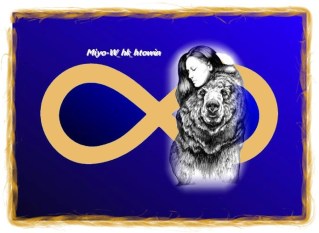
Artwork credit: Bear/Woman portion- Bear: Clan Mother, 2012 Jordan Thompson, mohawk-art-design.com; Metis addition – Robyn Lawson

 Our Home and Native Braves was published October 30, 2013 on the Reader’s Digest community website:
 Blog Woman!!! - Life Uncategorized