The Metis Nation, The MNO, and a Jarring Report On Identity

As a matter of noting impactful history as it’s occurring, a report presented at the March 9/10 Metis National Council’s (MNC), “Métis Identity, Citizenship & Homeland” conference in Saskatchewan, shocked many in attendance. It uncovered a troubling history that has led to serious issues for the Metis, now currently embroiled in what amounts to a ‘hostile takeover’ of their nation.

I shouldn’t have been surprised, let alone shocked about what we learned, because I am already well-aware of the immense issue for the Metis Nation in having to defend its identity and rights again. I’m well-versed in the history of the thousands of Canadians who more recently claim to be Metis, although many are seriously mistaken at best and others are purely fraudulent at worst.

The report presented wasn’t about those thousands of claims outside of the historical Metis communities, i.e.) those from regions in, and east of, Quebec. It concentrated on the claims of the legitimate Metis Nation’s own affiliate, the Metis Nation Ontario (MNO), one of five MNC affiliates.

Many already knew the MNO was fraught with membership filled with illegitimate claims of Metis ancestry and in 2019 they admitted to an overwhelming number; perhaps 90% of their membership, they said.

That was an astounding statement and regardless of the accuracy of that estimation, what percentage would they consider acceptable? That wasn’t the only issue at hand. The affiliate was also called into question after working unilaterally with the Province of Ontario government in 2017 to grant ‘historical Metis settlement’ status to 6 regions in Ontario outside of the Metis Nation historical homeland boundaries. The MNC, its other affiliate presidents and the Metis citizens were not included in that process.

(Update: in 2021, the MNO published approx. 77+% were non-Metis, thus they coined a new term, “Ontario Metis”, while continuing to use the cultural artifacts of the Red River Metis Nation).

Essentially then, the MNO is therefore mainly comprised of Ontarians of various ancestry who self-declared they were Metis and were accepted and seemingly legitimized by the MNO. If there are enough of these individuals in a particular region, this is taken as proof of the existence of a historical Métis “community”.

In November of 2018, the MNC and the other affiliates, with the exception of Alberta – which apparently has serious leadership [and membership] issues according to statements made at the March 10 meeting – voted to put the MNO on probation for one year to allow time to sort and re-register their members to fit the criteria of Metis Nation identity. Incidentally, that criteria aren’t different from any other world nation, which include immediate relation to the ancestry of the known Metis Nation families. The criteria was unanimously ratified by the Metis Nation in 2002. The MNO participated in that ratification and in its affirmation in 2013.

Back to 20 years later, and the one-year MNO probation term is over. The MNC, for which leadership is voted for & provided by its affiliate presidents, requested to review the new registers. The MNO responded with an incredulous refusal, stating they had their own ‘independent oversight’ and that the MNC were unwelcome ‘outsiders’.

They’d essentially announced they were a nation unto themselves and they went to Canada directly to try to create that into fact. They called it a ‘self-governance agreement’, which the government called ‘a step toward self-governance agreement’. What that will turn out to be is another story, but a main point is a clause in the agreement that states the MNO will get to decide for itself who is “Metis”.

An easy out compared to having to tell thousands of Ontarians they’re not Metis, some of whom hold influential positions in general society. There are also millions of dollars at stake in annual funding to oversee programs meant for the Indigenous, and specifically for, the Metis. If the MNO were to fail at attaining a new, unrelated pan-Indigenous nation recognized by Canada, that would make some of those members, not Metis, but non-status First Nations. Likely a good number would simply be recognized as non-Indigenous Canadians.

That’s the background to the March 9/10 MNC meeting. Here’s part of what’s stunning. The background historical research used by the MNO and the Ontario Government to justify inclusion of Ontario-based regions/people sometimes reads like a middle school copy & pasted book report. The conflations of ancestral claims are so flimsy in places, that at one point they barely bothered to provide evidence before bestowing the Metis flag to one region.

As is commonly practised by ‘self-identifiers’ in the further east, the Metis titles given by the MNO were based on claims of ancestry in nations unrelated to the Metis; on ancestors who were Europeans re-made into Indigenous; on ancestors that were and still are known as First Nations, whose descendants still live on the same reserves; by claiming First Nations villages were Metis; or as one person at the meeting stated, if a picture of their grandparents ‘looked Native’ to the registrar, they would be accepted. These people now outnumber the legitimate Metis in Ontario.

Excluding the MNO, the fight today is from within, from those who would allow anyone of any Indigenous ancestry to claim to be Metis vs. those who denounce the pan-Indigenous idea over their own unique, rich and richly established history, which included the herculean win in 1982 to achieve the recognition and rights to Section 35 of the Constitution for that nation.

Update: On September 29, 2021, the Manitoba Metis Federation, known as the heart of the Metis Nation homeland, withdrew from the Metis National Council in protest of its affiliate’s re-acceptance of the MNO into the MNC without proof of a Metis registry. Since then, the MNO has removed some of their more problematic membership claims, but has openly published its new version of identity parameters that extend their membership to over 77% unrelated to the Metis Nation. Unfortunately, they continue to call that registry, “Metis”.

RL

August 6, 2025 – The Chiefs of Ontario are calling on the province to release all the evidence and analysis used to justify the 2017 identification of the six “so-called historic Métis communities” in the province.

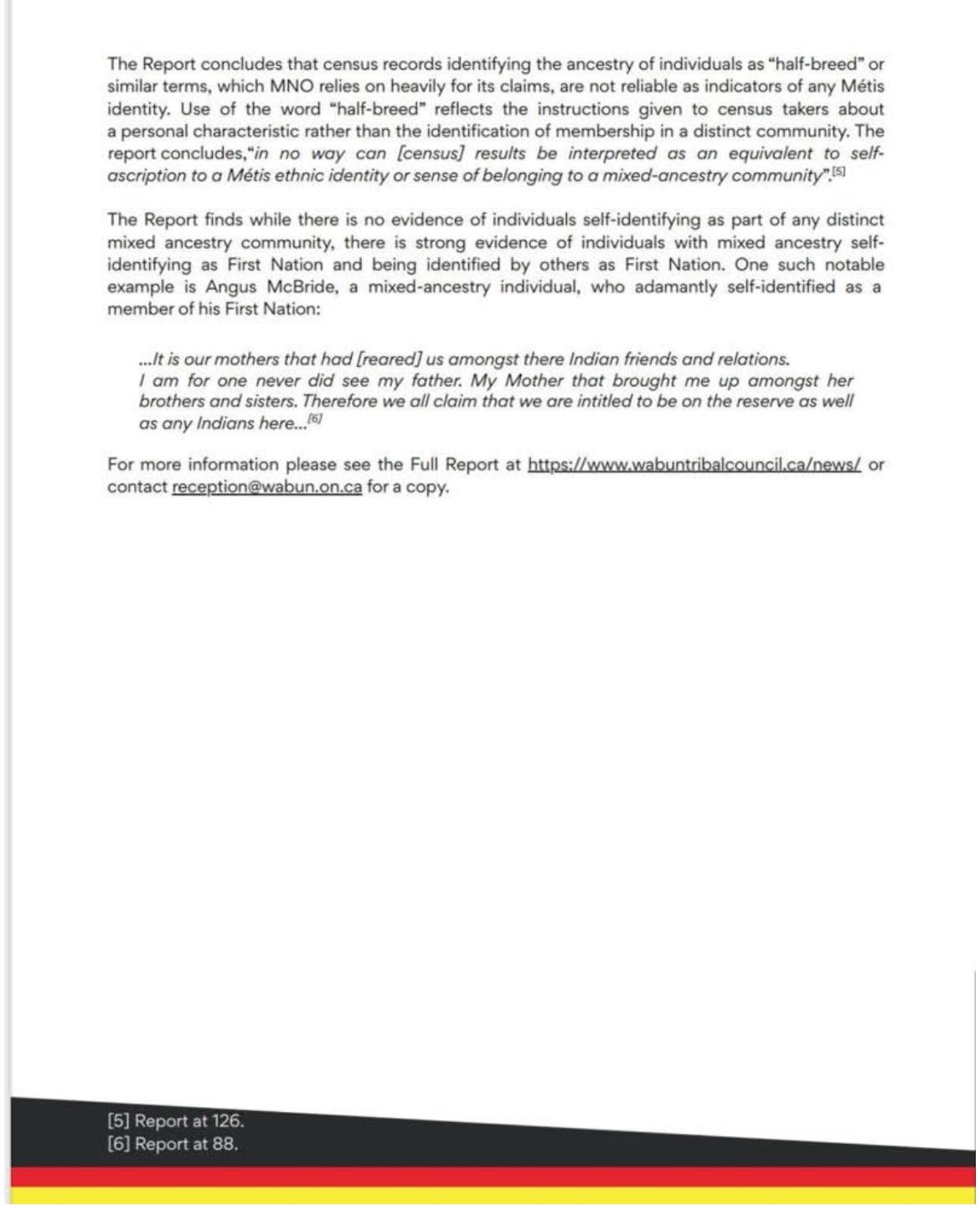
July 23, 2025 – Wabun tribal council released yet another academic report that challenges the MNO claims of historical existence of politically and culturally distinct “Métis” communities in northern Ontario/Great Lakes region.

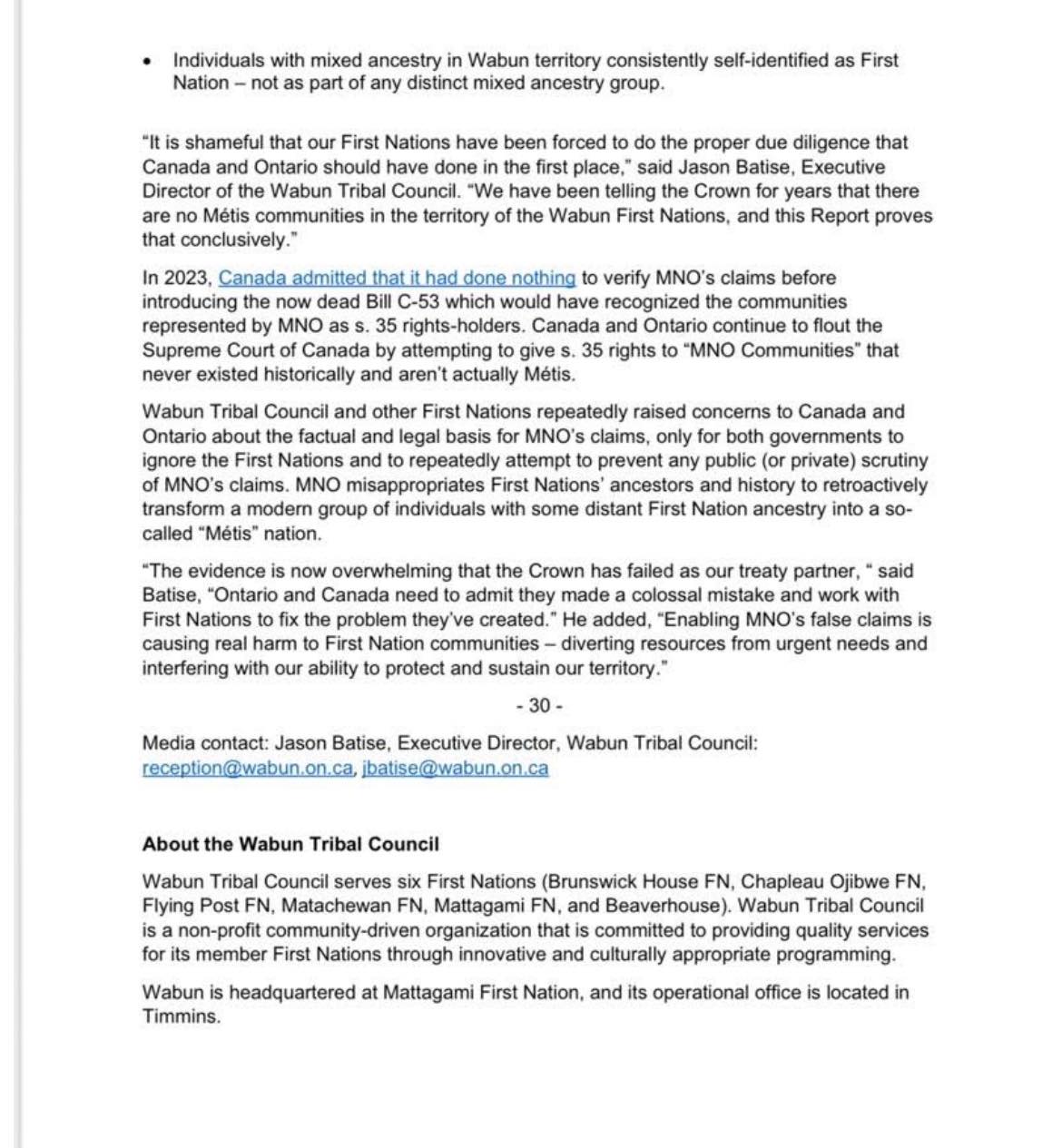
May 22, 2025 – New research, Assessing MNO Historical Claims to Rights in SON Territory, released today: “The Chiefs of Ontario stands in full support of the Saugeen Ojibway Nation in their release of Assessing Métis Historical Claims to Rights in SON Territory Report, which serves to protect their homelands and the assertion of their inherent rights and jurisdiction on their traditional and Treaty territories,” said Ontario Regional Chief Abram Benedict.

The report, prepared by two award-winning scholars, Dr. Heidi Bohaker, Professor of History at the University of Toronto, and Dr. Chandra Murdoch, a Post-Doctoral Fellow at Osgoode Hall Law School, was initiated in response to concerns from the Saugeen Ojibway Nation (SON) about claims being made by the Métis Nation of Ontario (MNO) and the Historic Saugeen Métis (HSM) in their territory.

A worthy note made by Dr. Darryl Leroux –There have now been 9 academics from fields as diverse as history, law, sociology, Indigenous studies, anthropology, and political science who have independently examined the MNO’s claims. Each time, they have found that the 2017 recognition of the MNO’s 7 new communities was a serious mistake by the Government of Ontario.”

May 20, 2025 – Manitoba Métis Federation and Chiefs of Ontario renew calls for government and institutional action in addressing Indigenous identity fraud

September 20, 2024 dated letter from Glen McCallum, MNS President to MNO President, Margaret Froh, appearing to set up backroom collaborations is discovered and made public. The letter undermines the MNS resolution of September 19, 2024; media attention; and the MNS constituents.

September 19 2024 – Final MNS resolution to resign from the Metis National Council (MNC) citing the lack of verifiable Metis registry of the MNO

September 18, 2024 – a new research study on the MNO’s “new historical Metis communities” for the Metis Nation SK presentation to the MNC finds the same conclusions by previous research reports looking into the MNO claims.

<object class="wp-block-file__embed" data="https://blog-woman.com/wp-content/uploads/2020/03/mns-commissioned-report-re-mno-final_votn.pdf&quot; type="application/pdf" style="width:100%;height:600px" aria-label="<strong>MNS COMMISSIONED REPORT RE MNO Final_VOTNMNS COMMISSIONED REPORT RE MNO Final_VOTNDownload

The MMF invite citizens and the public to read the report provided by Dr. Darryl Leroux, doctorate in Sociology and Anthropology, Assoc. Prof., Department of Social Justice and Community Studies at Saint Mary’s University, Prof. Darren O’Toole, Metis, Faculty of Law, University of Ottawa, Métis scholar Dr. Jennifer Adese, and professional genealogist, Gail Morin

An update to on the added communities by the MNO was prepared in October, 2020, which can be viewed and downloaded here:

<object class="wp-block-file__embed" data="https://blog-woman.com/wp-content/uploads/2020/03/mmf-report-update-october-2020-adese-leroux-otoole-.pdf&quot; type="application/pdf" style="width:100%;height:600px" aria-label="<strong>MMF-Report-Update October 2020 -Adese Leroux OTooleMMF-Report-Update October 2020 -Adese Leroux OTooleDownload

October 2023 – The Sault Ste. Marie “Métis” Community and “Halfbreed Petition”
Prepared for Robinson-Huron Waawiindemaagewin
by Drs. Celeste Pedri-Spade & Darryl Leroux

This report was commissioned by Robinson Huron Waawiindamaagewin in August 2023 as part of the research they’ve been leading
about the Métis Nation of Ontario’s (MNO) political claims in Robinson-Huron territory. The purpose of this latest project is twofold:

  • to assess to what extent historical reports and academic literature on the so-called Sault Ste. Marie Métis
    apply a consistent definition of “Métis” (specifically one that reflects more than just the presence of “mixedblood” individuals); and
  • to establish whether and/or to what extent this same research engages with Anishinabek history and governance in the MNO’s discussion of what it calls the SSM “Halfbreed Petition.”
    Our findings confirm that the research reports and academic literature that are often cited to legitimize the existence of a distinct Métis
    community in the Sault Ste. Marie region lack scholarly rigour in their use and understanding of the term “Métis.”
<object class="wp-block-file__embed" data="https://blog-woman.com/wp-content/uploads/2023/11/leroux-pedri-spade-the-sault-ste-marie-metis-community-and-halfbreed-petition-october-2023.pdf&quot; type="application/pdf" style="width:100%;height:600px" aria-label="<strong>leroux-pedri-spade-the-sault-ste-marie-metis-community-and-halfbreed-petition-october-2023leroux-pedri-spade-the-sault-ste-marie-metis-community-and-halfbreed-petition-october-2023Download

September 2023 – Examples of the false evidence used bythe Métis Nation of Ontario and the Province of Ontario to invent the historic Métis communityof Killarney & Environs

Statements by MNC November 19, 2020: Tri-council says it’s not leaving Metis National Council, but stalemate continues

February 3, 2021 Claims of ‘new’ Métis communities in Ontario rejected by MMF’s research document

February 5, 2021: Statement on the MNO “root ancestors” by Gail Morin, noted genealogist of Metis families for 30+ yrs and author of over 80 books

“Like it or not the majority of MNO root ancestors are French Canadian, status or Non-status”

“It took me a year or so to even get past the list of root ancestors available online c2018, but about 14 months ago I started looking. The MNO root list isn’t particularly user friendly and probably someone inexperienced in genealogy or research would never be able to sort it out. They use phrases like verified Métis ancestor for people who were born in Quebec and with no indigenous ancestry. Many of the families who were mixed bloods were living on Indian reserves. When the “rules” on enrollment started, the mixed bloods who stayed in Canada became non-status. Often these mixed bloods met and married US citizens. Some of them assimilated to the south, but many of them became part of US reservations. They aren’t Métis. Yes, there are some Métis in the mix. The list for Mattawa includes the well known Favel family. There is a Lhirondelle branch in Georgian Bay. The Rainy River families definitely had a connection to Manitoba. Considering $600,000+ was spent on this root ancestor project, I’m guessing it was commissioned to “let” people become Métis and to produce numbers. I know some of the grandfathered MNO members were eventually disallowed membership. They must have been part of the pre-1730s families from Quebec or in some cases had an Indian grandmother who was a white woman born in France or someone who was made up on the Internet. What a mess!”

September 1, 2022 a new report commissioned for the Wabun Tribal Council of Ontario in defense of their territorial titles against the MNO is published.

November 27, 2022 Link – Government must reject exaggerated claims of Métis heritage:

August 23, 2019 – Métis people in Ontario try to agree on governance – state up to 90% likely not Red River Metis
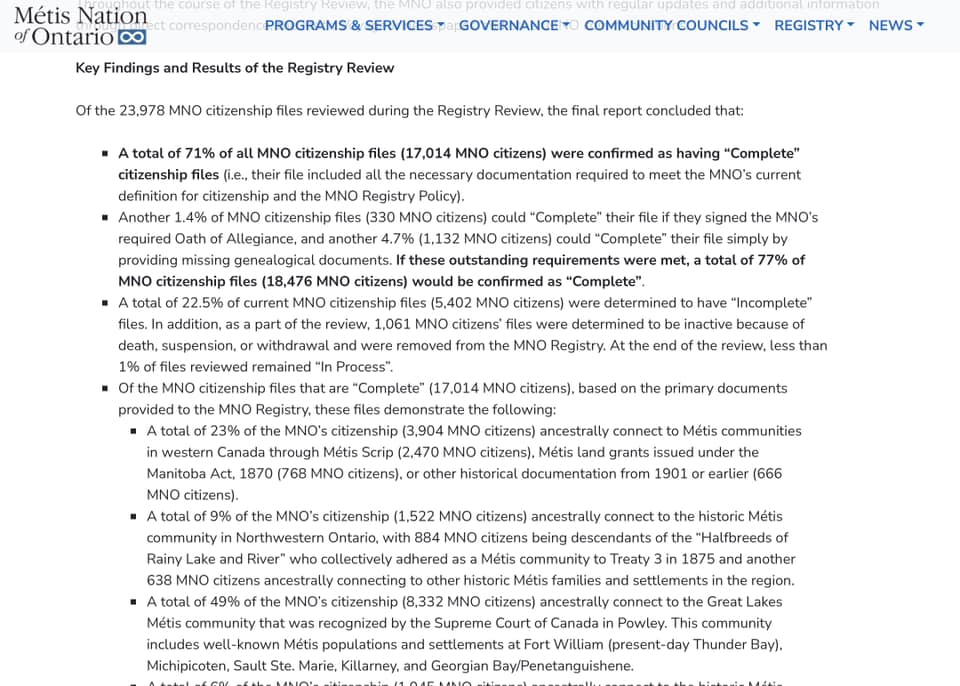
MNO key findings of

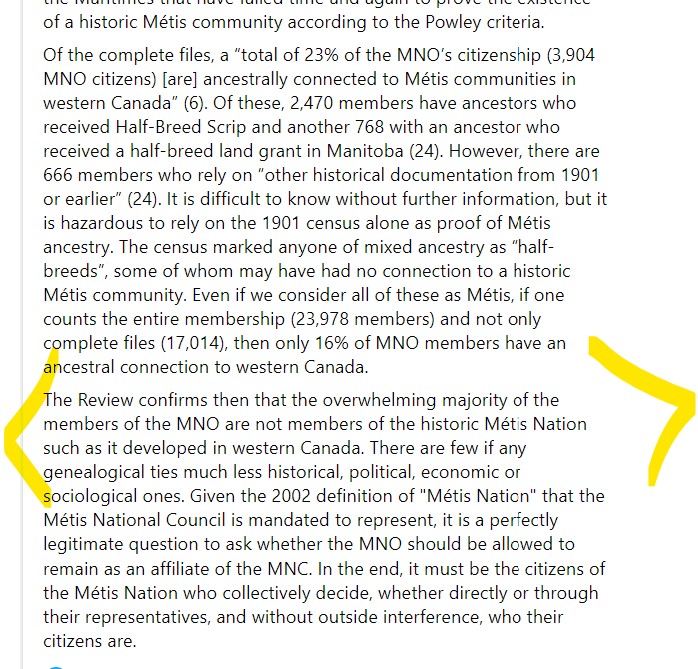
Metis lawyer, historian, Professor Darren O’Toole’s findings on the 2021 MNO registry review report.

May 13, 2024 – CANADIAN
Indigenous fraud summit in Winnipeg to discuss Inuit identity, federal legislation

May 15, 2024 Indigenous leaders pass declaration on Indigenous identity fraud at summit in Winnipeg

Mythical Drops of Blood; Pan-Indigenous Nations Don’t Exist

Calling oneself Indigenous or First Nations is equal to calling oneself European or African. Neither of these regions are a single culture. They are a multitude of nations, customs & traditions. So it is for the Indigenous in North America.

It’s often asked in Canada, “what makes someone Metis”? Asked & answered by the Metis Nation in 2002 and received Canadian recognition of it. The real question should be, “what makes one Indigenous”? Who believes a distant ancestor from a generation over 200 – 300 yrs ago or more now qualifies anyone to be recognized as Indigenous? You might be surprised by the number in Canada who think they are – in the hundreds of thousands.

When one says they want to connect with their Indigenous culture, but can’t name the nation they’re from, what then? This is where the Metis Nation is often chosen because of the misinformation it’s a culture that accepts any mixed ancestry. That is not the case, as is being spoken about frequently now by design to educate the public.

The Metis Nation has specific unique languages and customs & traditions of its own. There is a verification process in place for this nation. It is being enforced now because of widespread fraud (intended or not) that takes from the Metis Nation reputation and all opportunities meant for them as an Indigenous people.

So, what about those who got lost in the diaspora caused by Canadian policies? I’m well aware of the separation from Indigenous culture by events like residential schools and the 60’s Scoop. I was one of those kids. I’m also aware that I was lucky to know exactly what my nations are and the names of my grandparents, but I had to search for everything from there to know where I came from, including the customs & traditions of my nations.

Re-connection to one’s culture can only be attained by connecting with cultural centres or relations who can help guide anyone who knows at least their nation. Otherwise we’re really only learning about someone else’s nation and customs, aren’t we?

Although the Cree Nation is well known, I knew I came specifically from the Plains Cree. That was important because there are different Cree nations: Plains, Swampy, Woods, Moose, etc. They all have differences in their languages and customs in the same way any European grouping like the Swedish, Finnish and Norwegian do.

So calling oneself First Nations or Indigenous is not an automatic entry into a grand, pan-Indigenous experience. It certainly looks like that from many people’s promoted experiences of doing just that, but there is dishonesty in that; it does nothing in honouring one’s ancestors or culture.

These efforts only sustain and cement stereotypical ideas as often taught by ‘self-identified/proclaimed Indigenous people’ and onto those Canadian promotional materials using the Plains nations tipis and headdresses to depict an entire culture of cultures. This is rather insulting considering these items were never used in most Indigenous nations.

There are millions of people on this continent from Africa. They have no idea where their families originated from there; a continent of nations. They do not and cannot assume to know which nation is theirs. Some have been very lucky to learn their own historical truths, but most will never know. Unfortunately, this is the case for some people of Indigenous ancestry.

It’s criminal that this sad history persists, but no Indigenous nation is responsible for this horrific stain on Canada’s history. Neither are they obligated to let in just anyone who comes knocking on their door. This includes the Metis Nation. This seems to seriously antagonize a lot of people who want to claim themselves Metis regardless of their history. It may be infuriating and heartbreaking, but that is not the responsibility of the Metis Nation and its people.

So, where do people who don’t know their nations go? I don’t have an answer for that any more than I’d be able to tell African Americans what to do for representation. The only thing that can be done is an ancestral hunt to the best of one’s ability with a heap of good luck thrown in. This unfortunate diaspora is Canada’s doing and what they will do to make it right is the greatest unknown. In all honestly, I doubt it will be much.

RL

‘Alternative’ Metis Nation Alert; Frauds exposed from the west to the east

Updated October 26, 2018:  News reports on fraudulent ‘status’ cards and police investigations, and APTN interview with professor researching the ‘eastern Metis’ groups.

This is not new news, it has been reported in previous years, but it doesn’t seem to quell the ongoing efforts of those who would take advantage of a history not well known nor those who would reward them in the name of ‘reconciliation’ or any other feel-good motivation.

Although I’m aware of several well-known & award winning Canadians who have been exposed as having usurped Indigenous identity on which to build a career, i.e. Joseph Boyden, I’ve just learned of another, the Order of Canada and several other prestigious awards recipient, David Bouchard.

Bouchard, who claims Metis ancestry, was exposed for using the officially recognized Metis (Michif) Nation for his own background and gain, after it was discovered he didn’t meet the required ancestral lineage. He responded by creating ‘alternative metis’ groups, which appear to be based in some idea of a pan-Indigenous society. Let’s make it clear, Indigenous nations are nations as much as any other in the world.

Bouchard originally participated in the 2002 inclusion of the official BC Metis Nation arm of the recognized Metis Nation, but his application and involvement was rescinded when he failed the organization’s own requirement of meeting a current line of five direct generations to the prairie Michif people, history, culture, etc.

His ancestry was related to one Algonquin woman ancestor born in 1621. In 2008, he added to his lineage, a Chippewa grandfather and a grandmother from the middle-U.S. nation, the Osage,  circa 1800s. These nations are not related to the Metis Nation. These additional details were provided in 2013 by a U.S. genealogist who declared Bouchard a Metis. Unfortunately for Bouchard et al, that’s not how citizenship inclusion works. The research declared Bouchard as having mixed ancestry, but that research must then be taken to the Canadian situated and recognized Metis Nation for verification and then it is they who grant inclusion into the nation. It is understood that an updated application was not submitted to the Metis Nation. No word on whether or not the Osage Nation accepted him.

Although Bouchard’s level of involvement in the 2011 creation of the alternative group, the “BC Metis Federation” is unclear, he went on to create his own alternative national group, the “Metis Federation of Canada” in 2013, with Karole Dumont-Beckett, as first registrar and Sebastien Malette as “legal advisor”, and Johanne Brissette, aka Qalunnette or Abitawiskwe. Neither of these groups require lineage linked to the Michif history. Dumont-Beckett went on to take over yet another group called the “Metis Nation of Canada” in 2019.

One does not simply proclaim oneself to be Metis any more than one may proclaim to be Scottish or a Canadian. There are parameters to be met and a connection to any long-lost or Indigenous ancestor is not one of them. Nor does claiming ancestors prior to the ethnogenesis of the Metis Nation make anyone Metis. How is it people don’t recognize there were no Metis until then? They ignore the fact the Michif don’t call their own originating ancestors, Metis. They are recorded as they were, by their original nationhood, just as Canadians identify their ancestors by their originating nations.

The level to which these people have done damage to the reputation of the recognized Metis Nation and to the people who they sign onto their organizations with the same level of ancestral connections – which is to say non-existent to barely, has many in the Indigenous communities stating these kind of mis-representations could & should be considered  fraudulent.

They harm the recognized Indigenous peoples by mis-representing history, snatching opportunities in employment, awards, grants, scholarships and any other avenue meant to lend a hand up to the marginalized, and they mislead thousands of people into unwittingly believing they too belong to a community.

They go further though. They have members who seek out and harass anyone who speaks out about them by swarming on social media, contacting employers to claim all sort of reverse harassment, to threatening lawsuits.

The Metis Nation is an established nation with history of verifiable detail for centuries. For example, as a member of this nation, I could only state on my application my “Metis” – my Michif ancestry, not my Cree, Haudenosaunee, or any other Indigenous nation to which I’m related.

The details of these organizations are publicly available, as are the officially recognized Metis Nation on their own and the Government of Canada’s websites, yet award, grant or bursary organizations, employers, and especially the Canadian media have not thought to act on determining who is officially recognized, as they hand out opportunities meant for the Indigenous. The unfortunate result are long waiting lists for recognized nation members often held back for years, if not entirely rejected.

There is no pan-Indigenous society or ‘nation’ that one with any hint of Indigenous ancestry can run to for representation. Any who claim this are frauds. If one feels they belong to an Indigenous nation, then seek out the particular nation you believe you’re connected to.

On a personal note for those who falsely claim Indigeneity, you are doing so at the cost of opportunity for my child, myself or  my relations, although I suspect you already know that. I can only say – shame on you. May you face the price for impinging on the last bastion of our sovereignty – our very identity.

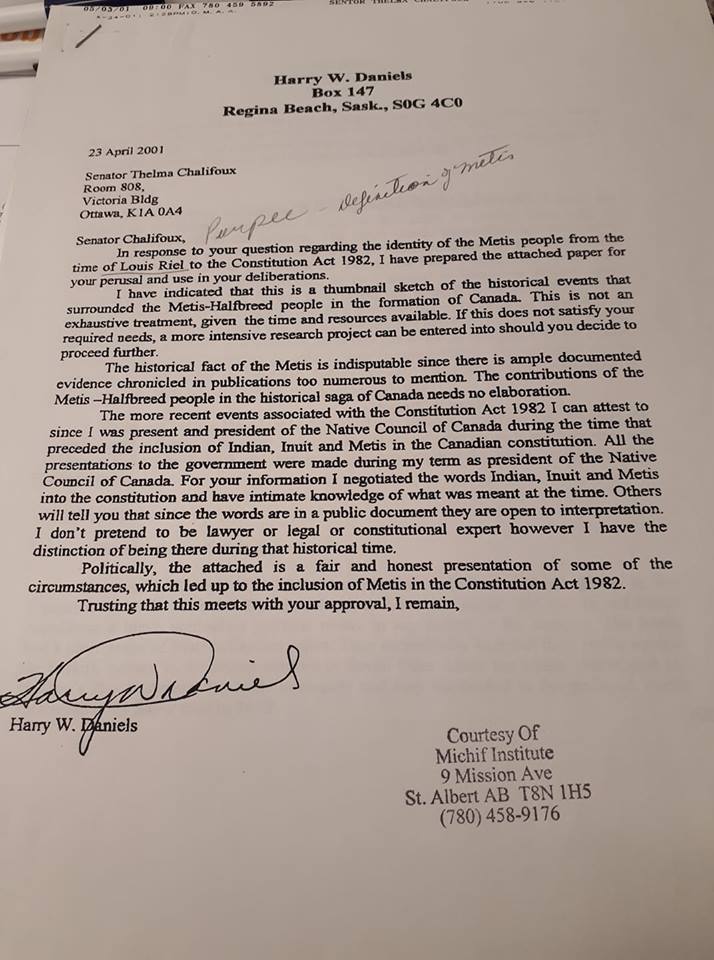
A visual on who may qualify as a Metis Nation citizen

The audacity to put one’s face next to the founders of a nation that none of Bouchard’s family, including himself, were ever a part of, until he self-declared himself Metis in his later adult years. This book should be removed from every school in western Canada.

BC Metis Nation order to rescind membership: David Bouchard MNBC membership application rescinded

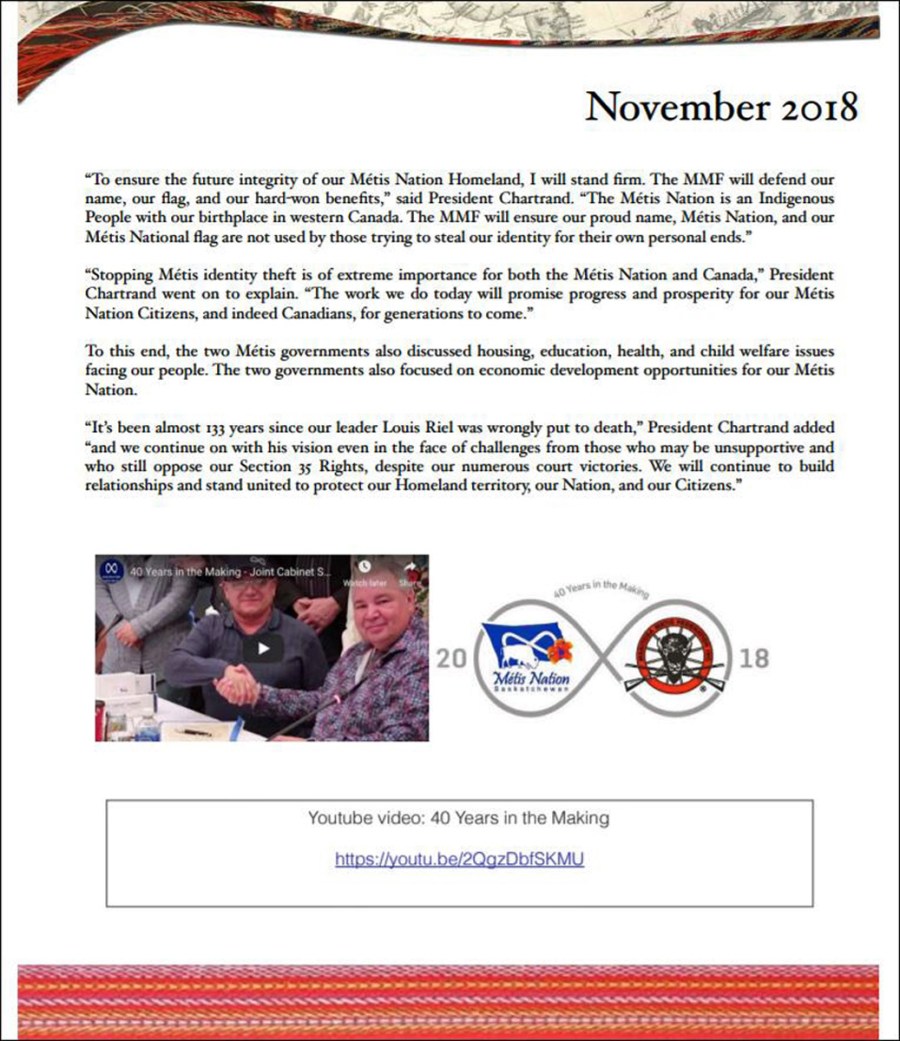
November 2018 Metis National Council & Manitoba Metis Federation release statements in protection of Metis Nation sovereignty and definition.

Dejah, The Warrior

This is a re-post for my dear friend, Glo, in tribute to the amazing life and soul of her baby, and their loved ones. It’s hard to believe it’s been 5 years. Already. I can’t say exactly how it feels for Gloria, Robert & Rayne, but I would like them to know we remember with them. We share in their heartrending memories and in support of their amazing capacity to move forward in strength, purpose and love for each other and for life. They couldn’t live a better legacy for their son and brother…

 …

I hardly know this young boy who impacted my life and so many others so profoundly. What kid is all that interested in their mother’s friends anyway? And so, I came to know him mostly through her, our Glo.

She is that quintessential statement of strength and courage, which can almost sound like a cliché, but it isn’t when it’s applied to a parent facing one of our worst fears. Which is what happened to her and she, true to character, faced that nightmare fully and head-on.

He was only three years old when they were told he had cancer. It was horribly bad news.  Most kids who get this kind of cancer have a pretty good outlook, but for some the challenge will push to the limit. This was to be the case for him.

I can’t imagine having to look at my baby’s sweet innocent face and into his trusting eyes, knowing what they knew was to come for their son and try to prepare for that. How unbearable could it have felt to know the awful truth of what was in store in some ways and not have any idea or certainty about anything else?

The only thing that turned out to be absolutely certain is that this kid had something else too – a hell of a fighting spirit. Those innocent eyes masked a strength that could rival a grown man’s, and that was good because he used it fully. It was what carried him beyond the lines of expectation.

As it turned out, his backup arsenal was also beyond outstanding. His shield of steel was the love and faith of his mother and his dad and sister were the center of his phalanx.

Phalanx is a perfect word for his story. I’d stumbled around for a while looking for a way to describe all the people who joined the power of this boy’s circle. My son said, “That sounds like you’re talking about a phalanx, mom”.  I asked what that was exactly. After he explained, I thought yes, that’s exactly what they are.

A phalanx is defined as a compact or close-knit body of people, a formation of infantry carrying overlapping shields and long spears. Perfect. That’s what they were – overlapping shields of love and spears of hope. The rest of that foundation was formidably filled out by all the family and friends who rallied around them.

No matter their role as those weapons of love and hope, every one of them, including the calvary of determined medical personnel was there in common spirit.  All were there to throw everything they could at that god-damned tumor.

They did it well for ten amazing years.  It wasn’t a smooth trip for sure, but they fought those ups and downs with purpose. He and his family were also determined to instill something meaningful into what would seem to be a senseless, painful ordeal.

He moved to the center of an organized effort to finally stop cancer in children. He and his family charged alongside an organization called Kick For A Cure, whose role is to fund the research that will finally “kick cancer where it hurts”.

Part of the fight for a full life was trying to be just a boy who could play and learn like everyone else. Why should any child have to fight to be just a 5 year old or an 8 year old? The balancing act to just be and to be a helper in the bigger picture becomes another unexpected fact of life, a new normal.

The day came when balance was made impossible and it became an effort to just hold on – to a few more hours spent wrapped in the bond of fighters who’ve survived together for so long. To a few more minutes of saying I love you; and for that one more heartbreaking second to look into each other’s eyes.

When children get so sick, when they die, we are devastated. We cry and feel deeply because for those moments, born to us or not, they all become our babies.

Maybe we ask God or the Universe, why or how?  Maybe one day we’ll have all the answers, but for now, at this moment, I need to believe that the Universe said these things to him:

Thank you, Dejah.

Thank you for enduring the pain of the fight for so long.

Thank you doing for so much work in such a short period of time to inform and teach about childhood cancer.

Thank you for all that you’ve given and taught to your mom, dad, and sister.

Thank you for all that you’ve given and shown to your family and friends.

Thank you for the sacrifice you gave to medicine that will one day make this illness less devastating for another child.

Thank you for the way you brought your community together over and over again, and got them all thinking about love, and for reminding them that, it is the only true purpose.

Your work is done Dejah, in superhero excellence. You’re finally pain free; dance wildly in joy.  You’ve earned it, kid.

You will always, always, be a kick ass hero.

Dejah Milne
February 4, 2000 – October 5, 2013

dejah

Photo by Cher Milne Gennaro‎, Memories with Dejah

RL

_______________________________________________________

The story of how Dejah affected his community and the people around the world was captured during his beautiful service tribute and in how his story was shared around the globe.

What is Metis Again?

Updated September 22, 2018

There’s unfortunate long-held misunderstanding of what being “Metis” means. That confusion has only grown messier in the last few years by increased numbers of various groups looking for recognized Metis identity, if not as entirely new nations altogether.

The misperceptions have lead to outright strife throughout communities, acted out in mild contentious chats to vicious trolling attacks on social media to threatening job losses and lawsuits.

Canada didn’t help this confusion when it formally recognized the western Metis Nation without clearly spelling out that following the steps to ‘self-identification as Metis’ also requires proving that you’re related to this nation. In other words, your relations must be of the known Metis ancestral names on record, language, history & culture from within this western Indigenous community. Thus, I could not put my Cree or other relations on my Metis application.

Canada’s not clearly stating that serves to inspire some to claim their Indigeneity by choosing to be Metis, a very mistaken concept. It is the Metis Nation itself that chooses who to accept in their nation – as does every other nation in the world.

People of no Indigenous ancestry have also been re-inventing their heritage in order to apply themselves, unchecked & un-vetted, to positions meant for the Indigenous in work & arts opportunities, education grants, and governance. Several of these interlopers have been uncovered within the last decade.

From there, groups work by literally re-writing history to usurp harvesting rights from First Nations and to demand retailers provide them rights that even the recognized Metis Nation don’t have – tax free gas & merchandise. Copies of meeting minutes from the “Eastern Metis”, detailed concern mainly for those ‘goodies’ and did not address a single issue plaguing the Indigenous in Canada today.

These groups are prolific, overwhelmingly white, many racist-based including three that merged and changed their name from the “Association for White Rights” to the “Eastern Metis”. They claim well over 20,000 members in Quebec & contest Innu land claims.  In Nova Scotia the self-identified Metis are fighting to claim the harvesting rights of the Mi’kmaq. The Mi’kmaq vehemently oppose those claims because they state, as does the Metis Nation, that there never were historical Metis settlements in Nova Scotia or New Brunswick.

Currently most people, even some indigenous people, believe ‘Metis” simply means a mix of any Indigenous with non-Indigenous ancestry – generally something European.  While the Metis Nation is comprised of some French & British men and the word ‘metis’ is French for mixed, this is not what is meant when it comes to defining the formally recognized Metis Nation.

This nation began forming in the 1600/1700s, solidifying in the early 1800s between a relatively small group of specific and well-documented Indigenous women, generally from the Plains Cree, Saulteaux, Assiniboine, and Dene nations and their French, British/Scot men. Their following generations went onto marry other members of this Metis grouping or their original First Nation tribes. The recognized Metis Nation’s battles alongside their ancestral nations for Indigenous rights, and having been persecuted and killed for doing so, is a well-established record.

The idea that being Metis is the simple work of dividing each generation by another half with white people is incorrect. That ancestry is currently known as mixed or “non-status First Nations” people, known as part whichever original nation(s). It is not, at all, the romanticized idea that the Metis lived one foot in the ‘white world’ and one in the ‘Native world’. The Metis were and are Indigenous.

Just to clarify further, there are also mixed ‘Status” First Nations people. Many of these cases are from families where a First Nations man married a white woman and full status was granted to she and their children. Not so for Indigenous women, who lost all status for herself and her children if she had children with a white man – the original non-status First Nations.

I understand why many want to identify as Metis because of the western Metis Nation federal recognition as ‘Indians’, but wanting it and being it is not the same thing. I do however, strongly believe verifiable non-status First Nations fully deserve the sorely lacking recognition and representation. This is in contrast to growing groups who feel it’s their right to claim Indigeneity on face-value, claiming persecution when asked for bona-fides. They seem to feel they’re above the routine requirement of all Indigenous to provide records of proof to claim status or membership into nation. No nation is obligated to accept anyone.

I’m not entering into the role of declaring who is or isn’t Indigenous. That’s not my fight. My personal expectation is that any individual or group looking for formal Indigenous  recognition have to meet the standards of nationhood that the western Metis Nation did: a distinct language, unique & established customs and traditions and a documented current line to historic Metis communities. If there are other mixed ancestral groups meeting these standards, by all means pursue it, but without denigrating the western Metis Nation for having achieved it. Your fight is with Canada.

Many groups asserting they’re Metis, regardless of the known parameters explain their line to the Metis is based in the claim they were ‘especially’ discriminated against, and so ‘hid out in plain sight’ all this time as a life-saving measure. How do they then square this with their claims of holding ‘known historical land bases’ that tie to them even today?

How does one publicly renounce their heritage for several generations by hiding out and living as and in non-Indigenous communities then come back now to claim their presence in those communities constitutes making those communities now Indigenous?  Qualified historians cannot establish these claims.

I’m very aware of the difficulties some of us have in finding our roots, however most indigenous families were well-documented by Canada for its own nefarious purposes. It’s not as easy to ‘cheat’ one’s way through Indigenous ancestry as one might think. To those who try, I can only say – shame. Shame on you for stealing the only thing any one person undeniably has a right to – their inherent identity.

If one is only seeking status in the hopes of attaining the mythical understandings of Indigenous rights, I’ve little sympathy for that. If you haven’t lived a day as an average Indigenous person in Canada, you are far removed from rights still being ferociously fought for, even as they are actively being reduced in Canada.

For those genuinely feeling the call of their Indigenous grandmothers in their hearts, do seek the home fires of your true nations. Honest peace and celebration is found within the real teachings of our culture(s). Programs dedicated to these efforts prove that.

We would all like easy resolution to our issues, but despite how some want to define Metis, there is more to it than simply throwing any and every nation into the mix.

RL

August 1, 2019: A guide to eastern organizations claiming to be Metis and their histories.

November 1, 2018Self-made métis, by Dr. Darryl Leroux.

Tens of thousands of Canadians have begun calling themselves Métis, Darryl Leroux finds, and now they’re trying to get the courts to agree.

Oct 24, 2018:  ‘Alternative’ Metis Nation Alert; Frauds exposed from the west to the east

Oct 3, 2018: Mi’kmaq of Nova Scotia and Métis sign historic Memorandum of Understanding affirming both Mi’kmaw and Métis nationhood in the face of proliferation of “Acadian-métis” claims. Commit to support each other’s sovereignty into the future. Mi’kmaq &amp; Métis Nation Leaders Come Together to Discuss Nationhood – Kwilmu’kw Maw-klusuaqn – we are seeking consensus

Oct 1, 2018: A 2007 list of known organizations usurping the rights the Indigenous across Canada.