So, The Right Honorable Paul Martin Called Me Up On Calling Him Out On CDA’s Racism

Revised June 8, 2018

2016 AvatarFormer Prime Minister, the Right Honorable Paul Martin called me in response to an email I sent him in reply to his comments made in a May 12th CBC story headlined: “Canadians not racist but Aboriginal issue ‘invisible’ to many, says Paul Martin”. While I’d assumed he was calling in some effort of support, I was disheartened at the realization he actually wanted to correct me on what Canadian racism is, or rather, isn’t.

While Mr. Martin did strongly point out in that and subsequent stories, the various awful inequities thrown at the Indigenous that cause significant and terrible consequences, I could not let that one sentence go:

“Racism isn’t the culprit, but that doesn’t change the fact that the challenges faced by Canada’s Aboriginal Peoples have long remained out of sight and mind to many”, says former Liberal prime minister Paul Martin.

I was stunned. Not only because the very fact that we still have an active piece of legislation called the Indian Act, which is all about the business of managing the Indigenous, but every day we read stories of examples of racism in action.

Every day, I see other examples, such as a recently posted widely-watched video put out by a very stridently racist Vancouver woman that compared AFN National Chief, Perry Bellegarde, to Hitler, demanding that the AFN members be arrested for treason, and complaining that all “natives are obsessed with white people”.

This is all enough to question just the idea that Canada is not racist, a country built upon the lies of trade and/or conquering as most Canadians believe, but to have had that statement come from a high profile public servant widely seen as a friend to the Indigenous?

It was incredible to me.

So, I wrote Mr. Martin.  I noted the points above, of others and attached the link to the despicable video.  I wrote to say I was disheartened, along with outraged because his background as friend to the Indigenous was precisely why it was especially important to not let stand yet another whitewash of history to make Canadians feel better, despite the fact they have all benefited from taking the lion’s share of Indigenous resources.

I admit I had no expectation of a response as I’d yet to get one from any of the fine members of Canada’s upper echelon in all my years of writing to them about Indigenous issues. However, 24 hours later I received an email asking if I would like to speak with Mr. Martin.

Stunned for a second time in 24 hours! Of course I said, yes, and within minutes my phone rang.

I was a little surprised by the opening of the conversation.  I found Mr. Martin to initially be quite defensive, not quite ready to recognize why I could be upset. He said it was hard to accept that people wouldn’t be able to see his message’s point, especially given his personal record of working to undo the wrongs against the Indigenous over all these years of service. This ignores the point that it was he who implemented the annual 2% funding spending cap for INAC in 1996, which imposed harsh consequences on the ability of Indigenous communities to thrive since.

He asked if I’d watched the actual interview, and I admitted I did not, however there was no video linked to the story in question. He specifically mentioned crafting the Kelowna Accord with Indigenous leaders that former Prime Minister, Stephen Harper, crushed the minute he came into office.

Of course, I am aware of Mr. Martin’s efforts; I absolutely acknowledge Mr. Martin’s role in that Accord and I would note I have used that Accord as an example in several conversations on the potential for moving forward (and it’s the third reason I came to despise Harper as PM). But, again, that’s precisely why I took especial exception to his words.

To get to his point, he said the Indigenous problem with Canadians is based in ignorance, a lack of history knowledge moreso than racism.  I said I do understand that as in large part, I believe racism is ignorance, however we have to be careful of how we state things too. I sensed this thought wasn’t particularly appreciated.

It was at this point he had to go and his final comment was that he feels that calling Canadians racist will not help in the work to help the Indigenous.

After we hung up, I thought about all the people my friends, acquaintances, and anti-racism workers encounter on that daily basis.  I thought about all of those who, like that racist video creator, remain fully and willfully ‘ignorant’ of facts, I wondered about the rest of the Canadians who actually are aware of the inequities, the injustices, the utter horrors of their country’s history.

I wonder what Mr. Martin would say about them, and how would he’d reply to questions such as:

What happens once the ignorance is dispelled, are these same Canadians then standing up for us?  Do they protest the inequities?  Do they even just move out of the way of progressing forward?  How many of these same good people are still exercising their right to indifference?

How is inaction or indifference not complicit racism, then? Isn’t that what Edmund Burke was speaking to when he said, “The only thing necessary for the triumph of evil is that good men do nothing”?

I mulled the conversation around with my aunt, Elder Maureen Kennedy.  She said, “Yes, we have our own hard work to do to get over and through everything, but they have their own hard work to do too”. I agree with my aunt, except I’d say, I don’t agree that they should be expecting our comfort for them on top of it all.

Mr. Martin also sits as board member for the *Canadians For a A New Partnership (CFNP) – a group of prominent leaders from both sides of the equation to “build a new partnership between Indigenous and non-Indigenous peoples in Canada”. I envision the Indigenous partners having to dance around the elephant in the room while seeking justice.

…And do Canadians really need to ‘feel better about themselves’ before they do the right thing?

RL

*In early January 2018, Paul Martin quietly closed the doors of the CFNP, the only announcement appearing to be an email to their website subscribers. Shortly after that, he created his own private charity foundation, ostensibly in support of Indigenous education. He requested funding from the Canadian government. They responded with a $30 million cheque for him.

June 8, 2016 – 87% of Canadians believe aboriginal people experience discrimination: survey

An Indigenous perspective on the realities of racism:

Wab Kinew On Canadian Racism, Relocating Attawapiskat, And The ‘Criminal’ State Of Aboriginal Education

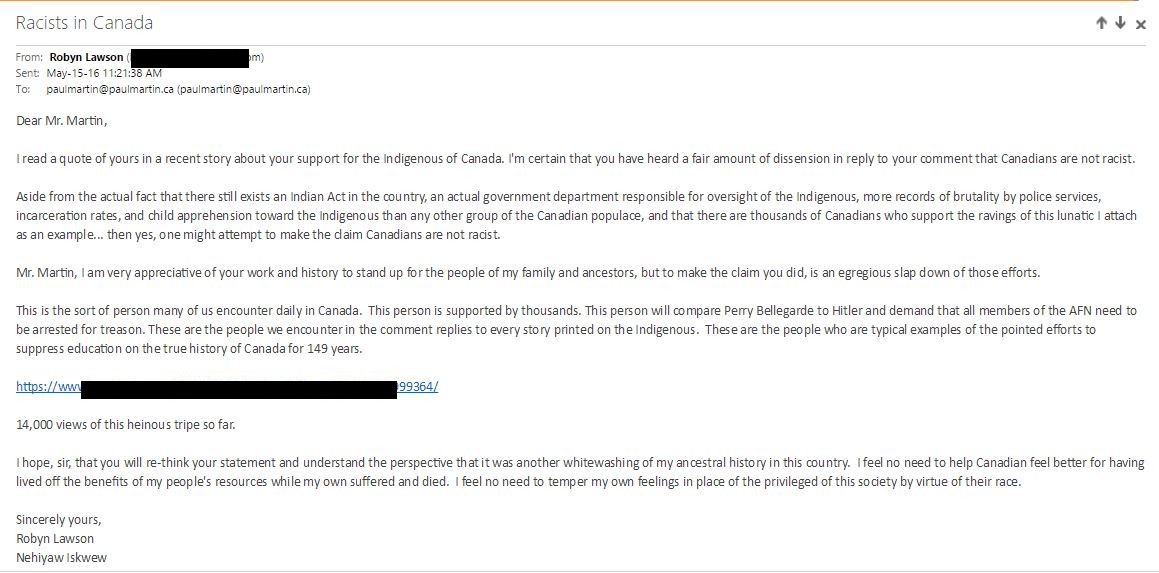
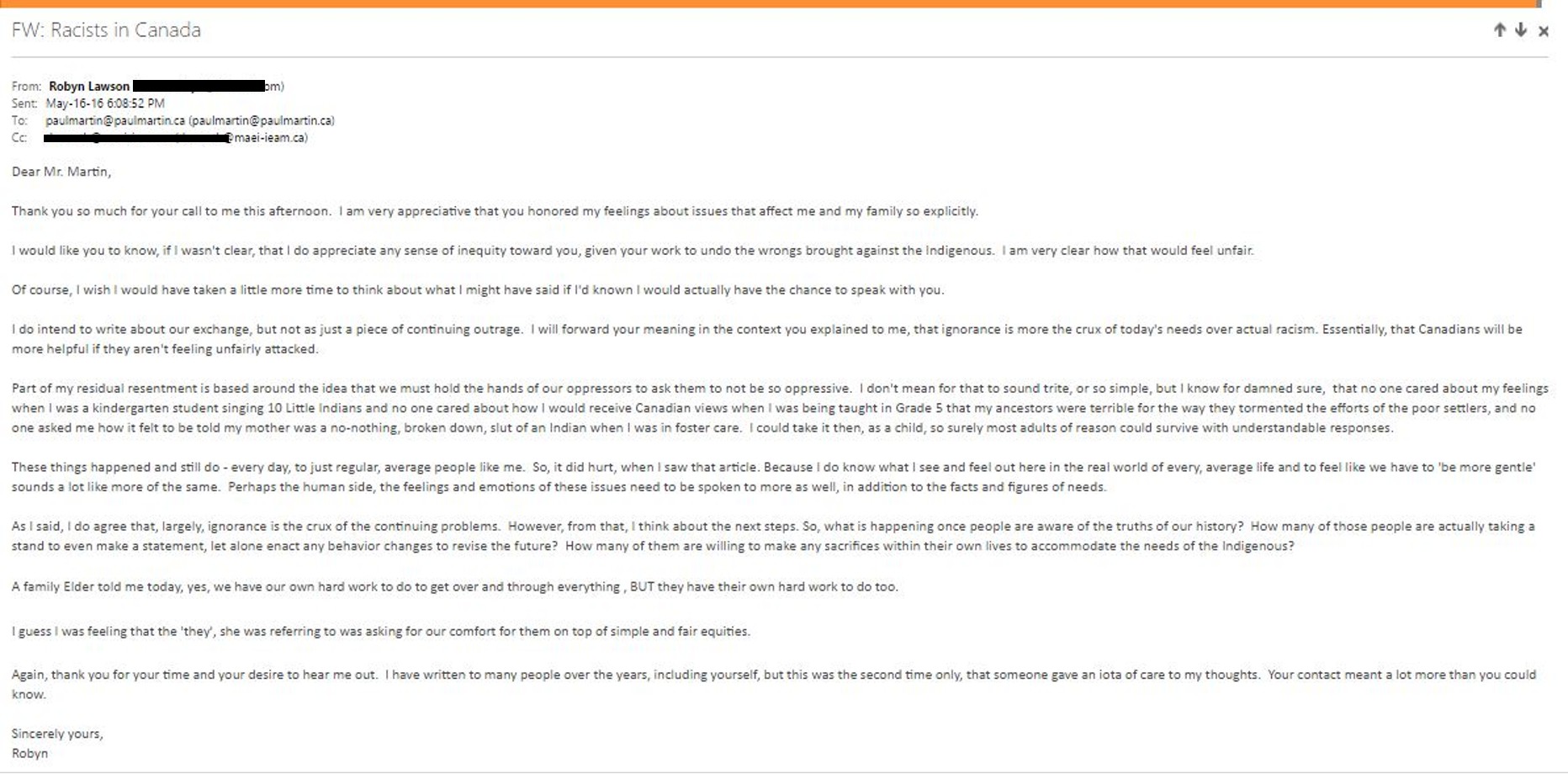
Martin email exchange

 Paul Martin reply May 16, 2016Email 1 to Paul Martin May 15, 2016 Email 2 to Paul Martin May 16, 2016

I Was Hacked, & By Friendly Fire Too

Unfortunately I was hacked and a post was put up on my page without my involvement today.  Although I am in support of the knowledge contained in the report that was posted, I will not support the tactics used to place it on my page.

I am a strong supporter of Indigenous issues and I speak out regularly on various platforms often and proudly, but I’m sorry that someone felt that placing their view, even if well-intentioned, without my permission would be a viable method.  I will ask for help if I have trouble finding my own words.

I appreciate someone else wanting help in spreading the word about the incredibly uninformed and racist views of Conservative candidates, but ask for my assistance, do not impose your will on me, the way Canadian policies were imposed on our ancestors.

I am aware of these candidates, I speak out about them, I encourage people to seek out the backgrounds of who they may be voting for, but most of all, please use the hard-earned right to do so.

RL

White Default – This Is Only a Test, But Please Adjust Your Settings Accordingly

Close your eyes and imagine a fire fighter, then a police officer.  Next, imagine Santa Claus. Take in what you see.

Imagine, Jesus. Yep, we all saw that same one,  didn’t we?  Long blondish-medium brown locks and blue eyes?  Why is that – when, at the time and place He was born, He would have been the only ‘white’ person in the region?

Let’s take it to another level.

When our eyes are open, look at what we see all around us and what we have seen historically in our:

Fairy tales
Money
Newspaper mastheads
Senate halls
Legislatures
Courthouses
Think of all those portraits along the walls of legislatures, libraries, courthouses that we all walk by
Police stations
Fire Stations
TV shows
Movie stars
Corporate boardrooms
Physicians
Teachers/Professors

Hand circleThis is only the beginning of trying to define our world’s cultural reference point called ‘white default’. This simple exercise of closing eyes to imagine our world in everyday fashion is quite effective for beginning the understanding of why we see things differently.

Despite the origins of people of color in our Western areas and those added willingly or not,  our world is still awash in ‘whiteness’, particularly in positions of authority. We need to be asking why is that and not pass it off with simplistic replies of convenience or avoidance.

I admit I only heard this term ‘white default’ not that long ago, thanks to a note on Twitter. It made me realize how deeply the teachings of my life had been ingrained in me without conscious or critical thought.  Which, given some of what I’ve lived as an Indigenous person is saying quite a bit.

I read an article explaining this phenomenon of recent understanding in Salon Magazine called, “How can white Americans be free”?  The writer, Kartina Richardson, said that, “The default belief that the white experience is a neutral and objective one hurts both white and American culture”.  I suggest that’s very applicable to most of the world.   She goes on:

“…The beginning; in the beginning there was Whiteness. This is the glittering starting point. This is The Default. This is what we measure everything else against”.

“Whites are free from the constant awareness (and subsequent constant paranoia) of existing in another person’s world. Because The Default has so successfully dominated our subconscious, because our egos have been shaped by it from the moment of birth, we perpetuate it in micro ways while fighting inequality with more obvious actions”.

We know this though, right? Because we did the eyes closed exercise and saw what we did.

Let’s close our eyes again and this time, let’s imagine all those portraits in those fine institutional halls as brown or black. Pay attention to your reaction as your imagination walks by them.  Now, picture Jesus as black or brown, how does that feel?  Odd, strange, uncomfortable?  And yet, the likelihood that that is how He actually looked is 100%.  Still, that is unacceptable for a large swath of people, Christians or not.  Interesting, no?

It’s that discomfort, one must realize, that is felt every day from the other side of the ‘unwashed’ fence, as in the not whitewashed, people of color.  This is what is at the centre of the differences. It’s only the beginning of why there really isn’t a level playing field for all to prosper and succeed.

Kartina expands the thought as this: “Whiteness as The Default keeps brown people in subjugation by convincing them that every part of their being, physical, spiritual and emotional, exists within a white narrative. When you are made to exist within something you are forced to be smaller than that which contains you. This is precisely the basis of racist thought. Brown existence, brown consciousness is smaller”.

I have certainly come to know what she is talking about.  I have encountered that first-hand, particularly by some people who thought I was getting ‘uppity’ when I began to write about the inequities and misconceptions about Indigenous peoples.  What I wrote was somehow seen as an attack and yet, I merely gave factual details to update old ideas and misconceptions.  Even that much myth-busting was too unsettling for some.

It showed me how strongly some people want to believe in the notion of their worlds, as opposed to what actually is.

How bizarre is it really though, when people of color are told their Creator is really a white guy who was actually born black or brown?

These demands to adhere to the whitewash are currently sealed into the cement of our societies. This is why it is so damned hard to get past the barriers that should not have been there in the first place, especially for the peoples who are the original inhabitants of said lands.  The fear of change and/or difference is at the heart of the need to keep plugging on this issue.

We know change is hard, even for the better. It’s not that white people are being asked to change their visions of Jesus or Santa, but mainly to revise the idea that only their visions can be trusted for themselves and for the rest of the world.

Those are the very thoughts that have created the environments we’ve been working to change for centuries now. This is what affects how people of color may or may not succeed in these standards set by white default.

It means that we have to consciously check our own thoughts and the statements we teach our children with, until that one magical day when the norm for our societies is equal representation in all those areas of everyday life and authority.

If you’re still not convinced that we have to actively pursue true color-blindness when it comes to true equality, check out this latest report published in the New York Times on January 3rd called, “Racial Bias, Even When We Have Good Intentions”.  Even blind tests produce the sadly expected results.

We really need to get to work, people.

RL

KING: Dylann Roof’s journal once again shows the danger in the myth of white Jesus
http://www.nydailynews.com/news/national/king-dylann-roof-journal-shows-danger-myth-white-jesus-article-1.2939039

White people… “are conditioned to the myth of white superiority from the moment … in fact, before birth, we are conditioned to the myth of white superiority” – Jane Elliott
href=”https://www.facebook.com/404147323119785/videos/447071435494040/”>https://www.facebook.com/404147323119785/videos/447071435494040/

For those interested in exploring privileges from a non-Indigenous viewpoint, I recommend a great organization working hard for mutual understanding: http://www.truepartnership.org/white-privilege/

An excellent article on White Fragility:  White Women’s Tears and the Men Who Love Them
http://goodmenproject.com/featured-content/white-womens-tears-and-the-men-who-love-them-twlm/

Educate, Not Dominate

(Warning:  usage of full racial epithets in this opinion piece, because I don’t believe one is more important or blatant than the rest in this point of view).
 

Our truths are largely based on what side of a fence we grew up on. One side, one truth is largely equal to merely indoctrination as education, and this is not restricted to religion.  It’s about everything we grew up to believe about the world.

Education is not about only learning more about our side of the fence, it’s supposed to be learning about all the other fences too, or as many as we’re able.  This should be a lifelong effort, and if not, why not?

Education has always been key in resolving conflict and ignorance of intents.  The process gets all muddled up with the yeah buts, if you knew what he/she did, we need this or we need that.

So what’s really needed?  What is really needed to live ably and in relative comfort?  The big questions are, what is worth killing children for?  What is worth demeaning their value as people?

What’s worth a walk up to a child and looking her in the eyes to  call her dirty, a camel ja&*er, a ni*&er, a reds&*n, a ch* nk, a h&nky, or any other of the demeaning terms we need to make up to dehumanize another person?   Nothing?  Thank the Universe you have not descended into madness.  Yet.

Childrens eyes 2I say ‘yet’ because I wonder how many people wouldn’t be able to do that, but do remark loudly and viciously about the lowness of those children’s parents when in disagreement. These are most noticeable in the comment sections of news stories like those about children dying in the Middle East, resources on someones land, or for the change of an American football team name.

Would these same people kneel down to this child and look her in the eyes and tell her that the purpose of their gain is worth her loss of worth or life?  We know there are some who will, and have.  They have become madness embodied.

This is what’s meant to be feared.  They say they do this on behalf of all the people, their people, and unbelievably, they are believed.   What fear is the madness based in?  Loss?   What fear of loss is so great that it’s worth dehumanizing or killing a child over?

That madness spreads like dust, but dust can be cleaned away.  How do we stop the advent of madmen?  We educate all of our children now.  We all have to stop, whenever it’s made possible, to ask if we’ve truly made an effort to look over the top of our fences.  Have we really searched for the reasons behind our fears and anger about something, or most importantly, someone?

If not, why not? It’s never been easier.

RL

Cherokee Nation Triples in One Week, & Don’t Call Me a Redskin

We should be impressed with how many people are well versed in Native American culture and history.  It’s been amazing and enlightening to see all kinds of average citizens report and comment so expertly on First Nations and Aboriginal issues lately.  Of course, this post isn’t really about how much is known about Native Americans as much as how deplorably inadequate our education about the culture(s) still is.

The story that has caused all the questionable commentary was the news the U.S. Patent Office revoked the name trademark for football team, the Washington Redskins.  The public response has revealed that a number of people feel immersed enough in Native American culture that they can speak for how Native Americans should or do feel about all kinds of issues.  This includes how to react to the use of a term historically known as racist for the sake of sports team logos and names.

I keep reading things like, as a Native, I’m one of the people who doesn’t really care about this, and so why should anyone else.  I most definitely have feelings about this – I feel hurt, angry, and sometimes surges of the humiliation burn I endured at times throughout my life because I am a Native person. The sting of being called a dirty redskin when I was a child is as piercing now as it was then.

peace is our promiseI’ve read over and over that even if I do care, what I feel is beside the point because there are far more people out there who really matter.  I happen to think it’s the ones who stand against racism and discrimination of any form that matter.  I believe in the ones who say let’s make the world a better place without the cost of that being another human.  I seek those who speak beyond the words that filled so many, too many, of the commentaries like this:

BUT – 90% of the Universe Likes the Name!

“90% of Indians don’t mind the name Redskins.” or sometimes it’s stated as, “90% of Americans like the name”.  These statements refer to the often cited, but academically questioned, National Annenberg Election Survey from 2004. They proudly quote that 90% figure, but that’s 90% of the 768 respondents – 691 people who claimed Native American ancestry, not 90% of all Native Americans. That’s part of why people take exception to this poll.  It also took almost a year to find those 768 respondents, which begs the question, which neighbourhoods were they looking in?

If you want to get technical, according to U.S. Census records for 2004, there were approximately 3,000,000 Native Americans in the U.S. then.  The number needed to statistically represent 90% of Natives (with a 3% +/- error margin) would’ve had to have been at least 1,100 people  – preferably Native Americans who live within the culture, or are well-versed in it.

There is a constantly ignored October 2013 SurveyUSA poll that showed 59% of 500 non-Native American Washington DC residents thought the name was offensive.  79% of them didn’t think changing the name would make them think less of the team.

There was something else I noticed in the comments and that was how many Native American relatives we all have. If the number of self-identified part-Native Americans claiming not to have a problem with the name is true, then Native Americans must really represent close to a third of the overall U.S. population. For sure the Cherokee nation’s population has got to have tripled in the last week.

There is tremendous debate as to the truth of the word’s offensiveness.  This is where the vast in-depth knowledge of Native American history appears most in the comments.  The origin of the word is debated to the nth degree with disagreement about the word being born of racism.  Therefore, no racist beginning, no problem.

Origin is not the point

 noun: etymology

  1. the study of the origin of words and the way in which their meanings have changed throughout history.   The origin of a word and the historical development of its meaning.

plural noun: etymologies

A paper by Ives Goddard is often cited as incontrovertible proof that the word did not begin as a slur because he cites English and French notes from 17th-19th century journals where they note a chief and some tribal members called themselves red people. First Nations are hundreds of cultures. Some people take exception to those notes because Native historians  – as in the Native peoples themselves – did not record their history in the same way, and most do not historically refer to themselves as red people, let alone redskins.  In any case, the paper does acknowledge the term evolved into a slur, or “obloquy”.

Next, victoriously trotted out are exceptions to the view that most Native Americans are offended and why they shouldn’t be:

  • The first Redskins coach was Native – Disputed as someone who took on a Sioux identity to escape the draft. He also did not name the team.
  • The team was honoring that coach and four Indian players – disputed by redskins owner in a 1933 interview with the Hartford Courant.
  • The Natives have always been proud of these honors – it was Natives who started the trademark revocation in 1992, but overall objections to the name began in the 1950s.
  • Many school teams, even Native ones, call themselves redskins and are damned proud of it.  Most are forgetting when those schools were originally named and by whom, but even so, self identification to claim the name is not the same thing.
  • Oklahoma is Native named and is Choctow for ‘Red People’.  Actually, ˆ“Ogla-ut-homma”, has a different etymology. In the Choctaw language “Homma,” can mean rust, brown, tan, or red. Oklahoma could easily be translated as ‘tan people.’

This may be interesting debate so far, but what isn’t disputed is that the name evolved into a term that evokes centuries of derision, hatefulness, discrimination, and attempted genocide. The term is recorded in historical accounts repeatedly calling for the scalps and genitalia of our ancestors. It’s this part of history that most resonates with the people who are offended by the images and names that dehumanize them to a cartooned existence, i.e. redskins.

Despite that, the reasons given to keep the name run the gamut from derision to the absurd; Natives and white liberals are just whiners and choosing to be victimized. There is simple ignorance of the issue to blaming Obama, who apparently is in need of another distraction.  Some people are very concerned about the expenses this could cost teams if they have to re-tool names or images.  Some people want to cling to tradition, eagerly willing to overlook the horrific and bloody history associated with the term.

Coming to terms with the idea of change can be hard, and for some people, very hard.  Changing something that is eight decades along is even seen as dishonoring “tradition”.  However, if a tradition is based in the highly questionable honor of documentable racism, the time for change is long overdue.

Banning racist slurs may not change everything, but words do have power and standing against words that caused so much damage is the beginning of the end of discriminations, and it says, yes, we do matter.

Besides, there are already cases to show that it can be done without irreparable loss.

  • The University of Utah Redskins became Utah Utes in 1972.
  • The Miami University (of Ohio) Redskins became the RedHawks in 1997.
  • The Southern Nazarene University Redskins became the Crimson Storm in 1998.
  • To date, there were more than 3,000 American Indian mascots and names used in school K-12 athletic programs; more than two-thirds of those have been changed.

Still don’t think any racism underlies the word?  Then why do you suppose that in every single one of those comments – all those stridently opposed to change and steadfastly insistent that the term redskins is really an honor – why did none of them refer to Native Americans as redskins? Not a single one.

RL

Some may have noticed I didn’t capitalize the term in some areas. I did that in order to reflect how that term changes tone even with a simple adjustment of a letter.  I doubt the irony of that was missed by even the most ardent slur defender.

Updated July 7, 2014 Washington Redskins PR Hire is a good idea for Native Americans:   2006 Ben Tribbett Proves Washington Team Name Is Slur, 2014 Ben Tribbett Paid To Defend It

Updated June 29, 2014 to include the Oklahoma reference increasingly cited as self-description for entire Native American nations. With thanks for the information provided by Paula Starr,  Executive Director at Southern California Indian Center.