Yes, I am That Confident – Up Yours!


It was 3 years ago that I posted the Facebook rant that launched my blogging career. Sometimes when you feel a little lost and like you need to meet you again, the re-set button can be as easy as looking into your own life archives. I’m fortunate mine was as easy a start as back to this beginning…

“Well you can’t fix stupid either and you proved that”!!

Actually, although my blogging life has been an incredibly uplifting experience overall,  it blows me away a little that I’ve been insulted through it too from time to time. …But I digress…

That particular insult was lobbed at me in a Facebook note.  It was from someone who’d had only few superficial conversations with me and no involvement in the situation at hand at the time. Not that really knowing me, nor having full knowledge of the details then changes the bottom line.

I admit I was somewhat shocked at that charged-up energy that came at me. There are all kinds of ways to respond, but at the time I was more engrossed in the event that precipitated the results of her research.

I re-read the post later and those words actually ended up making me smile. They reminded me of a personal motto I used to say: “I hope I’m the dumbest one in the room”.  In return I usually got a look like I’d just confirmed that for them.

Peace

What I really meant was that regardless of whatever endeavor I was involved in, I wanted whomever else I was working with to be wiser, more knowledgeable, and more creative than me.  I was sure that would get me an opportunity to learn something, probably something great and hopefully a lot of it.  Yup, not quite that insult’s target, but I know myself well enough to be confident in what I may or may not be.

That event had interesting timing. Some friends and I had been having conversations about self-esteem and the often misinterpreted difference between assertiveness & confidence or self-centeredness & aggression. There are many examples of how these characteristics are practised, but in our chats we narrowed the illustration down to standing up for oneself.

We partially surmised that self-centredness starts with feeling some sense of entitlement or an innate belief that one can do no wrong. The world better be good to me first or the world is gonna hear about it:

“Don’t confuse my personality and my attitude because my personality is ME and my attitude depends on YOU”.

Awww snap! Or – Aw snap!, snap!, snap! if they are particularly perturbed. This is more of a passive/aggressive or aggressive/aggressive defensiveness beyond my Psych 101 capabilities, or more to the point, my patience levels. Whatever happened to personal responsibility/self control?

On the other hand, real confidence says I will be good to you and if you are unkind in return, I can walk away with my self-respect fully intact without having to bring you down a peg to accomplish that. I would add that that also exhibits dignity, not an unworthy effort and something I wish I could have attached myself to much earlier in life.

Confidence asks how does whatever this is really matter to my life or me? Most of the time, whatever it is doesn’t make a bit of difference to anything.

Confidence also includes the element of humbleness. It says sometimes I may be wrong, but that does not diminish that I am a good and decent person and I will fix what I can fix about it.  By the way, the fixing action begins with offering genuine apologies, followed by genuine efforts to not repeat the offenses. Amazes me to this day, how hard this concept is for some to grasp.

Self-centredness mistakes the element of humbleness in confidence as weakness. That mistake is the weakness that truly exposes lack of self-esteem.

A little follow up: some time after sending that note, my ‘insulter’s’ defense was that she thought something negative was said about her. I did my best to reassure, but no matter, once her reaction was on the world-wide-web for all to see, the never-intended reason became fact for her anyway.  One less Facebook friend.

Too bad she didn’t take the minute to ask me about my intentions before she posted that over-the-top response.

So yes, it was interesting that that whole scenario played out right in the middle of those chats about confidence.  I guess you could say that a couple of us learned more than we were expecting at the time.

There’s far more to the depth of these issues than I can, or care to, note here, but if you were to ask me what would I say in return to that hotly lobbed insult now?  In short: up your self- esteem!

Yours truly,
Hopefully the Dumbest One in the Room

RL

So, The Right Honorable Paul Martin Called Me Up On Calling Him Out On CDA’s Racism

Revised June 8, 2018

2016 AvatarFormer Prime Minister, the Right Honorable Paul Martin called me in response to an email I sent him in reply to his comments made in a May 12th CBC story headlined: “Canadians not racist but Aboriginal issue ‘invisible’ to many, says Paul Martin”. While I’d assumed he was calling in some effort of support, I was disheartened at the realization he actually wanted to correct me on what Canadian racism is, or rather, isn’t.

While Mr. Martin did strongly point out in that and subsequent stories, the various awful inequities thrown at the Indigenous that cause significant and terrible consequences, I could not let that one sentence go:

“Racism isn’t the culprit, but that doesn’t change the fact that the challenges faced by Canada’s Aboriginal Peoples have long remained out of sight and mind to many”, says former Liberal prime minister Paul Martin.

I was stunned. Not only because the very fact that we still have an active piece of legislation called the Indian Act, which is all about the business of managing the Indigenous, but every day we read stories of examples of racism in action.

Every day, I see other examples, such as a recently posted widely-watched video put out by a very stridently racist Vancouver woman that compared AFN National Chief, Perry Bellegarde, to Hitler, demanding that the AFN members be arrested for treason, and complaining that all “natives are obsessed with white people”.

This is all enough to question just the idea that Canada is not racist, a country built upon the lies of trade and/or conquering as most Canadians believe, but to have had that statement come from a high profile public servant widely seen as a friend to the Indigenous?

It was incredible to me.

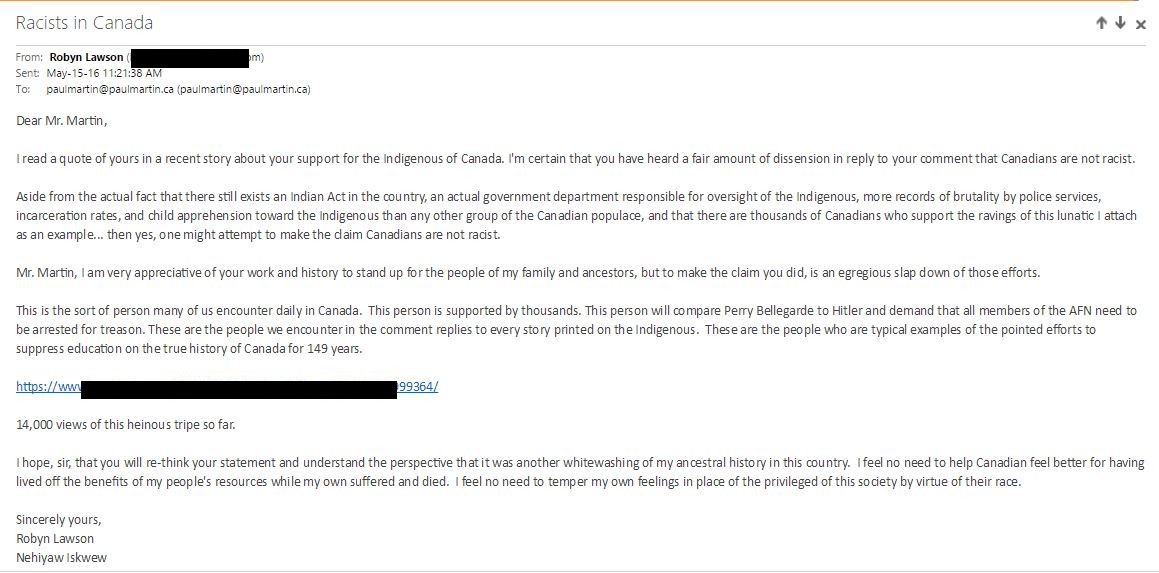
So, I wrote Mr. Martin.  I noted the points above, of others and attached the link to the despicable video.  I wrote to say I was disheartened, along with outraged because his background as friend to the Indigenous was precisely why it was especially important to not let stand yet another whitewash of history to make Canadians feel better, despite the fact they have all benefited from taking the lion’s share of Indigenous resources.

I admit I had no expectation of a response as I’d yet to get one from any of the fine members of Canada’s upper echelon in all my years of writing to them about Indigenous issues. However, 24 hours later I received an email asking if I would like to speak with Mr. Martin.

Stunned for a second time in 24 hours! Of course I said, yes, and within minutes my phone rang.

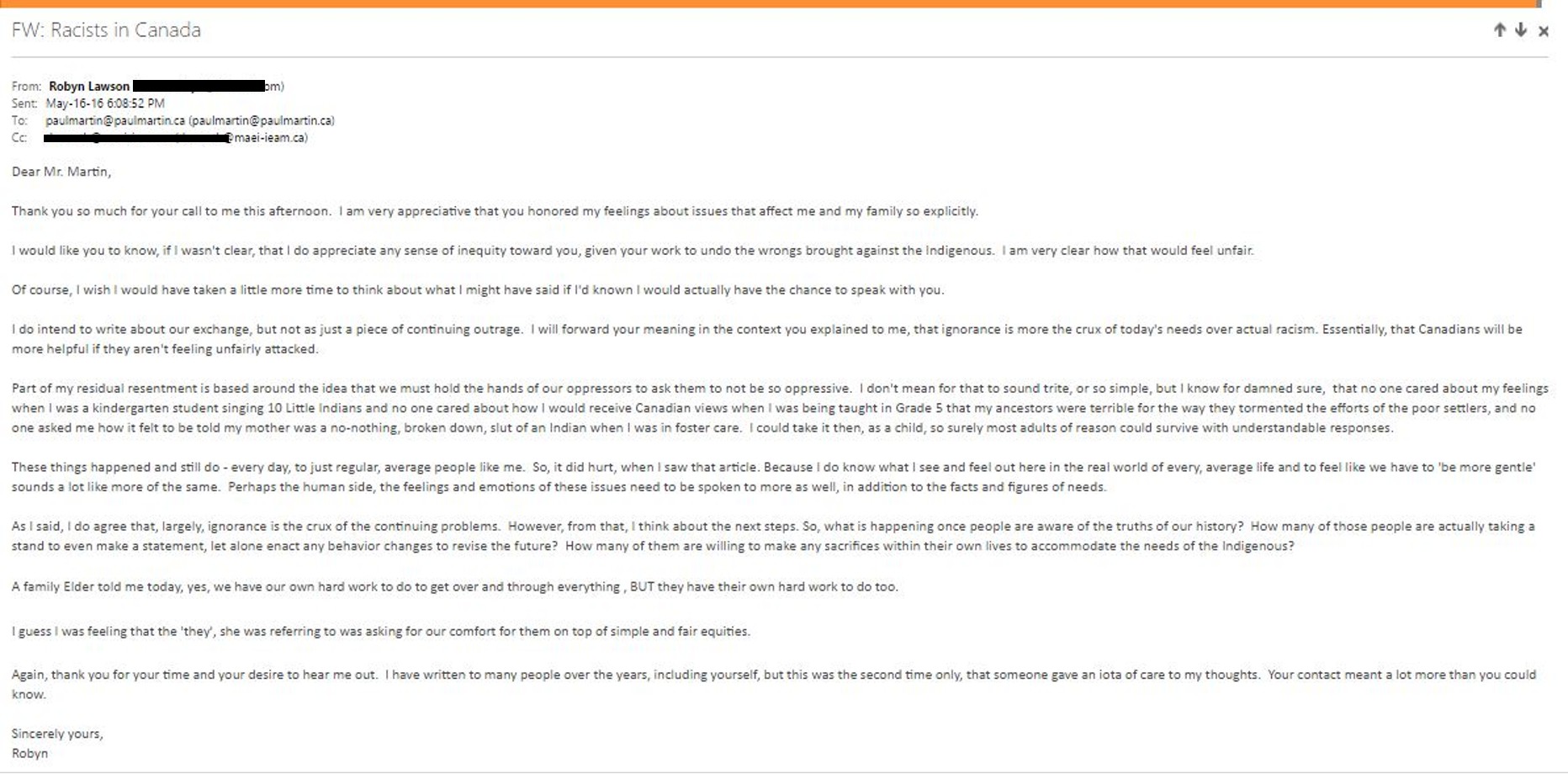
I was a little surprised by the opening of the conversation.  I found Mr. Martin to initially be quite defensive, not quite ready to recognize why I could be upset. He said it was hard to accept that people wouldn’t be able to see his message’s point, especially given his personal record of working to undo the wrongs against the Indigenous over all these years of service. This ignores the point that it was he who implemented the annual 2% funding spending cap for INAC in 1996, which imposed harsh consequences on the ability of Indigenous communities to thrive since.

He asked if I’d watched the actual interview, and I admitted I did not, however there was no video linked to the story in question. He specifically mentioned crafting the Kelowna Accord with Indigenous leaders that former Prime Minister, Stephen Harper, crushed the minute he came into office.

Of course, I am aware of Mr. Martin’s efforts; I absolutely acknowledge Mr. Martin’s role in that Accord and I would note I have used that Accord as an example in several conversations on the potential for moving forward (and it’s the third reason I came to despise Harper as PM). But, again, that’s precisely why I took especial exception to his words.

To get to his point, he said the Indigenous problem with Canadians is based in ignorance, a lack of history knowledge moreso than racism.  I said I do understand that as in large part, I believe racism is ignorance, however we have to be careful of how we state things too. I sensed this thought wasn’t particularly appreciated.

It was at this point he had to go and his final comment was that he feels that calling Canadians racist will not help in the work to help the Indigenous.

After we hung up, I thought about all the people my friends, acquaintances, and anti-racism workers encounter on that daily basis.  I thought about all of those who, like that racist video creator, remain fully and willfully ‘ignorant’ of facts, I wondered about the rest of the Canadians who actually are aware of the inequities, the injustices, the utter horrors of their country’s history.

I wonder what Mr. Martin would say about them, and how would he’d reply to questions such as:

What happens once the ignorance is dispelled, are these same Canadians then standing up for us?  Do they protest the inequities?  Do they even just move out of the way of progressing forward?  How many of these same good people are still exercising their right to indifference?

How is inaction or indifference not complicit racism, then? Isn’t that what Edmund Burke was speaking to when he said, “The only thing necessary for the triumph of evil is that good men do nothing”?

I mulled the conversation around with my aunt, Elder Maureen Kennedy.  She said, “Yes, we have our own hard work to do to get over and through everything, but they have their own hard work to do too”. I agree with my aunt, except I’d say, I don’t agree that they should be expecting our comfort for them on top of it all.

Mr. Martin also sits as board member for the *Canadians For a A New Partnership (CFNP) – a group of prominent leaders from both sides of the equation to “build a new partnership between Indigenous and non-Indigenous peoples in Canada”. I envision the Indigenous partners having to dance around the elephant in the room while seeking justice.

…And do Canadians really need to ‘feel better about themselves’ before they do the right thing?

RL

*In early January 2018, Paul Martin quietly closed the doors of the CFNP, the only announcement appearing to be an email to their website subscribers. Shortly after that, he created his own private charity foundation, ostensibly in support of Indigenous education. He requested funding from the Canadian government. They responded with a $30 million cheque for him.

June 8, 2016 – 87% of Canadians believe aboriginal people experience discrimination: survey

An Indigenous perspective on the realities of racism:

Wab Kinew On Canadian Racism, Relocating Attawapiskat, And The ‘Criminal’ State Of Aboriginal Education

Martin email exchange

 Paul Martin reply May 16, 2016Email 1 to Paul Martin May 15, 2016 Email 2 to Paul Martin May 16, 2016

That! Is My Answer

Someone once reached an uncharted part of me…
Only one time …
Ever…
Finally!

lovebirds

Someone dived deeply into my needs and said I will fight for them. I will be the salve that fills them.

I can do that.  I will do that – because you are so fucking worth it.

That!

It was that –  that ignited a visceral, cellular level response revealing a deeply buried gratitude effervescing in complete joy to the surface of my being.  For him.

It would take that to have me soaring after eagles again.
It’s what separates punks from the men,
The heroes from the ... weak.
It takes that for me to feel loved,
And safe,
And secure.

It’s that…
that I want
and need…
Still.
It was always,

That.

Why would I settle for anything else, ever again?
Settle for what?

Nothing, less than – that.

RL

The end of tributes… I lay down tobacco today to finish the healing.

A Man’s Perspective On Abuse by Ned Hickson – “Real Men Have Mastered Control of Themselves, Not Others”

I often say my one true purpose in this lifetime, and my main desired goal, is to raise one good man.  I’m not sure my son feels my purpose is as much heavenly ordained as making him my beast of burden.  I kid of course, but I’m sure he would say I have not made his growing up years a piece of cake either.

Outside of that, I am confident that he does feel seen, heard, and that he matters.  It’s these points that I’m hopeful he’ll gently pass on to the next generation(s) in our family – that would be the cake icing.

When I come across positive qualities in a man, I love to point those out to my boy.  One man who remains constant in those examples is one of my favorite writing pals, popular syndicated humorist & author, Ned Hickson. I’ve re-blogged a couple of his humor columns before, but this one really resonated with me in another way.

It spoke to me because we share the desire to overcome similar childhood experience. As he commented to me in typical Ned style, “As you know, we are kindred spirits in a way. Not just because we both have good hair and occasionally wear glasses, but also through our past experiences with abuse.”

It’s in that vein that Ned tackled the topic of abuse from a man’s point of view.

This post was originally published on Ned’s website and was featured on the Good Men Project, April 9th. I can’t recommend enough reading Ned for consistent quality in humorous perspectives and for his occasional, very eloquent approaches to some tough subjects.  I give you Ned…


Control Box - Ned Hickson

Anyone who reads my weekly newspaper column or blog posts knows I try to keep life in perspective through humor. In fact, I’d say it’s one of the reasons my children are still alive today. While I joke about that, for many years humor was also part of a coping mechanism from a childhood witnessing both verbal and physical abuse by the men in my family—specifically, my father and older brothers.

The good news is that each of them eventually turned themselves, their lives, and the lives of the people they loved, around. It wasn’t until I became a father that I realized the impact that a childhood witnessing abuse had on me, and how some of those wounds—as both a witness and recipient—had never truly healed. I know this because I occasionally saw reflections of my father and brothers in myself as I fought to avoid making the same mistakes with my own children; I also know this because I came to realize that as much as we want to tell ourselves we can choose not to take any baggage with us on our journey through life, ultimately it’s always somewhere waiting to be claimed.

There is no getting rid of it completely, only a conscious decision to leave it circling on the carousel.

Because I am a father with teenage boys and girls, I stay hip to the way they communicate.

Wow. Did you just feel that? It was their eyes rolling.

Actually, I’m not “hip” as much as I am privy to how they talk to each other. While social media has opened the doors to communication in some ways, it has swung too far in others. Verbal abuse still takes place; it just happens in hushed Tweets and SnapChats instead. The result is the development of a disposable sense of emotions—a disconnect from face-to-face that has been replaced by Facebook-to-Facebook.

As a result, spotting the signs of abuse has become tougher while becoming an abuser is easier. Thanks to social media, those opportunities are literally at our fingertips. For those with a hair-trigger temper, every Tweet, text or post sent in anger pre-conditions abusive behavior and makes it harder to recognize in ourselves.

It becomes a conditioned response in a cycle that gets harder and harder to break.

For young men, their teens and early 20s are a time when they are defining themselves and establishing their place in a male-dominated world while, at the same time, trying to understand the intricacies of communicating with the opposite sex. How do I know this? Because, statistically speaking, I was a young man once. Trying to appear tough among your peers while still holding on to the part of you that is thoughtful and caring feels contradictory to what we’re taught about being a man.

We see it in movies and advertising; we hear it in music:

Being a man means being in control. In charge. In command.

Of life and our relationships.

It’s a social stereotype perpetuated mostly through media and advertising. Why? Because it sells. Body wash. Albums. Movie tickets. Clothes. Video games.

It’s baggage our culture has been carrying for generations.

Being a real man does mean being in control. But not of others. It means being in control of yourself enough to understand, acknowledge and accept your strengths and weaknesses. It also means never using your strength—physically or verbally—to overpower others. Particularly the women in your life, whether it be your wife, girlfriend, mother or daughter.

A real man provides protection, safety, and acceptance; a weak man dishes out pain, insecurity, and denial. In either case, they are reflections of your inner self.

The question is: What kind of reflection do you want to see when you look in the mirror each day?

There’s no denying sexism and a male-dominance mentality are still deeply woven into the fabric of our society. And while we have made strides in some areas by recognizing and discussing matters of physical and verbal abuse, that baggage is still out there circling on the carousel.

As men, we must make a conscious decision each day to avoid claiming it.

-Ned Hickson
Ned

Ned is an award-winning syndicated humor columnist and editor for Siuslaw News.  His weekly column appears in dozens of newspapers in the U.S. and Canada as a syndicated feature for News Media Corporation.  He is the author of “Humor At The Speed of Life”. Look for his latest upcoming book called, “Pearls of Writing Wisdom: (From 16 years as a shucking columnist)” through Port Hole Publishing.


Ordinary pearls

Nedism Wisdom  (Thanks, Ned)

Half-Breed to Metis – My Return from a ‘Savage’ Wilderness; PART 2

 Click here to read part one – How I acquired the title of dirty Indian…

Aside from having to dream up a name to match any exotic ancestry I could claim, my real family history was more colourful than that anyway. We were the stereotypes of typical Indigenous life. Those lives scorned without understanding of the history behind the creation of those stereotypes.

It was a life loaded with issues around unsteady work, alcohol abuse, abuses under every heading, police visits, child apprehension, foster homes and a single mother on welfare. We moved a lot – always new towns, new friends, new crosses to bear.

So, by the time I could think a little for myself, I couldn’t wait to move on.  At nearly 16 yrs. I did move – onto a grown-up job and night school to get a better job, all in the name of getting as far away as possible from my childhood hurts.

Several years later my life had taken shape in a measure of success and definitely I thought I’d finally escaped being a poor and dirty little Indian. It seemed like I’d escaped the legacy of that drama. As it turned out, despite education and job titles, that wasn’t exactly the case. The various abuses never really ended regardless of the dressing I put up around them. I became even more desperate for a sense of value, meaning and peace. 

It was a bit incredible and maybe even miraculous from where the answers to my prayerful pleading would begin – searching the internet for a history project.

While I was doing that search, I stumbled across some family tidbits in the history records. It was astounding to me to see names I knew connected to others I’d never known about. Inexplicably I began to hear the call of my grandmothers in them and I quickly became obsessed with genealogy. Something was being filled in me that I’d been completely unconscious about missing.  I found the past. I continued in my search for years, able to trace my family back to the 1700s.

The uncovered voices of my ancestors undid the pain of my childhood humiliations.  Unlike the shame-based history the old input and my fearful imagination had originally filled in for me, I learned that we came from fiercely able, independent, inspiring Peoples.  I learned, in addition to Cree and Metis, my people were also Mohawk, among other nations.

I learned my ancestors were skillful and adept providers who worked the land, and they were warriors – from the Louis Riel uprising, to World Wars 1 and 2, and the Korean War.   They were explorers and guides for famous European explorers; they were leaders and treaty witnesses.

They were exactly what one might dream their forbearers are.  It was breathtaking discovery for me, but I later realized that, as wonderful as it was to feel the pride of their accomplishments, they didn’t need to be all that for me to feel found.

It would have been just as healing simply to find where I came from; to learn who my people were as a people, not as the butt of the jokes so common then on the western prairies.  Not as the people we learned about in school who were so low that even as kids, when we played cowboys and Indians, none of us wanted to be the Indians.

Fast forward some decades to when my son and I were going to a western-themed party.  We got all geared up in our cowboy boots and hats, jeans and checked shirts.  When we got home, my son was a little miffed.  His history lessons have been quite different from mine. He wanted to know why we hadn’t instead dressed up as Indigenous.  It was a good question, but I couldn’t find a good answer.

Although I’d identified as my Metis and First Nations ancestry for several years by then, I began to feel I was falling too short on the allegiance that my grandmothers deserved. Especially with the amount of public misinformation about the Indigenous still the norm in general.

However, despite the longing, I still had one foot out the door, just in case.  Old fears take a very long time to heal, if they ever do.  When I finally decided to stand up and be counted, I applied for a Metis citizenship card.

I’d like to set the record straight about how one goes about claiming that card.  Many comments in those newspaper and social media arenas revolve around thoughts like “well, pretty much everyone in Canada can claim some kind of Indigenous status now”.  No, they can’t.  You can’t just make a call and say, “Hello Government, I’m part-native, send me a card, thanks, and can I get free gas now like that Beiber kid”?

The application process took several months.  Actually, it took years counting the time it took to accumulate the various required records. I had to provide a genealogical history of 5 immediate generations of Indigenous ancestry with proof that included birth, baptismal, and marriage certificates.  It included scrip records, Hudson Bay Company work records, and other various historical records.  At a minimum, I had to link my direct ancestors to records known in western Canada at approximately 1860. Then all of this had to be verified by the society historians.

So that’s what I did, and now when I look into my mother’s eyes, I proudly see my history for thousands of years.  When my son looks in mine, he will see his own.  I turned away from that all those years ago when I thought I was meant to disown my heritage.

We talk a lot about how much the entire continent needs the true education on its own history, and that is absolute fact, but that’s just as true for many, if not most, of the Indigenous too.  We had our history taken from us long before we were even born and we know how terribly that changed us.

I can only feel sadness for that walk in the wilderness now, mine and all my relations of the last 5 generations who actually had our culture taken and even made illegal.  I know it doesn’t do any good to wonder about things that might have been, but sometimes I do.  I still have far too much to learn about them, and our ways.

On the day I received my official stamped Metis citizenship card, I stared at it and cried.  It was real, it was done, I’d stood up.  I really didn’t know then or even now, what difference in my life this official recognition will make.  I only know how I feel in those old wounded places in my heart.  I feel my grandmothers surrounding me now. My grandmothers called for PiPiSiw and I’ve come home.

Grandmothers

kakiyaw niwākomākanak
(All My Relations)

RL

I want to add a little thank you so, so much to the people who have emailed me to tell me how glad they are for any of us able to speak out. You are a huge part of what makes these efforts meaningful. You are the people who allow my heart to feel full and worthwhile.
Hiy hiy….

With great gratitude to Dick Garneau, whose years of work compiling centuries of First Nations & Metis journal entries led me to more family discoveries than I ever dreamed I’d find. Hiy hiy, Dick. Thank you for your amazing work and generosity. May many others be as blessed as my family was with his work.  http://metis-history.info

21 things you may not know about the Indian Act – The Indian Act has been in place for 140 years:
http://www.cbc.ca/news/aboriginal/21-things-you-may-not-know-about-the-indian-act-1.3533613

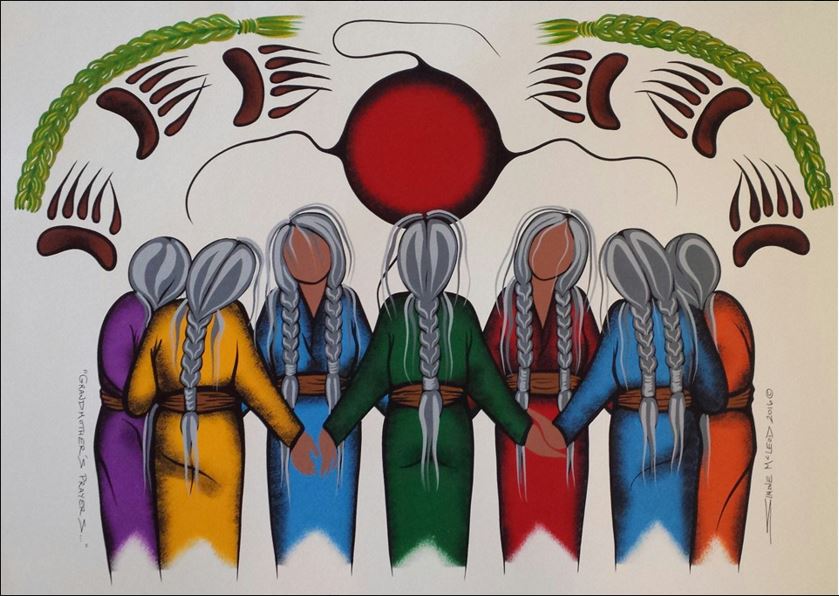
Artwork credit, with permission: Grandmother’s Prayers:
Simone Mcleod, http://www.fisherstarcreations.com/simonemcleod-acrylics Facebook: https://www.facebook.com/anishinaabepaintersimonemcleod/info/?tab=page_info