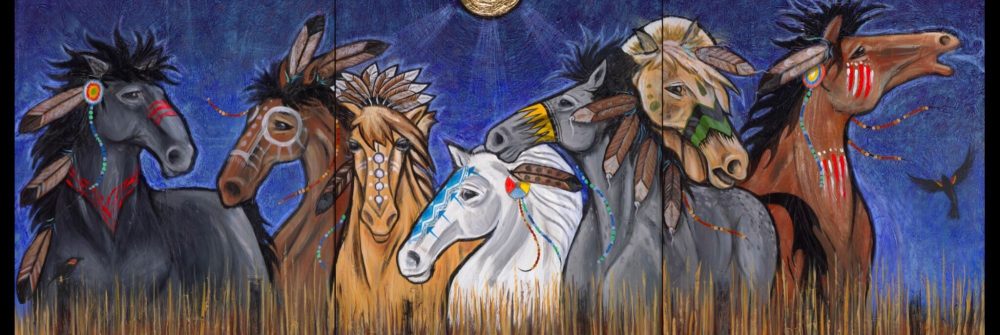
Mother, Nehiyaw, Metis, & Itisahwâkan – career communicator. This is my collection of opinions, stories, and the occasional rise to, or fall from, challenge. In other words, it's my party, I can fun if I want to. Artwork by aaronpaquette.net
Race-shifting to Indigeneity is so prevalent in Canada, that to say it’s rampant wouldn’t be much of an exaggeration. The big question is, who’s going to be responsible for halting these destructive behaviors? The Canadian Government; the Indian Act department, CIRNA; every Indigenous nation encroached upon? Where do employers, educators and media fit in?
Over the last few years, I’ve learned “pretendians” vary in reason for their desire to be Indigenous and that they cut a wide swath in professions, learning institutes, and even within Indigenous communities.
When we point out an uncovered discovery publicly, this is about far more than ‘shaming’. This is more than ‘gate-keeping’. This is protection and an effort to stanch the continuing effort to dilute, diminish and degrade the teachings & traditions and resources of entire cultures.
The sheer numbers today make the fight against race-shifting feel futile at times because Indigenous peoples are striving to re-educate an entire country that has decades of deliberate mis-education and obfuscation about them. While they pursue that, they also have to put out as many of these current fires as possible; it’s a constant, agonizing game of whack-a-mole.
How do the Indigenous fight the enormous numbers of non-Indigenous who have chosen to speak over them and for them because of reasons like this:
They want part of the mythical ‘free money’ they were told repeatedly by Canada that the Indigenous receive.
They want the hard-won restoration of harvesting rights of the Indigenous.
They want the hard-won land titles, such as they are.
They want to act on behalf of Canada as “consent givers” for resources extraction.
They want to make claims on those big money resources.
They want to receive the jobs, grants, scholarships, and awards set up to lend a helping hand to the marginalized.
They want the acclaim of being an ‘Indigenous success’.
They want to write governance policy for the Indigenous.
They want to continue to re-write history to wash over the truths.
They heard they had an Indigenous ancestor somewhere in their background and now they are suddenly fulfilled as a whole being and must dance to the drums of ‘their ancestors’.
They are bereft of culture and need to be fulfilled emotionally, spiritually, and mentally.
These people aren’t readily identifiable as terrible trespassers. They are neighbors, co-workers, friends and sometimes, family. Many are exceptionally friendly, articulate and some are very charismatic, which makes for frustrating, vigorous protection by those around them when questioned.
Some of the roles where we’ve found these people are:
Politicians
Professors
Lawyers
Senatorial assistants & policy writers
Facebook “Educator” pages, some with several thousand followers
Radio show hosts
Students in all levels of education
Teachers
Counselors
Prison and medically centred “Indigenous Elders”
Ceremonial Elders / Spiritual guides
Authors
Actors
Musicians
Artists
Other social media accounts for various “Indigenous products”
The list continues to grow.
What we often hear, when this is brought to the attention of an employer or a position of authority is, “what are we to do about it”? The efforts of the 2015 “Truth and Reconciliation Report” with its 94 calls to action have yet to be realized in a substantial way by the Canadian Government and its citizens.
This isn’t to step over those who are making an effort to follow-through, but how can that follow-through be meaningful and effective if the very people they’re turning to for direction and education are not Indigenous; are not involved in any community in a genuine way; and certainly have no idea of the issues and needs of the many and various Indigenous communities?
How is this not a national concern by this time? How is Indigenous identity still managed by the Canadian Government and its ‘self-identifying’ citizens, those who believe any claim of blood quantum is their entitlement?
Residential schools all finally shut down in 1996, but their teachings are still being readily applied. The point of those schools, to Canada’s great shame, was only about re-imagining and shifting who the Indigenous are. They wanted the Indigenous to be demeaned enough to be easily cleansed away. Canadians do not like the term genocide applied to their country, but hiding it isn’t making any of it go away. It only changes its shape until it’s palatable enough to ignore.
Now there are thousands of Canadians who’ve shifted their identities, insidiously continuing the legacy of removing Indigenous voices for gain. They are indeed very welcomed as a seemingly more palatable “Indians”.
2020 has been a year for critically exposing our societal failings and as a catalyst for revolution and evolution. What a revelation it would be, if we all started to seriously assess and question why it’s normal to assume the Indian Act system, with its +4,500 employees is still a reasonable normal in the 21st century? Surely at a minimum, we could ask why the Indigenous aren’t overseeing Indigenous identity and citizenship themselves on a national level?
RL
Addendum: For a fuller picture of the race-shifting phenomenon, I recommend the book, “Distorted Descent”, by Dr. Darryl Leroux, along with the works of Chris Anderson, “Métis” Race, Recognition, and the Struggle for Indigenous Peoplehood; and “The Northwest Is Our Mother”, by Jean Teillet.
As a matter of noting impactful history as it’s occurring, a report presented at the March 9/10 Metis National Council’s (MNC), “Métis Identity, Citizenship & Homeland” conference in Saskatchewan, shocked many in attendance. It uncovered a troubling history that has led to serious issues for the Metis, now currently embroiled in what amounts to a ‘hostile takeover’ of their nation.
I shouldn’t have been surprised, let alone shocked about what we learned, because I am already well-aware of the immense issue for the Metis Nation in having to defend its identity and rights again. I’m well-versed in the history of the thousands of Canadians who more recently claim to be Metis, although many are seriously mistaken at best and others are purely fraudulent at worst.
The report presented wasn’t about those thousands of claims outside of the historical Metis communities, i.e.) those from regions in, and east of, Quebec. It concentrated on the claims of the legitimate Metis Nation’s own affiliate, the Metis Nation Ontario (MNO), one of five MNC affiliates.
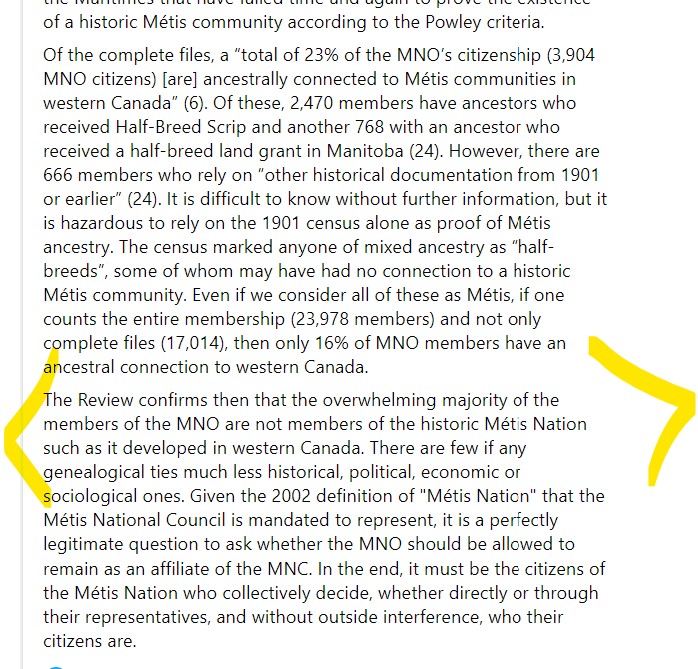
That was an astounding statement and regardless of the accuracy of that estimation, what percentage would they consider acceptable? That wasn’t the only issue at hand. The affiliate was also called into question after working unilaterally with the Province of Ontario government in 2017 to grant ‘historical Metis settlement’ status to 6 regions in Ontario outside of the Metis Nation historical homeland boundaries. The MNC, its other affiliate presidents and the Metis citizens were not included in that process.
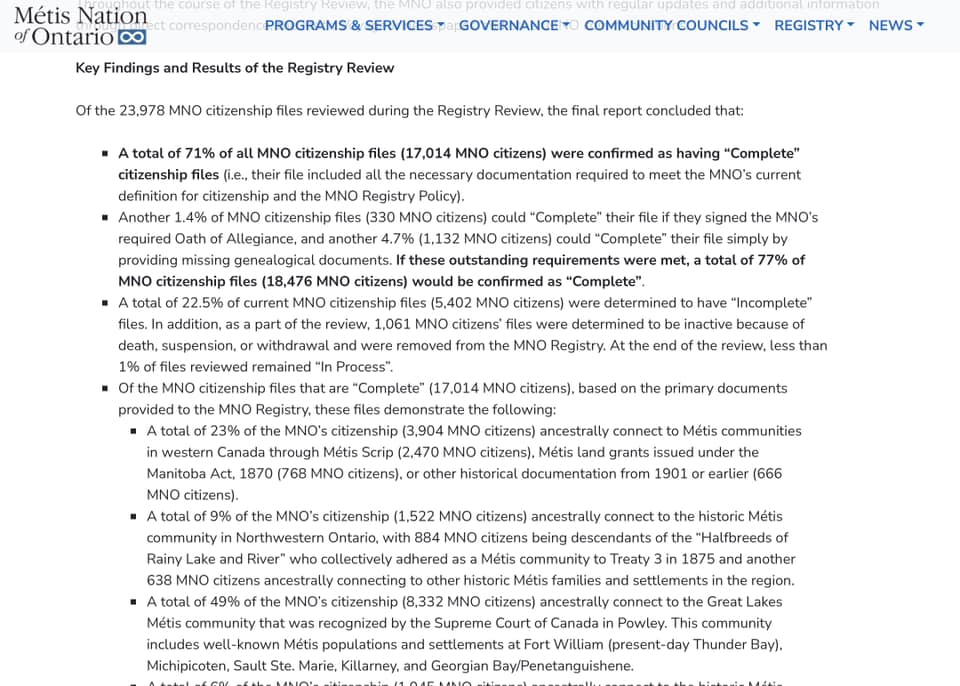
(Update: in 2021, the MNO published approx. 77+% were non-Metis, thus they coined a new term, “Ontario Metis”, while continuing to use the cultural artifacts of the Red River Metis Nation).
Essentially then, the MNO is therefore mainly comprised of Ontarians of various ancestry who self-declared they were Metis and were accepted and seemingly legitimized by the MNO. If there are enough of these individuals in a particular region, this is taken as proof of the existence of a historical Métis “community”.
In November of 2018, the MNC and the other affiliates, with the exception of Alberta – which apparently has serious leadership [and membership] issues according to statements made at the March 10 meeting – voted to put the MNO on probation for one year to allow time to sort and re-register their members to fit the criteria of Metis Nation identity. Incidentally, that criteria aren’t different from any other world nation, which include immediate relation to the ancestry of the known Metis Nation families. The criteria was unanimously ratified by the Metis Nation in 2002. The MNO participated in that ratification and in its affirmation in 2013.
Back to 20 years later, and the one-year MNO probation term is over. The MNC, for which leadership is voted for & provided by its affiliate presidents, requested to review the new registers. The MNO responded with an incredulous refusal, stating they had their own ‘independent oversight’ and that the MNC were unwelcome ‘outsiders’.
They’d essentially announced they were a nation unto themselves and they went to Canada directly to try to create that into fact. They called it a ‘self-governance agreement’, which the government called ‘a step toward self-governance agreement’. What that will turn out to be is another story, but a main point is a clause in the agreement that states the MNO will get to decide for itself who is “Metis”.
An easy out compared to having to tell thousands of Ontarians they’re not Metis, some of whom hold influential positions in general society. There are also millions of dollars at stake in annual funding to oversee programs meant for the Indigenous, and specifically for, the Metis. If the MNO were to fail at attaining a new, unrelated pan-Indigenous nation recognized by Canada, that would make some of those members, not Metis, but non-status First Nations. Likely a good number would simply be recognized as non-Indigenous Canadians.
That’s the background to the March 9/10 MNC meeting. Here’s part of what’s stunning. The background historical research used by the MNO and the Ontario Government to justify inclusion of Ontario-based regions/people sometimes reads like a middle school copy & pasted book report. The conflations of ancestral claims are so flimsy in places, that at one point they barely bothered to provide evidence before bestowing the Metis flag to one region.
As is commonly practised by ‘self-identifiers’ in the further east, the Metis titles given by the MNO were based on claims of ancestry in nations unrelated to the Metis; on ancestors who were Europeans re-made into Indigenous; on ancestors that were and still are known as First Nations, whose descendants still live on the same reserves; by claiming First Nations villages were Metis; or as one person at the meeting stated, if a picture of their grandparents ‘looked Native’ to the registrar, they would be accepted. These people now outnumber the legitimate Metis in Ontario.
Excluding the MNO, the fight today is from within, from those who would allow anyone of any Indigenous ancestry to claim to be Metis vs. those who denounce the pan-Indigenous idea over their own unique, rich and richly established history, which included the herculean win in 1982 to achieve the recognition and rights to Section 35 of the Constitution for that nation.
Update: On September 29, 2021, the Manitoba Metis Federation, known as the heart of the Metis Nation homeland, withdrew from the Metis National Council in protest of its affiliate’s re-acceptance of the MNO into the MNC without proof of a Metis registry. Since then, the MNO has removed some of their more problematic membership claims, but has openly published its new version of identity parameters that extend their membership to over 77% unrelated to the Metis Nation. Unfortunately, they continue to call that registry, “Metis”.
RL
August 6, 2025 – The Chiefs of Ontario are calling on the province to release all the evidence and analysis used to justify the 2017 identification of the six “so-called historic Métis communities” in the province.
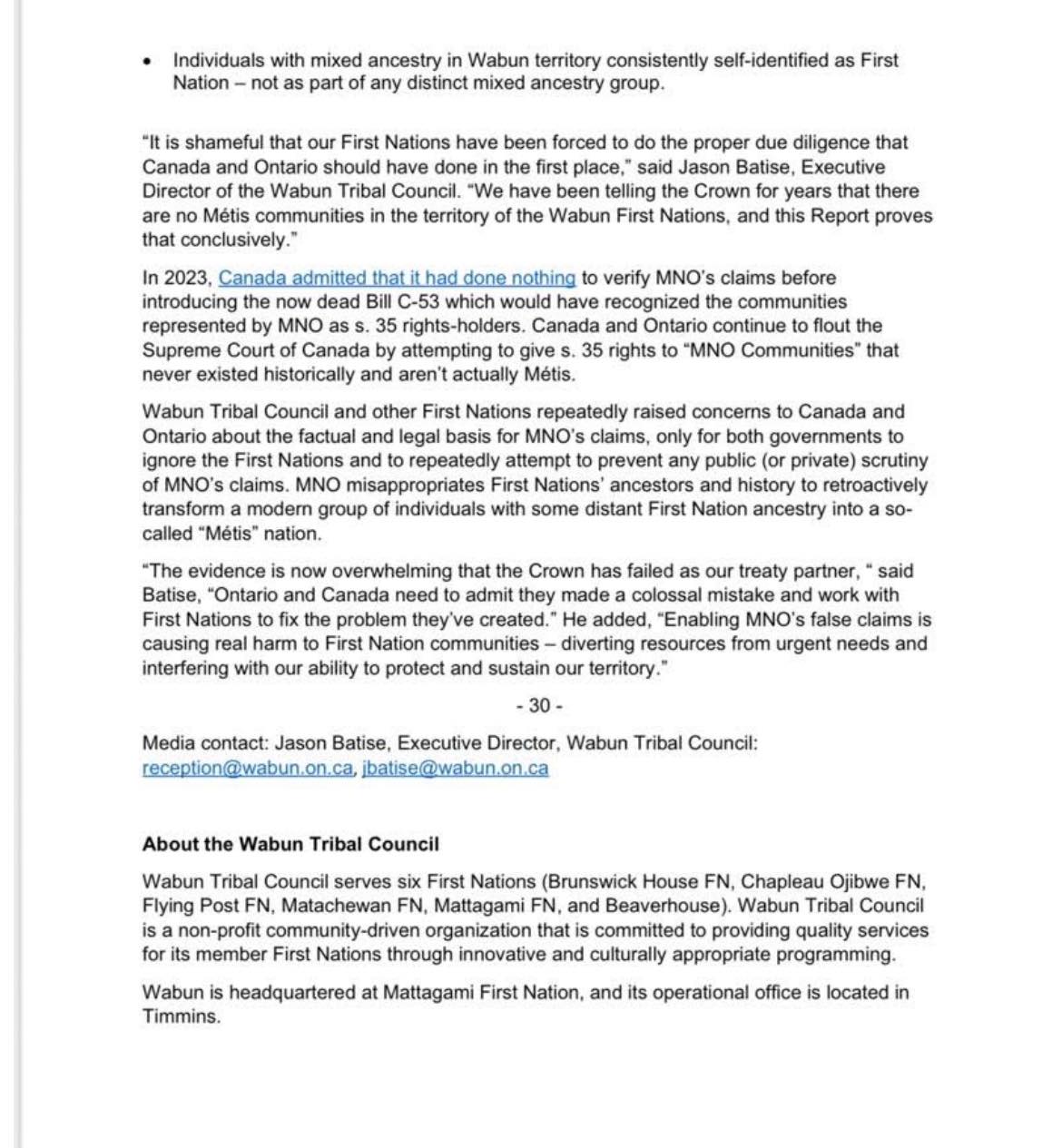
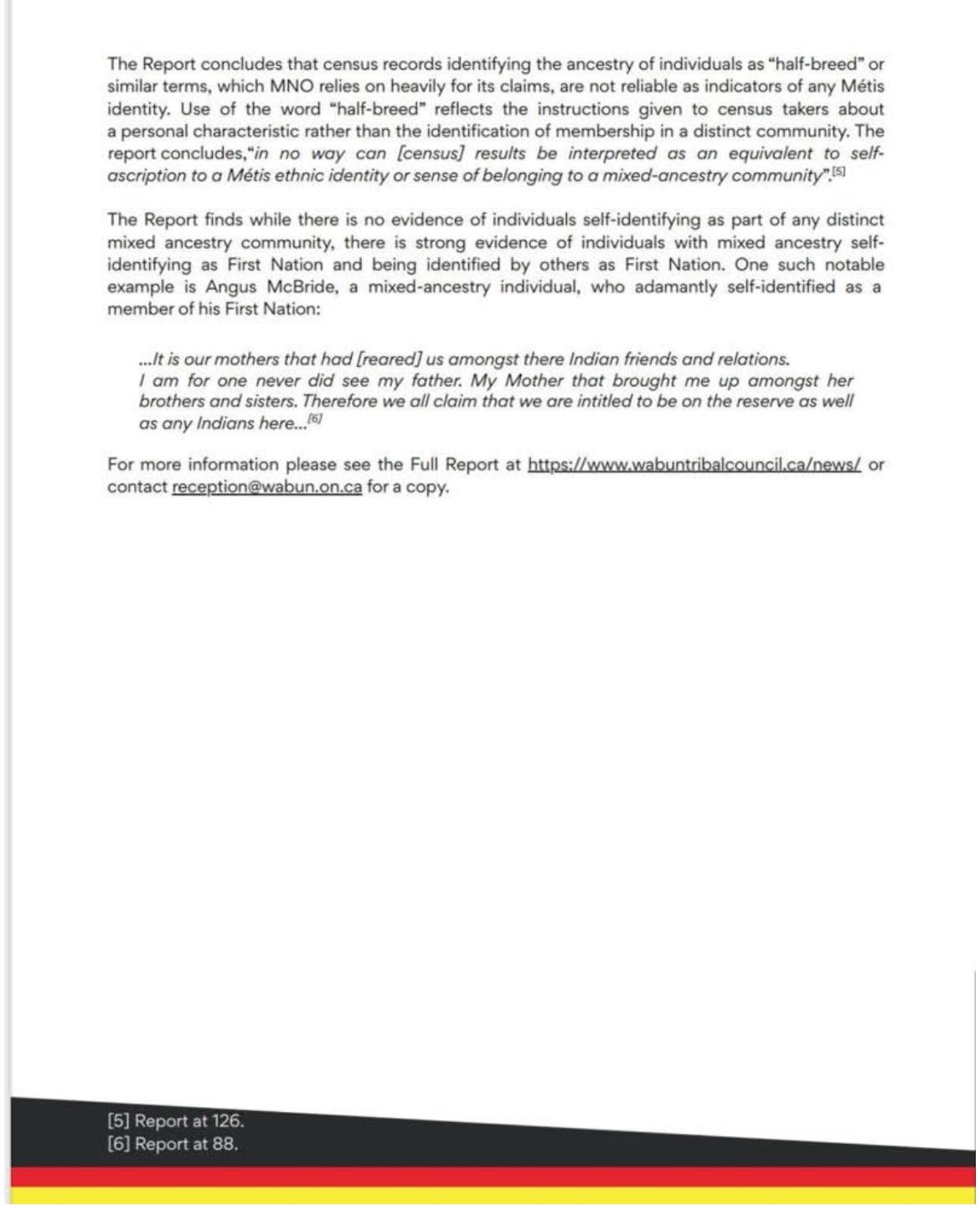
July 23, 2025 – Wabun tribal council released yet another academic report that challenges the MNO claims of historical existence of politically and culturally distinct “Métis” communities in northern Ontario/Great Lakes region.
May 22, 2025 – New research, Assessing MNO Historical Claims to Rights in SON Territory, released today: “The Chiefs of Ontario stands in full support of the Saugeen Ojibway Nation in their release of Assessing Métis Historical Claims to Rights in SON Territory Report, which serves to protect their homelands and the assertion of their inherent rights and jurisdiction on their traditional and Treaty territories,” said Ontario Regional Chief Abram Benedict.
The report, prepared by two award-winning scholars, Dr. Heidi Bohaker, Professor of History at the University of Toronto, and Dr. Chandra Murdoch, a Post-Doctoral Fellow at Osgoode Hall Law School, was initiated in response to concerns from the Saugeen Ojibway Nation (SON) about claims being made by the Métis Nation of Ontario (MNO) and the Historic Saugeen Métis (HSM) in their territory.
A worthy note made by Dr. Darryl Leroux – “There have now been 9 academics from fields as diverse as history, law, sociology, Indigenous studies, anthropology, and political science who have independently examined the MNO’s claims. Each time, they have found that the 2017 recognition of the MNO’s 7 new communities was a serious mistake by the Government of Ontario.”
May 20, 2025 – Manitoba Métis Federation and Chiefs of Ontario renew calls for government and institutional action in addressing Indigenous identity fraud
September 20, 2024 dated letter from Glen McCallum, MNS President to MNO President, Margaret Froh, appearing to set up backroom collaborations is discovered and made public. The letter undermines the MNS resolution of September 19, 2024; media attention; and the MNS constituents.
September 18, 2024 – a new research study on the MNO’s “new historical Metis communities” for the Metis Nation SK presentation to the MNC finds the same conclusions by previous research reports looking into the MNO claims.
The MMF invite citizens and the public to read the report provided by Dr. Darryl Leroux, doctorate in Sociology and Anthropology, Assoc. Prof., Department of Social Justice and Community Studies at Saint Mary’s University, Prof. Darren O’Toole, Metis, Faculty of Law, University of Ottawa, Métis scholar Dr. Jennifer Adese, and professional genealogist, Gail Morin
October 2023 – The Sault Ste. Marie “Métis” Community and “Halfbreed Petition” Prepared for Robinson-Huron Waawiindemaagewin by Drs. Celeste Pedri-Spade & Darryl Leroux
This report was commissioned by Robinson Huron Waawiindamaagewin in August 2023 as part of the research they’ve been leading about the Métis Nation of Ontario’s (MNO) political claims in Robinson-Huron territory. The purpose of this latest project is twofold:
to assess to what extent historical reports and academic literature on the so-called Sault Ste. Marie Métis apply a consistent definition of “Métis” (specifically one that reflects more than just the presence of “mixedblood” individuals); and
to establish whether and/or to what extent this same research engages with Anishinabek history and governance in the MNO’s discussion of what it calls the SSM “Halfbreed Petition.” Our findings confirm that the research reports and academic literature that are often cited to legitimize the existence of a distinct Métis community in the Sault Ste. Marie region lack scholarly rigour in their use and understanding of the term “Métis.”
September 2023 – Examples of the false evidence used bythe Métis Nation of Ontario and the Province of Ontario to invent the historic Métis communityof Killarney & Environs
February 5, 2021: Statement on the MNO “root ancestors” by Gail Morin, noted genealogist of Metis families for 30+ yrs and author of over 80 books
“Like it or not the majority of MNO root ancestors are French Canadian, status or Non-status”
“It took me a year or so to even get past the list of root ancestors available online c2018, but about 14 months ago I started looking. The MNO root list isn’t particularly user friendly and probably someone inexperienced in genealogy or research would never be able to sort it out. They use phrases like verified Métis ancestor for people who were born in Quebec and with no indigenous ancestry. Many of the families who were mixed bloods were living on Indian reserves. When the “rules” on enrollment started, the mixed bloods who stayed in Canada became non-status. Often these mixed bloods met and married US citizens. Some of them assimilated to the south, but many of them became part of US reservations. They aren’t Métis. Yes, there are some Métis in the mix. The list for Mattawa includes the well known Favel family. There is a Lhirondelle branch in Georgian Bay. The Rainy River families definitely had a connection to Manitoba. Considering $600,000+ was spent on this root ancestor project, I’m guessing it was commissioned to “let” people become Métis and to produce numbers. I know some of the grandfathered MNO members were eventually disallowed membership. They must have been part of the pre-1730s families from Quebec or in some cases had an Indian grandmother who was a white woman born in France or someone who was made up on the Internet. What a mess!”
September 1, 2022 a new report commissioned for the Wabun Tribal Councilof Ontario in defense of their territorial titles against the MNO is published.
I know it doesn’t matter what you do or how you do it, there will always be people who will ridicule you. They’ll talk about you, jeer, dismiss, and even attempt to undermine you. A good number of times, one will endure that from their own family. I’ve encountered all of that and I suppose I could always be a target for that mentality at any time and in any place. That’s just the really shitty side of life. That side comes from people who have yet to really dig deep into their own issues. What I’ve learned about that is, I’m not obligated to stay in that place with them – no matter who they are.
Despite a lifetime of being told it was a fruitless endeavor, there was good reason why I headed back 20 years ago to the community of my childhood. The fact that the community happened to be Indigenous was both inconsequential and utterly life saving.
I’d spent years looking for ways to understand why there was such a messed-up history that wrecked my nuclear family. Yes, it’s wonderful that much of the generation after mine has made great strides in the efforts of home ownership and good jobs, but behind all of that is that big black hole that still trails us. None of that is resolved by a good job, a nice home, an education, nor in running across or from the country. I did all of that first.
That black hole was borne in place of my familial history when I was taught my community, my relatives, my grandmothers and grandfathers were the cause of our life’s woes. Much like they are still said to be the bane of Canada and ‘its purse strings’. Because of that, I was meant to deny my own heritage and I followed through with it, like many in my immediate family still do.
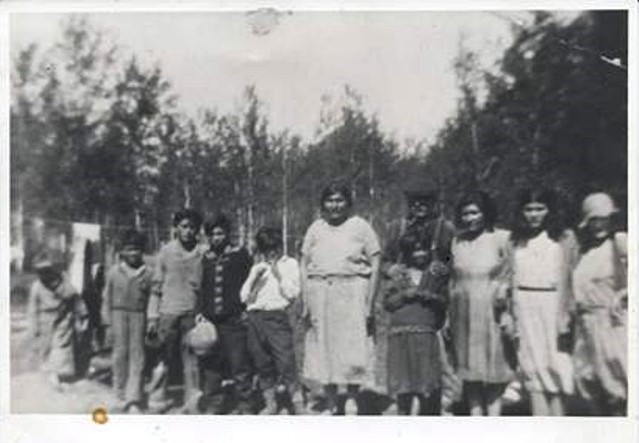
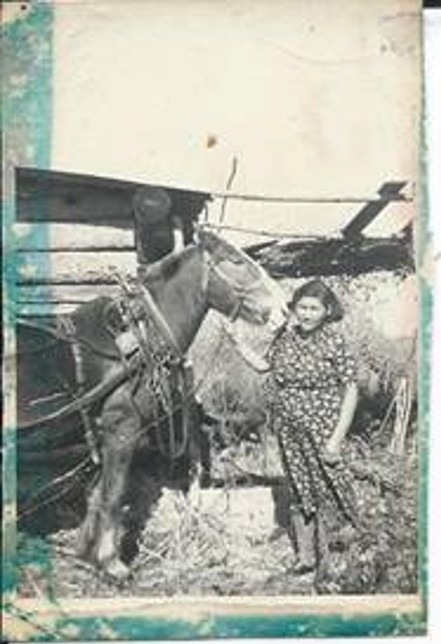
Mother, grandmother & grandfather, great-grandmothers, aunties, uncles and cousins – Cree, Metis, my family, my history
I did my best to be a good Canadian woman who strives to be a success. Except, when your foundation is based in a self-loathing that no one, including myself, seemed to understand, all that hard work can go up in smoke as quickly as it takes to get into a really bad relationship or receive a phone call that informs you are seriously ill. Those were my turning points.
I’d spent years trying to figure out the basis of that self-loathing. Counseling helped me deal with emotional ups and downs and during the moments when it would intensify to unbearable, but in too many instances, it only served to confuse me further. Applying standard accredited counseling services to an Indigenous inter-generational trauma survivor was woefully inadequate and sometimes even more harmful.
An example was a group therapy effort where I was advised the point of my issues was a deep internal desire to be in a sexual relationship with the woman who had driven me to the ‘retreat’. Another was asking me to not only re-create a scene of sexual abuse, but to do it in front of an entire group. I left any support services for quite a while after the work of that eye-crossing frustration. Therapy created in absence of truth, the truth – still mostly unknown to all even today, is just more marginalization of Indigenous peoples.
When those old moments of inexplicable fears arose again, I turned to other methods of coping. Art projects, writing, loads of volunteering or Al-Anon – which was great support, but incomplete. Then I went back to the idea that a super, new job title was the answer after all. Three additional years of corporate abuse dispelled that notion for good.
As it turned out, underneath it all, I did know what I feared most– being seen for who I really was. That was one of the concepts they’d told me about years before, but the thing is, that was wrong too. Because as it is for most, it really all boiled down to being seen for all that had happened to me – and my mother, and her mother – for generations, and for what I’d done in all the processes to cope with that.
So, despite all that running, in the end, I edged my way back to that place I feared most – that black hole. To the source of all the pain and rage and searing sadness. To that place that is my Indigeneity. To that place where apparently, any value as a realized human is only partial for us, according to school, neighbors, Canadian politics, and the punitive digs by a few of my own chosen relationships.
I was never going to know about me until I saw the real me, the whole me, desperately in need of being heard by anyone who could truly know the very real and distinct intricacies of the Indigenous journey in Canada – and that sure as hell wasn’t on the couch of a Freudian-oriented psychiatrist.
It could only be found back among my own, with my own relations where they knew what I was saying with only a third of the words. Where they knew what I was feeling without having to provide every denigrating detail, and far more importantly, they knew everything behind the whys. They carried the key and it was what I needed to finally fill in that hole of debilitation.
I wrote this because despite reams of paper trails to show what this journey entailed and why I am where I am today, I am still in the line of fire for derision. Despite the triumph of being armed with the understanding of my own culture and its incredible value, I am now ridiculed for standing up for it, even from some family.
Canada has claimed dominion over many of us, and I understand the ease of giving in, but I carry centuries worth of family knowledge. That history matters. I understand exactly why the events that occurred happened. I understand them on multiple levels and that’s what killed the shame that was never mine to carry in the first place. I stand up for my mother and my grandmothers because I am them and I was always meant to embrace that.
This is a country that still must answer for my family and so many others who are still swept away in the daily mixed messages of what it means to be Indigenous within it. It’s a horrible shame those messages remain; it’s devastating to know they’re still being internalized at all – on both sides of the equation.
I do what I can to help where I can, but the truth is that often, if not most of the time, I really don’t feel seen or heard. I feel as effective as a tiny chirp at the back of the cacophony that earns maybe a slight eyebrow raise from some bored listener on Facebook.
I resist the urge to screech louder. We’re supposed to be cautious about over-sharing or zealotry… Even so, I know at times I push that envelope – so bewildered that so few seem to understand or see what I see, even though what I end up screeching about is very much about their world too – equity and equality, corrupt industry and leadership, preserving clean waters… This is OUR world, damn it.
Realistically, of course I know I’m not really an island and I’m definitely not alone in my concerns nor alone on the front lines of a march or rally. Still, while people outside of those rallies, on social media et al, may seem not to notice, I think some, at least do. But what can really be said in response? How many times will people say, yes, I agree, before moving on?
So where do I or anyone else who desire to influence or create change for the better go from there? I suppose it’s at this point that some of us quit and maybe go look for whatever peace is available in our daily survival struggles. Or maybe we push even harder, hoping more serious agitation will move greater numbers. Or maybe like me, regardless of how despondent, quitting is impossible, (trust me, Cree blood is hot!). So, we continue to push for some semblance of balance in all options.
Having said all that, once in a while something happens out of the blue, maybe even something really quite sweet or even astonishing. Like an old friend and Juno Award winner writes a song and he says your efforts inspired him and all you can think is… holay!
What a beautiful event, this unexpected gift from a friend’s heart. He told me I could sing and record it; it’s mine to do with as I wish. Maybe I will sing and record it. Maybe I’ll just sing it with him some day – and I’d love that, but for now, I’d really love to share it with all the other dreamers who dare to strive. We can’t possibly know all who actually see or hear us, but someone is there and maybe, no matter how many, they’re all we’re meant to connect with. Maybe that really is enough…











 Blog Woman!!! - Life Uncategorized