
Own Your Past Canada – A Simple Guide How To

There were a lot of opinions flying after the recent release of the TRC summary of the Truth and Reconciliation report, but sadly, it was hard to discern which one was the majority – acknowledgement or denial.

The Past Shows Us the Way

————————–The Past Shows Us the Way————————— aaronpaquette.net

This report was several years in the making and outlines the history and consequences of the genocide effort Canada inflicted upon its Indigenous peoples from 1876 until presently.

The opinions that followed seemed to hold mostly two views – one that included a good deal of understanding, and support for the recommendations for Canada to acknowledge and manage the issues related to the Indigenous communities.

The other was this example, written by a Sudbury, Ont resident. I felt it encapsulated some very common views about Canada’s Indigenous history. He began his piece by asserting that, yes, Canada did bad things:

“However, the inflammatory statements made are just a little over the top. ‘Cultural genocide’ sounds much worst (sic) than what really happened”.

He goes on to assert that the First Nations people chose to live on reserves and the …“ills that come with that”.  Continuing on, he states what many of us hear daily:

…“a lot of negative assertions and accusations thrown at the government of the day, as well as the churches involved”.  After all  …“Let’s give credit to our leaders of a hundred years ago for realizing native people were living in a perpetually unsustainable cycle of poverty and violence, and at least tried to do something about it”.

Then he concluded his thoughts with this statement:

“Many other cultures have been assimilated without being so accused. These cultures have melded into our own, yet retained some identifying remnants that we share, enriching the culture of Canada. We are all better for it”

I’m at a loss to understand why a newspaper would publish such an opinion when the full summary outlining the facts of history and the point(s) of the TRC is readily available to the public, and certainly for this paper’s editors.  Unless, this was a lesson to show how much ignorance must still be countered within the country.

I won’t bother going over every detail of his inaccuracies because frankly, it was entirely inaccurate and again, the facts in point are readily available from simple internet searches, university resources, libraries and even the actual government department that oversees the affairs of the Indigenous.

What I prefer to highlight is this ongoing effort to continue to publicly obscure historical fact, which is really current, as the Indian Act of 1876 is in fact, still in effect.

The idea that assimilation is an effort that must still be completed underscores the need to realize that not all cultures adopt the European model of success adapted to the North American version, and indeed, why should they?

What this continent needs to do is stop attempting to tell other cultures, and in particular the actual original inhabitants of these lands, how they need to be living. What this country needs to do is really quite simple and that is live up to the agreements in the treaties.

The sad history, and the reason genocide came into being was, simply put, for the stealing of the land and resources that were negotiated for in the treaties — still in effect today, much to the chagrin of many an assimilation apologist.  In fact, treaties are still being negotiated even now.

Then there is the other side of the equation, which is written within the very Indian Act created for the genocide efforts.  It states very clearly, promises to the Indigenous for coercing them onto those reserves. Those promises have yet to be half-way lived up to.

If Canada wants to truly end this travesty, living up to the honour it brags about around the world is the start. Too many people think that becoming “equal” means becoming the same. There is a difference between equal rights, the rights for all people, and the Indigenous rights bargained for on their homelands since the beginning.

RL

http://www.thesudburystar.com/2015/06/21/sudbury-letter-report-unfair-to-canada

The Blacker the Pot… Guest Comment by Paul Curran

“Ahhh, Robyn, well said. Bravo”.  Well, when you’re getting an opening like that in reply to one of your posts, you know you’re going to do some reading.  I’m one of a great many bloggers who enjoy getting the insights from one of our favorite readers and occasional guest blogger, Paul Curran.  When I read through his entire reply to my last post “Hello Kettle, Black Pots Steam & Trumpet”, I had to share his unique and enlightening view, and so I decided his was a comment that was really a post of its own.  I hope you enjoy his thoughts that expanded on my post about hypocrisy.

KettleCallingPotBlack (2)Ahhh, Robyn, well said. Bravo. Matthew 18:15-17 “15“ – Moreover if your brother sins against you, go and tell him his fault is between you and him alone. If he hears you, you have gained your brother. 16.  But if he will not hear, take with you one or two more, that ‘by the mouth of two or three witnesses every word may be established.’[a] 17 And if he refuses to hear them, tell it to the church. But if he refuses even to hear the church, let him be to you like a heathen and a tax collector.” Basically, after you have tried, walk away and do not keep company with those who will not listen.

You know Robyn that when you are making a stew for nourishment in that pot – the longer it simmers, the blacker the pot gets and yet the tastier the stew. The outside blackness can be a result of making excellent nourishment to feed the soul. Mind you if boiled dry and ignored all can be ruined in a black pot. So, the blackness can mean two very different things – or as another old adage goes to make an omelette one must break some eggs. I agree you are right on about teachers teaching what they need to learn. and in perfection, those who teach for the best reasons do so because they know they need to learn and in fact pursue learning simultaneously.

One blogger that comes to mind is Beth over at http://ididnthavemyglasseson.com. She is continuously learning about life and she teaches for a living. I had a French teacher at work (1/3 of our customers were French so the company sponsored lessons for management who dealt with these customers)who was amazing. I spoke to her one day and it turns out that although she had two degrees in languages and was fluent in six languages (she was a university professor), she was spending her evenings learning German because she said she could not teach properly unless she could see the students perspective and she could only do that if she was learning too.

We were also training in a new computer language for the company main frame – a much more efficient language. This teacher was also excellent and could answer any question from the trenches so i asked how that could be so when he taught full time. His answer was telling – he said that he could only teach while he was doing the job and all the learning that goes with it so he worked 40 hours a week teaching and 40 hour programming.

Interestingly enough, given that mistakes make the pot black, I think those who are the best at what the do have leaned through mistakes – many mistakes, so very black. At one point Babe Ruth was the home run king of baseball – and yet what many do not mention is that he was simultaneously the strike out king. His pot was black from trying and from learning from his mistakes. Thomas Edison once said to a reporter that he did not fail 1,000 times when he was looking for a workable light bulb filament, but rather he found 1,000 ways it didn’t work.

So, as is typical of real life, differential equations and quantum mechanics, there can be more than one correct answer as to why the pot is black and the answers are sometimes diametrically opposed. (Just as the square root of 4 can be either 2 or -2.) She who makes many mistakes in the learning process has a black pot and he who continuously makes mistakes because he doesn’t learn from them also has a black pot. They are both understandable and immediately identifiable. The ones that make me wary are those whose pots are supposedly clean – they know not of what they speak or they are hiding their mistakes. Both of which make me nervous.

-Paul Curran

Hello Kettle, Black Pots Steam & Trumpet

black swan pot fireSome pots are so blackened that they think they gleam only in the color of innocence, and are the only innocents that matter. Makes you just wanna smack ’em! Sorry, Karma, but there are those days, you know.

From Wikipedia:  “The idiom The pot calling the kettle black is used in a situation where a person is considered guilty of the very thing of which they accuse another. It dates from the time when cooking was done over an open hearth fireplace; both the kettle and the cooking pot would be suspended above it and collect the same amount of soot. The earliest instances {of using this saying} date from the early 17th century”.

More recently, comedian Stephen Colbert somewhat updated the idea when he coined the marvelous word, truthiness:  “Truthiness is what you want the facts to be, as opposed to what the facts are. What feels like the right answer as opposed to what reality will support”.

I‘ve had my share of encounters with either idea  and  have crossed the path of one or two of the blackest of these pots.  These are the ones who actually seem to be more Black Swan than mostly innocuous semi-hypocritical vessels.

You may have known one or two of these (pardon me), foul fowl as well.  I mean the kind that swim regularly in the pool of the pet words  –  impetuous, petulant, and petty.  They can be Brutus-like power posers or your sweet as pie pals on the surface, but they both practise the behavior of intimidation and bullying to get their own way, or in revenge for not getting their way.

Generally, I’ve learned to simply cross the metaphorical street with this sort.  You can try to have a heart to heart chat with them, but if you do and the result isn’t something you can live with, do yourself a favor and let it go.  It’s unlikely that you’ll gain a win/win with that kind of mindset.

It’s more likely the most you’d be losing is a load of unnecessary aggravation.  I have every reason to know that there really are few things in life that really are important enough to stand your ground for, and an honest heart to heart with yourself will move you in the right direction in deciding that.

Putting the darkest side aside, while we’re being honest, I suspect that we’d all admit that, from time to time, we are the pot too.  I’ve often heard it said that we are irritated most by the things about others that are in us.  If so, I think it’s really about the degrees of it; the more we’ve worked through those bothers of our own, the less we are bothered by them in others.  This idea has also been followed up by another saying – we teach most what we need to learn.

If we aren’t sure what we may most need to learn at the moment, we could pay attention to what we are putting out there the most.  What are we thinking about?  What are our conversations centered on?  What are our social media posts  about?  If we put out a particular message or focus on a semi-regular to regular basis, it says as much to us as it does to those we’re supposedly ‘teaching’.  Probably more so.

Our only life-changing job in life is our own.  If we do that well, we and our loved ones will flourish.  Doing it well means doing it in accordance to the real meaning of the teachings that come our way, not by following our personal ‘truthiness’ interpretations as conveniently needed.

Regardless of how black our pots become, we all start out the colour of shiny innocence.  At some point we have to accept responsibility for washing it as needed ourselves, and in knowing that we don’t have a right to scrub another’s.

RL

Originally Published on 7/19/2013

Because I Can…

people heart redSometimes, maybe a lot of times, we need to remember, or at least ponder, what this whole experience of life is supposed to be about.  We hear it all the time; it’s about love. It’s about helping one another.  It’s about lifting each other up when we’ve been pushed down by experiences too heavy to carry on our own.

Living this mindset to any great degree didn’t happen overnight for me nor did it come easy. My middle name is Macadamia, (look it up). It took a number of jarring incidents to make me stop and assess where I was heading and how. We call those incidents philosophical bricks.

Philosophical, schmilosophical – the solid OUCH of those bricks served to open my abilities to care beyond my immediate family needs and the occasional charity event. One clunker that demanded attention is a chronic health condition. When I’ve had to deal with acute phases of it or any other life crises, (I’m really good at getting those), I’ve had the honor of being taught time and time again how living up to life is actually demonstrated. As it turned out, it’s really not as hard as I once might have resentfully imagined.

Those who know me would likely say I’m a strong person.  I know I am.  If you haven’t been defeated by life’s bricks and kicks, you likely are, but there have been times when I’d been so far down, I’d have sworn I was at the end and I was good with that. Relieved even.

I wish I could say I pulled myself out of those periods of desolation by the straps of self-determination, but the truth is, the ball to real self-help really couldn’t have started rolling if I hadn’t first been shown the path via the hearts of my near and dear.

They weren’t the surgeons or psychologists or ministers.  They were the friends who came to me to talk, listen, and hold my hand while I cried. They shared their wisdom and their resources to nurse and support the basics of life.

At the worst of times, they managed to break through despair that was blocking my will to fight any more. They showed me how to breathe once again through those debilitating trials. They worked with great and gentle care to help me feel seen and heard.

Those acts of simple and generous kindnesses were teaching me how to be a better human being, even as I felt incapable of even existing. In the most exquisite and genuine ways, I learned how to act when life grabs a tight hold and demands immediate action for survival.

Compassion changes so many levels of pain. It infuses you with honest empathy. It changed me in ways that I hope never gets unchanged. They showed me how to get up and say, yes I can.

Yes, I can get through this day, pain, event. Yes, I can take time to tell someone I’m thinking of them. Yes, I can listen, yes I can cook a (barely edible) casserole for someone who can’t.  Yes, I can give a few dollars, even if it feels like I can’t afford to, yes I can help.  I can do all the things done for me and more. Yes, I can.

My ‘Yes, I Can’ mantra graduated to ‘Because I Can’.  For me ‘Yes, I can’ and ‘because I can’ means I am alive. I may be limited in talent or immediate resources, but I’m not limited in possibilities to demonstrate care.

It’s my sincere desire, maybe even an obligation, to live up to the promise, the truest meaning of life as so ably demonstrated by those loved ones I call heroes. ‘Yes, I can’ is more than a trite statement or a campaign slogan, it’s a way of life.

It’s not about becoming a saint or a world leader to do something that changes the world. You don’t even have to be a ‘good person’; if someone needs a hand, help them.  I’ll bet you’ll end up pretty happy too, and if not, then please be reasonable enough to settle for content. There are plenty of days in a life well-lived when that is more than enough.

RL

Originally Posted on

“I Will Never”…

It’s a rare occurrence for me to re-blog, but sometimes someone speaks so eloquently from their hearts, that I feel compelled to share those strongly felt thoughts.  They can be in the form of a beautiful poem, a touching story, or as is the one I am about to share – words from a heart-felt voice who speaks out in recognition of their privilege in life. She is speaking of her view of life for those of Indigenous ancestry from the other side their experiences.  I found it very touching on many levels , and I was grateful for her generosity of spirit.

I’ve also attached a link to a video from a “white redneck” who says “take responsibility white people”.  His is a rather saltier version, but it’s no less compelling.

The first story begins here, but you will have to click the link following for the finish…

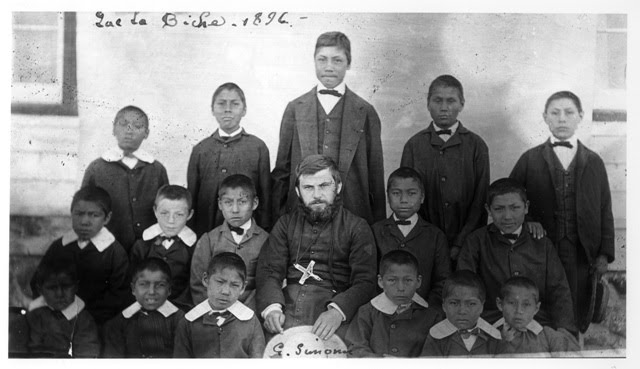
lac-la-biche-mission-1896“It would be another 100 years before the last residential school was closed in Canada — 1996. I graduated high school in 1996. I was preparing for my freshman year at college. I was under the impression that residential schools all looked like the picture above: black and white, old and grainy, things of the past, sad but irrevocable pieces of history.

Today I’m sitting in a cafe that’s live-streaming Edmonton’s Truth & Reconciliation Events. Due to the crazy traffic and parking fiasco I went through, I wasn’t able to make it physically to The Shaw Conference Centre today. Live-streaming is the next best thing, I guess.

What am I to think?

I’m white.

I’m Christian.

The whites.

The Christians.

We were the haters, the oppressors, the mongerers, the rapers, the abusers, the greedy mouths that took away almost everything from you… dear First Peoples of Turtle Island.

No, I’m not trying to impress you with my terminology. I am trying in my small broken way to address you with the respect you deserve. As I sip on my tea, I’m pondering: “What now?” The TRC cannot be both the beginning and the end. Surely not! But still”…

“I WILL NEVER” – A LETTER FROM A WHITE CHRISTIAN AT THE TRC

And,  now for a word from a self-described white redneck.  If you have an extra 5 minutes,  here is a great video from a white redneck who says, “take responsibility”. The language is rough in some spots, but his point is only underlined by it:  https://www.youtube.com/watch?v=JGJt0JXX05M