REDress Day of Recognition #MMIWG 2016

This is a day to pay tribute to those women and girls we’ve lost from Indigenous communities, and to honor those we have hope will one day return home. October 4th is chosen to honor the lives of over 4,000 Indigenous women tragically taken from their loved ones, most often with little awareness of the circumstances between 1980 to 2016.

This day is meant to raise awareness about that and of the ongoing violence, at significantly higher rates toward Indigenous women and girls than any other demographic on the continent. With awareness comes greater hope and opportunity to get to the root of all the issues that encompass these losses.  We remain diligent and attentive as a national inquiry is now underway in Canada.

It’s the 10th year of this recognition started by the Sisters In Spirit Vigil (SIS) organization which, along with an idea begun by artist Jaime Black for public displays of red dresses to represent missing and murdered Indigenous women, includes marches and candlelight vigils in many towns and cities across the country.

Last year I hung my red dress under my weeping willow tree.  This year I hung a dress in a location that holds the memory of many women. The entire effort took some interesting legwork and cost me some scratches and torn clothing, but I wanted to speak for them. I wanted them to know we remember, I wanted them to know they are loved.

I held out my tobacco offering and prayers and hung up the dress while a friend took pictures of my appeal for awareness.  He edited out the hanging stand, lending an ethereal effect. It seemed to make the dress feel free or freed.

Within this all, I send my love and hope for all our grandmothers, mothers, aunties, sisters, and our daughters…

(click or scroll over photos to see entire picture)

Update October 6th: Photographer Darren Quarin drove by the farm and found that the chair had been thrown off the hill it was photographed on and the red dress was nowhere to be found…

RL

Photo & Editing Credits: Darren Quarin, Quarin Photography

When Bunk Is Passed As Progress For All, We All Fail, Site C Dam Failures

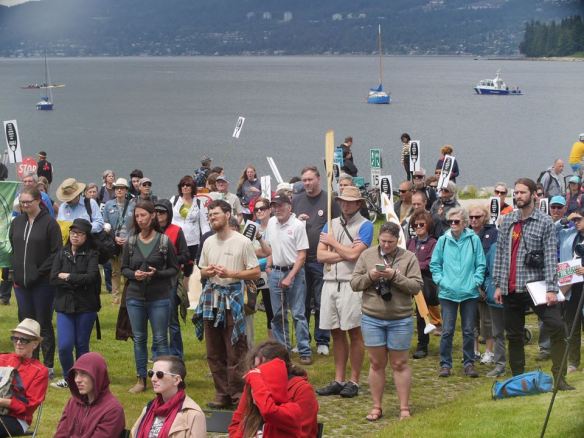
I attended a rally yesterday to protest the continuing efforts to raze the land within the Peace River district of British Columbia and Alberta also known as Treaty 8 territory.  The protests are not about ‘hindering progresses’, they are about speaking against an incredible sense of depravity within the desire to forever ruin the lives of people and all the history of their ancestors for the simple purpose of serving big money. It is unconscionable and especially so because it is unnecessary.

The publicized intention is to flood that area’s prime agricultural and hunting/gathering grounds for the purpose of generating much-needed electricity.  In a word, that’s bunk. Typical BC Liberal & big business bunk.

site c protest july 9

Grab A Paddle- Stop Site C Vancouver protest gathering, July 9 Photo by, Devin Gillan

The basis is greed… spending billions of dollars to build a dam that will serve international need in industries that many people are coming to realize are relics of progress past and are in the midst of being turned away from for the betterment of the entire planet – the purpose is mostly for moving bitumen and tar products overseas.

Story after story has been published about the facts and figures of these points and still the BC Liberal government (a misnomer if there ever was one because this political party is as conservative as the former ruling party of Canada, the Progressive Conservatives) bulldozes on.  Links to a few of these stories are noted below.

I speak to the human side of this issue, about the real people who live there and who are somehow meant to be mere side effects of big business allegedly on behalf of the majority of the population which lives in BC’s lower mainland.

BC Hydro says 73-77% of BC residents support this project. I find it extremely hard to believe that many BC residents support this when most Vancouver residents already understand it is not the clean energy being touted:  “The Site C dam is being built with taxpayer dollars to generate energy for expansion of fracking and the tar sands, contributing to life threatening climate change and destroying precious farmland and artifacts,”  said Audrey Siegl, Musqueam Band member and community organizer, in a release.

Treaty 8 is my ancestral homelands.  In fact, my great-grandfather was a signor on that 1899 Treaty.  Do I think that he and all Indigenous signors believed they’d be signing away their homelands, the very source of life sustenance for their children and children’s children in any manner and for any reason close to what has been happening ever since?  I will ask you instead.  What do you think?

In only one of many examples of what this project for China et al is all about: when a government is paying out $55 million per year to turn off even one working electricity generator that means we have no power supply shortages now or for the immediate forseeable future. In fact, electrical consumption has been going down.  This is a make-work project for some people at the expense of generations of others.  It’s a get-rich project for even fewer.

I do not believe, I simply cannot believe, that the majority of BC and even Alberta residents think they are more important than the grandmothers, grandfathers, their children and their children’s children in northern communities. I think if it were about the devastation of their families and stunning landscape, they’d be vocal and taking action to stop this insanity too.

So, that’s what I’m asking for… that’s what I hope for – that people will help people in their own back yards not have to suffer and succumb to the utter havoc being wreaked against an area and the people who live there for no damned good reason.

Sign the petitions of the noted organizations working on behalf of this critical issue. Send your own letters to the provincial and federal governments. Sign the online works and forward the pages on. It’s that simple.  Surely to God, people can do that much to help their fellow neighbours…because eventually this greedy madness will affect everyone when the bills for it come due.  Remember when so many doubted the effects of climate change? Well this is part of the reason for it.

Please, for the love of God’s green earth – do something.

RL

Organizations you can look up to read about the issues or sign a petition:

RAVEN – Urgent Cause: Stand with First Nations against Site-C – Raven Trust
LeadNow – http://www.leadnow.ca/stop-site-c/
PVEA/Sierra Club/Y2Y – http://www.stopsitec.org/
Amnesty International – http://bit.ly/28Jvlpa
Official Government of Canada petition – https://petitions.parl.gc.ca/en/Petition/Details?Petition=e-324
Wilderness Committee
COPE
The Council of Canadians
KAIROS Metro Vancouver
Canadian Parks and Wilderness Society

Fight Site C – dedicated group

Vancouver protest of Site C dam at Vanier Park

Vaughn Palmer: NDP government would demand independent review of Site C

BC HYDRO SEEKS AN INJUNCTION FOR SITE C

So, The Right Honorable Paul Martin Called Me Up On Calling Him Out On CDA’s Racism

Revised June 8, 2018

2016 AvatarFormer Prime Minister, the Right Honorable Paul Martin called me in response to an email I sent him in reply to his comments made in a May 12th CBC story headlined: “Canadians not racist but Aboriginal issue ‘invisible’ to many, says Paul Martin”. While I’d assumed he was calling in some effort of support, I was disheartened at the realization he actually wanted to correct me on what Canadian racism is, or rather, isn’t.

While Mr. Martin did strongly point out in that and subsequent stories, the various awful inequities thrown at the Indigenous that cause significant and terrible consequences, I could not let that one sentence go:

“Racism isn’t the culprit, but that doesn’t change the fact that the challenges faced by Canada’s Aboriginal Peoples have long remained out of sight and mind to many”, says former Liberal prime minister Paul Martin.

I was stunned. Not only because the very fact that we still have an active piece of legislation called the Indian Act, which is all about the business of managing the Indigenous, but every day we read stories of examples of racism in action.

Every day, I see other examples, such as a recently posted widely-watched video put out by a very stridently racist Vancouver woman that compared AFN National Chief, Perry Bellegarde, to Hitler, demanding that the AFN members be arrested for treason, and complaining that all “natives are obsessed with white people”.

This is all enough to question just the idea that Canada is not racist, a country built upon the lies of trade and/or conquering as most Canadians believe, but to have had that statement come from a high profile public servant widely seen as a friend to the Indigenous?

It was incredible to me.

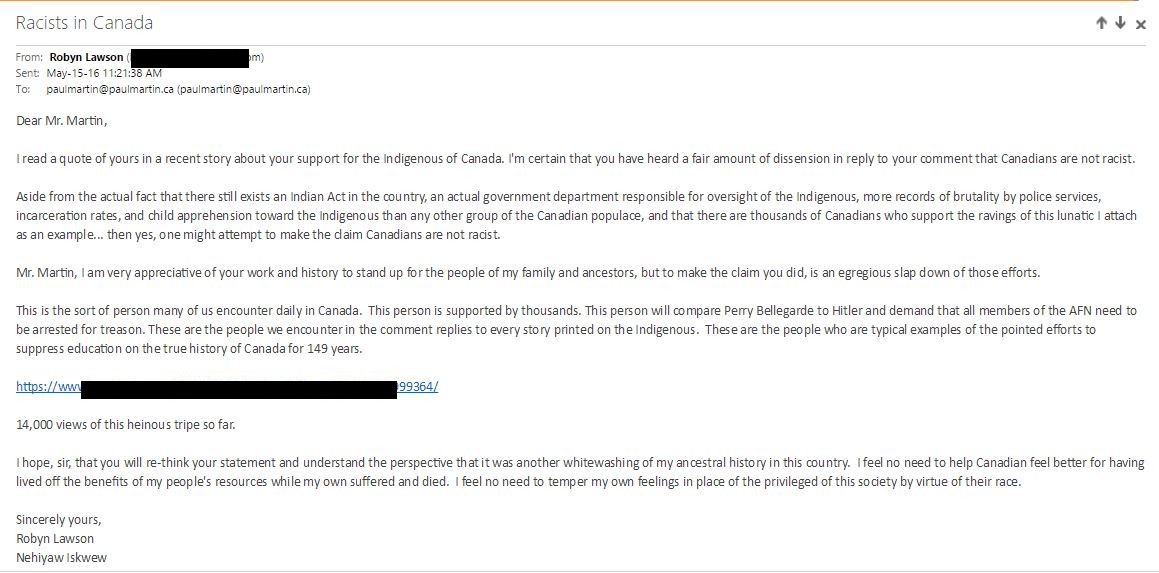
So, I wrote Mr. Martin.  I noted the points above, of others and attached the link to the despicable video.  I wrote to say I was disheartened, along with outraged because his background as friend to the Indigenous was precisely why it was especially important to not let stand yet another whitewash of history to make Canadians feel better, despite the fact they have all benefited from taking the lion’s share of Indigenous resources.

I admit I had no expectation of a response as I’d yet to get one from any of the fine members of Canada’s upper echelon in all my years of writing to them about Indigenous issues. However, 24 hours later I received an email asking if I would like to speak with Mr. Martin.

Stunned for a second time in 24 hours! Of course I said, yes, and within minutes my phone rang.

I was a little surprised by the opening of the conversation.  I found Mr. Martin to initially be quite defensive, not quite ready to recognize why I could be upset. He said it was hard to accept that people wouldn’t be able to see his message’s point, especially given his personal record of working to undo the wrongs against the Indigenous over all these years of service. This ignores the point that it was he who implemented the annual 2% funding spending cap for INAC in 1996, which imposed harsh consequences on the ability of Indigenous communities to thrive since.

He asked if I’d watched the actual interview, and I admitted I did not, however there was no video linked to the story in question. He specifically mentioned crafting the Kelowna Accord with Indigenous leaders that former Prime Minister, Stephen Harper, crushed the minute he came into office.

Of course, I am aware of Mr. Martin’s efforts; I absolutely acknowledge Mr. Martin’s role in that Accord and I would note I have used that Accord as an example in several conversations on the potential for moving forward (and it’s the third reason I came to despise Harper as PM). But, again, that’s precisely why I took especial exception to his words.

To get to his point, he said the Indigenous problem with Canadians is based in ignorance, a lack of history knowledge moreso than racism.  I said I do understand that as in large part, I believe racism is ignorance, however we have to be careful of how we state things too. I sensed this thought wasn’t particularly appreciated.

It was at this point he had to go and his final comment was that he feels that calling Canadians racist will not help in the work to help the Indigenous.

After we hung up, I thought about all the people my friends, acquaintances, and anti-racism workers encounter on that daily basis.  I thought about all of those who, like that racist video creator, remain fully and willfully ‘ignorant’ of facts, I wondered about the rest of the Canadians who actually are aware of the inequities, the injustices, the utter horrors of their country’s history.

I wonder what Mr. Martin would say about them, and how would he’d reply to questions such as:

What happens once the ignorance is dispelled, are these same Canadians then standing up for us?  Do they protest the inequities?  Do they even just move out of the way of progressing forward?  How many of these same good people are still exercising their right to indifference?

How is inaction or indifference not complicit racism, then? Isn’t that what Edmund Burke was speaking to when he said, “The only thing necessary for the triumph of evil is that good men do nothing”?

I mulled the conversation around with my aunt, Elder Maureen Kennedy.  She said, “Yes, we have our own hard work to do to get over and through everything, but they have their own hard work to do too”. I agree with my aunt, except I’d say, I don’t agree that they should be expecting our comfort for them on top of it all.

Mr. Martin also sits as board member for the *Canadians For a A New Partnership (CFNP) – a group of prominent leaders from both sides of the equation to “build a new partnership between Indigenous and non-Indigenous peoples in Canada”. I envision the Indigenous partners having to dance around the elephant in the room while seeking justice.

…And do Canadians really need to ‘feel better about themselves’ before they do the right thing?

RL

*In early January 2018, Paul Martin quietly closed the doors of the CFNP, the only announcement appearing to be an email to their website subscribers. Shortly after that, he created his own private charity foundation, ostensibly in support of Indigenous education. He requested funding from the Canadian government. They responded with a $30 million cheque for him.

June 8, 2016 – 87% of Canadians believe aboriginal people experience discrimination: survey

An Indigenous perspective on the realities of racism:

Wab Kinew On Canadian Racism, Relocating Attawapiskat, And The ‘Criminal’ State Of Aboriginal Education

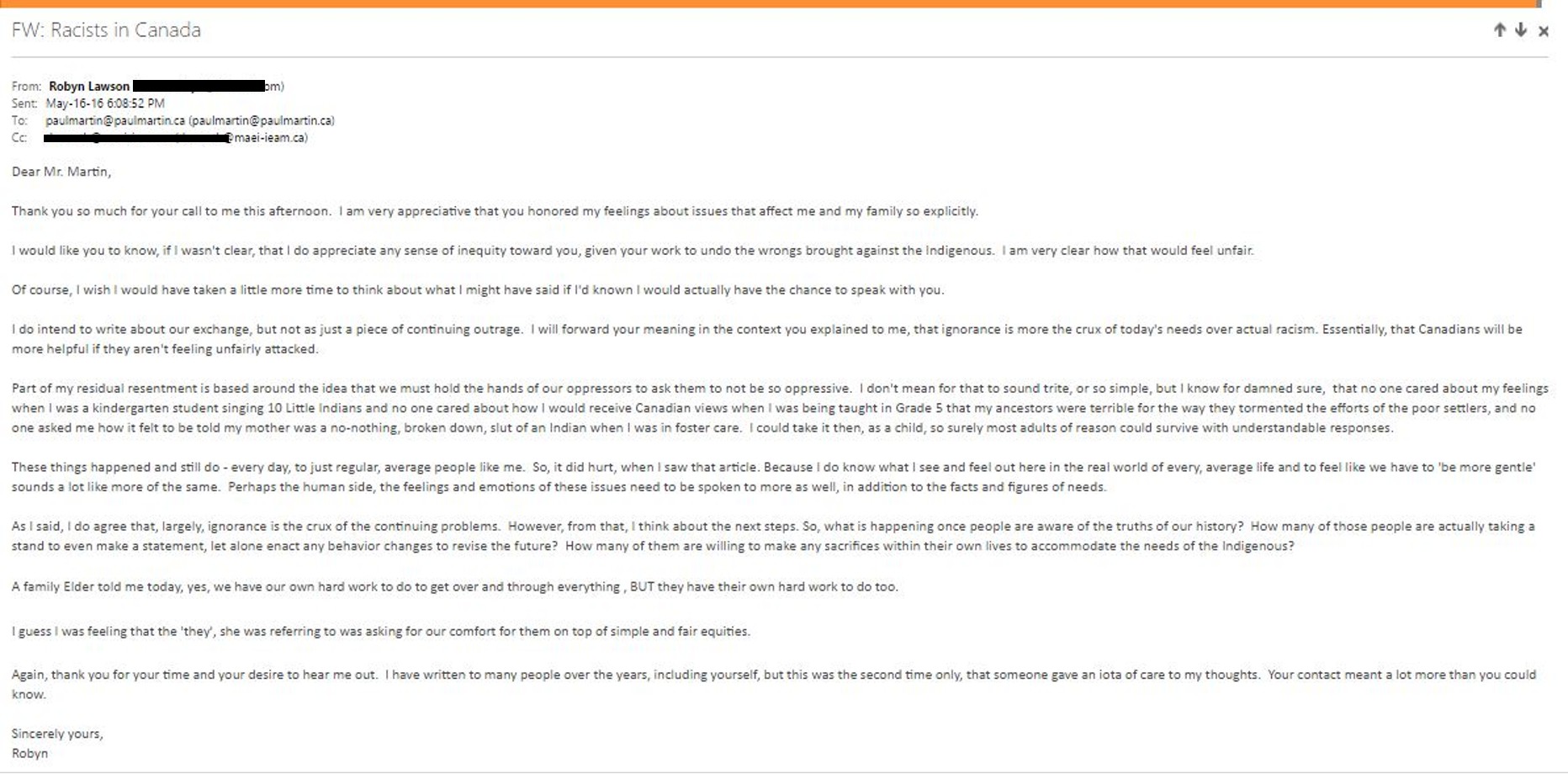
Martin email exchange

 Paul Martin reply May 16, 2016Email 1 to Paul Martin May 15, 2016 Email 2 to Paul Martin May 16, 2016

Half-Breed to Metis – My Return from a ‘Savage’ Wilderness; PART 2

 Click here to read part one – How I acquired the title of dirty Indian…

Aside from having to dream up a name to match any exotic ancestry I could claim, my real family history was more colourful than that anyway. We were the stereotypes of typical Indigenous life. Those lives scorned without understanding of the history behind the creation of those stereotypes.

It was a life loaded with issues around unsteady work, alcohol abuse, abuses under every heading, police visits, child apprehension, foster homes and a single mother on welfare. We moved a lot – always new towns, new friends, new crosses to bear.

So, by the time I could think a little for myself, I couldn’t wait to move on.  At nearly 16 yrs. I did move – onto a grown-up job and night school to get a better job, all in the name of getting as far away as possible from my childhood hurts.

Several years later my life had taken shape in a measure of success and definitely I thought I’d finally escaped being a poor and dirty little Indian. It seemed like I’d escaped the legacy of that drama. As it turned out, despite education and job titles, that wasn’t exactly the case. The various abuses never really ended regardless of the dressing I put up around them. I became even more desperate for a sense of value, meaning and peace. 

It was a bit incredible and maybe even miraculous from where the answers to my prayerful pleading would begin – searching the internet for a history project.

While I was doing that search, I stumbled across some family tidbits in the history records. It was astounding to me to see names I knew connected to others I’d never known about. Inexplicably I began to hear the call of my grandmothers in them and I quickly became obsessed with genealogy. Something was being filled in me that I’d been completely unconscious about missing.  I found the past. I continued in my search for years, able to trace my family back to the 1700s.

The uncovered voices of my ancestors undid the pain of my childhood humiliations.  Unlike the shame-based history the old input and my fearful imagination had originally filled in for me, I learned that we came from fiercely able, independent, inspiring Peoples.  I learned, in addition to Cree and Metis, my people were also Mohawk, among other nations.

I learned my ancestors were skillful and adept providers who worked the land, and they were warriors – from the Louis Riel uprising, to World Wars 1 and 2, and the Korean War.   They were explorers and guides for famous European explorers; they were leaders and treaty witnesses.

They were exactly what one might dream their forbearers are.  It was breathtaking discovery for me, but I later realized that, as wonderful as it was to feel the pride of their accomplishments, they didn’t need to be all that for me to feel found.

It would have been just as healing simply to find where I came from; to learn who my people were as a people, not as the butt of the jokes so common then on the western prairies.  Not as the people we learned about in school who were so low that even as kids, when we played cowboys and Indians, none of us wanted to be the Indians.

Fast forward some decades to when my son and I were going to a western-themed party.  We got all geared up in our cowboy boots and hats, jeans and checked shirts.  When we got home, my son was a little miffed.  His history lessons have been quite different from mine. He wanted to know why we hadn’t instead dressed up as Indigenous.  It was a good question, but I couldn’t find a good answer.

Although I’d identified as my Metis and First Nations ancestry for several years by then, I began to feel I was falling too short on the allegiance that my grandmothers deserved. Especially with the amount of public misinformation about the Indigenous still the norm in general.

However, despite the longing, I still had one foot out the door, just in case.  Old fears take a very long time to heal, if they ever do.  When I finally decided to stand up and be counted, I applied for a Metis citizenship card.

I’d like to set the record straight about how one goes about claiming that card.  Many comments in those newspaper and social media arenas revolve around thoughts like “well, pretty much everyone in Canada can claim some kind of Indigenous status now”.  No, they can’t.  You can’t just make a call and say, “Hello Government, I’m part-native, send me a card, thanks, and can I get free gas now like that Beiber kid”?

The application process took several months.  Actually, it took years counting the time it took to accumulate the various required records. I had to provide a genealogical history of 5 immediate generations of Indigenous ancestry with proof that included birth, baptismal, and marriage certificates.  It included scrip records, Hudson Bay Company work records, and other various historical records.  At a minimum, I had to link my direct ancestors to records known in western Canada at approximately 1860. Then all of this had to be verified by the society historians.

So that’s what I did, and now when I look into my mother’s eyes, I proudly see my history for thousands of years.  When my son looks in mine, he will see his own.  I turned away from that all those years ago when I thought I was meant to disown my heritage.

We talk a lot about how much the entire continent needs the true education on its own history, and that is absolute fact, but that’s just as true for many, if not most, of the Indigenous too.  We had our history taken from us long before we were even born and we know how terribly that changed us.

I can only feel sadness for that walk in the wilderness now, mine and all my relations of the last 5 generations who actually had our culture taken and even made illegal.  I know it doesn’t do any good to wonder about things that might have been, but sometimes I do.  I still have far too much to learn about them, and our ways.

On the day I received my official stamped Metis citizenship card, I stared at it and cried.  It was real, it was done, I’d stood up.  I really didn’t know then or even now, what difference in my life this official recognition will make.  I only know how I feel in those old wounded places in my heart.  I feel my grandmothers surrounding me now. My grandmothers called for PiPiSiw and I’ve come home.
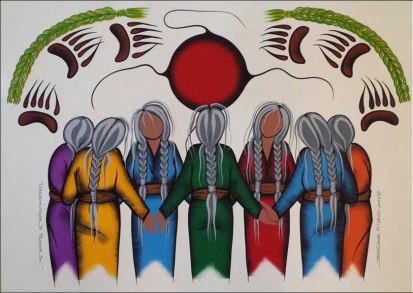
Grandmothers

kakiyaw niwākomākanak
(All My Relations)

RL

I want to add a little thank you so, so much to the people who have emailed me to tell me how glad they are for any of us able to speak out. You are a huge part of what makes these efforts meaningful. You are the people who allow my heart to feel full and worthwhile.
Hiy hiy….

With great gratitude to Dick Garneau, whose years of work compiling centuries of First Nations & Metis journal entries led me to more family discoveries than I ever dreamed I’d find. Hiy hiy, Dick. Thank you for your amazing work and generosity. May many others be as blessed as my family was with his work.  http://metis-history.info

21 things you may not know about the Indian Act – The Indian Act has been in place for 140 years:
http://www.cbc.ca/news/aboriginal/21-things-you-may-not-know-about-the-indian-act-1.3533613

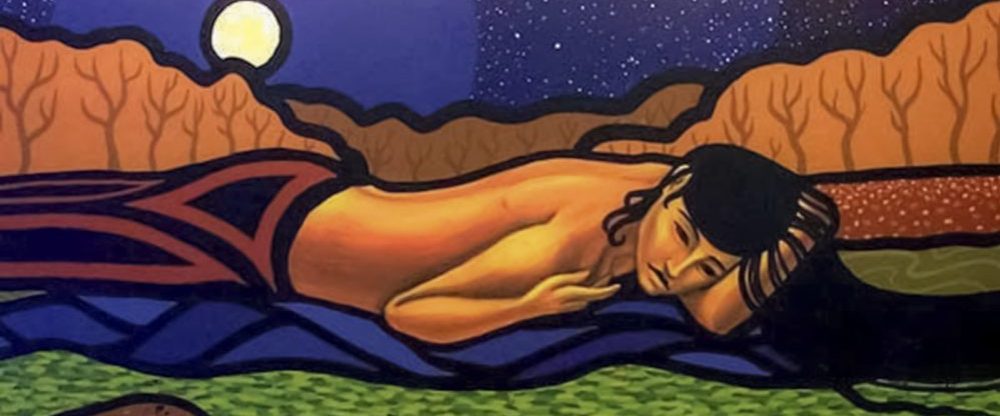
Artwork credit, with permission: Grandmother’s Prayers:
Simone Mcleod, http://www.fisherstarcreations.com/simonemcleod-acrylics Facebook: https://www.facebook.com/anishinaabepaintersimonemcleod/info/?tab=page_info

Half-Breed to Metis – My Return from a ‘Savage’ Wilderness; PART 1

(Originally partially posted in 2013 and revised 2016)

My name is Pipisiw.  That’s what my grandmother called me. I’ve loved her, all my life, even though she died when I was three yrs. old.  I sometimes imagine I can remember hearing her call out to me… “Pi-piiii-siww”.

Now it makes me smile, but after she died, when I grew a little older, I came to hate that name.  I hated when my mother or uncles would call me by it. It came to represent all that was shameful to me about myself.

metis-bear blue-edged2That shame was really about my childhood and it was deep and even subconscious. I blamed most of it on the fact that I had been born of “Indian” ancestry.

Whether or not being Indigenous actually was the overall reason for the issues didn’t really matter because it was what was driven home to me as a child. Whatever bad that happened, was mostly because of that, regardless of where we were.

Neighbours, strangers and even friends reinforced that belief by at times calling me racist names or treating me with a certain disdain reserved for those considered lesser. I overheard countless comments on the general uselessness of Indians.

As an adult, it was astounding to hear occasional comments in my business world that continued those views. I’d thought the more educated could be held to a higher standard of decency in general.

Although communications was always a major role in my jobs, and most definitely, a full-on accusation as a child, I never spoke up when anyone said anything like that.  Along with the shame I carried was a belief that, for the most part, those comments were true. I’d come to believe we were lesser and despite innate defensiveness, my heart still carried it.

It took decades and a long look back for me to heal enough from those wounds to feel like I could truly stand up in recognition of my history and my own people.  I made that recognition statement by applying for Metis recognition.  I didn’t have a home band to call my own for the Cree/Nehiyaw side of our family, but I did I qualify for our Metis recognition.

My decision to apply was partly spurred by much of what I’d read in the papers and on social media over the last decade on how Indigenous issues are somehow an old idea and we should all be over it by now.  I’d hear a voice in the back of my head saying, that’s complete bullshit; no one tells anyone to get over the Jewish holocaust, what about ours? And why then, does this continent still have government departments to oversee the ‘Indians’? Then that voice asked, so where’s your voice in this?

There was a burning anger building in me and it fueled me to face my fears and delve into my past to answer that question. When I did, I still got butterflies that a broad, official declaration, ‘I am Cree, I am Metis’, would somehow affect me negatively.  In the end, the sense of injustice overwhelmed the fear; if anyone were to come for me and my boy, I’d rather go with that than live in shame any more.  Mostly though, I was able to stand up with pride by finally learning I did not come from some shame-filled abyss. None of us did.

It’s true that there are many issues that need attending to in Indigenous communities, the road of healing from the consequences of long-term colonialist oppression is still too long. Part of that healing needs far more awareness by most North Americans that those same oppressive systems are still in place today.

On the personal side of it, I really wonder if any community can truly fully grow if its foundation is unintentionally made flimsy by too many of us that feel like I did, sub-par and lost in a kind of black hole.

It took that long trek into the past to climb out of that hole.  I had no idea that walk would be over three centuries long and the first steps began with some of my earliest memories of being an “indian” child.

Those earliest recollections of being told what I was, not by family, but other people who were around us was normal and many of those lessons were taught in school. In class, among the typical stories and songs we all regularly sang were things like, “One Little, Two Little, Three Little Indians”, (apparently still popular with the uninformed). Right up there with Three Blind Mice. Hard to imagine that changed to 10 little Irish or Jewish boys.

At around Grade 5, at 10 yrs old, I remember being more conscious of learning about how those Indians who kept getting in the way of the settlers were really quite awful. It was that year that my relationship to those awful Indians was cemented after an incident with a non-Indigenous friend.  It’s here where I really started my journey back to the beginning…

“Get out of here, you filthy little Indian”!  The echo of those words screeched at me when I was 10 yrs. old never left the recesses of my heart. I was chased out of the home of my best friend by her mother, who accused me of doing something to dirty her home. I don’t remember the exact details of the crime, but I remember being very confused; I remember being made to feel dirty and small.

I ran from her and with each step my humiliation and devastation deepened.  Her words continued to boom loudly behind me as I raced up the street.  She made sure that everyone knew what I really was. She very nearly made sure I’d know what I was for the rest of my life.

It wasn’t the first time I’d been called some pejorative statement about my ancestry.   I heard them before I even began school: half-breed, squaw, redskin, savage…  The incidences lessened around 11 or 12 yrs. of age.  By then we’d learned to call each other squaw and savages anyway.

The name calling decreased more when I was about 15 yrs. old.  I’m guessing it was because it was becoming more largely politically incorrect in the late 1970’s. It wasn’t a daily or even weekly event anymore, but I wouldn’t be completely free of it at any time in my life, so far.

As I aged people would often ask me what I was and in return I would ask, what do you think?  They would give me all kinds of guesses, usually something Mediterranean, sometimes Eastern European, or even Eurasian when I moved to the coast.  I would always tell them, yes, that is correct – good guess!

One time someone asked me if I was Greek.  Of course, I said.  Well, what’s your name then?  Oh great, I had to come up with a Greek name.  I just barely found out what tzatziki was!  My panicking wit managed to squeeze out, “Athena” – that goddess of love kind of thing.   “Athena what”?  Oh, good grief!   “Acropolis, I am Athena Acropolis”!

I’m pretty sure it was then that he knew I was lying, but I just kept eating my tzatziki and pita as though it had been the first solid food fed to me as a baby by my definitely Greek parents…

Click here to read Part 2 – …What a search through history solved and  finally gave me… and it didn’t include a Greek anything…

RL

With great gratitude to Dick Garneau, whose years of work compiling centuries of First Nations & Metis journal entries led me to more family discoveries than I ever dreamed I’d find. Hiy hiy, Dick. Thank you for your amazing work and generosity. May many others be as blessed as my family was with his work.  http://metis-history.info

A short note just to add some context to how the Stereotypes began:
21 things you may not know about the Indian Act – The Indian Act has been in place for 140 years:
http://www.cbc.ca/news/aboriginal/21-things-you-may-not-know-about-the-indian-act-1.3533613

Artwork credit: Bear/Woman portion- Bear: Clan Mother, 2012  Jordan Thompson, mohawk-art-design.com;  Metis addition – Robyn Lawson