Taxpayers DO NOT Pay For First Nations; First Nations ARE Taxpayers

Part 2 to September 22, 2014 post:  Pathetic and Dense; You HAVE To Be an Indian.

I’m not an authority on all things Indigenous.  I am only an authority on being one. Despite my great-grandfather, being an Indian signatory on Treaty 8, most of the information regarding our history with government oversight is new to me, as I expect it will be to most of you.  What a shame this statement is.
use your heartbeats wellI’ve condensed a huge amount of myth debunking information here, which I sincerely hope you’ll find interesting, enlightening, and worthy of sharing.

If you’ve ever read general media stories on Indigenous issues, coupled with what you likely learned in school, it wouldn’t be surprising if you have very light, usually unfavorable understanding, of First Nations peoples. Too often we’ve been portrayed as drains on society’s purse and guilt strings.

The headlines, commentaries, and letters to Editors that I see daily certainly provide ample evidence of that.  We’re at a place now where we can rise to counter the myths and we should.

My son has been in our local school district’s Aboriginal Program since 1st grade and though his lessons have included more cultural detail and none of the talk about Indians terrorizing settlers that I’d learned, there’s wasn’t much beyond that except one disturbing lesson.

It was only 3 yrs ago, within the general curriculum, that he was taught that Indigenous children forced into the infamous residential schools was a good thing because they were able to get an education. For the record, those notorious schools are not ancient history; the last of them closed in 1996.

Apparently, those school lessons remain much the same for the general curriculum and Aboriginal program until graduation.  There are no details added such as why the original Indian/Aboriginal/First Nations reserve system was created, what the rules were for living on them, and how they’re funded.

This is mainly what’s behind the long-held misconceptions about what and why things are the way they are. I don’t think this is by mistake.  I think we were all misled by early and some current governmental efforts to hide, subvert, and muddy the details of Indigenous history and issues in Canada.  I think there was disinterest by most media who, given generous benefit of the doubt, were likely unaware of the full picture too.

As more demands for governing transparency are made and more communications technology becomes available, we’re all learning far more, which benefits the Indigenous greatly by finally being heard in more vast and accessible ways.  Government records are being posted online for all to review, including the many Indigenous peoples catching up in education.

As mentioned in my previous post, some of my recent discussions about First Nations were rife with that lack of education and full of bitter assertions, derision and accusations against First Nations. When I contradicted their understandings, barrels of outrage erupted.  The chats quickly devolved into calling me names and mentally unfit.

 The highlights of the madness that ensued are these:

  • Since when do First Nations people pay taxes”?
National Post Missing Women Sept 18 2014-3a

We give you our taxes!

The majority of First Nations people do, in fact, pay all taxes. Of the 1,400,700 Indigenous as of 2011, which includes registered and non-registered First Nations, Metis, Treaty, and Inuit, all are required to pay income tax and the same goods and services taxes as everyone else.

Most of these people (+70%) do not live on reserves. The fewer numbers who live on reserves, and who can now earn income on reserve land, do get some income and goods and service tax exemptions, but not near the often assumed levels of ‘privilege’.

As for those other often touted ‘free funds for Natives’, I’m a card carrying legitimately recognized Metis and I have yet to find any funding to meet my medical needs or for continuing education outside of the same channels for everyone else.

  • …“How do all the chiefs get away with taking millions while their band members freeze, with no clean water”?
National Post Missing Women Sept 18 2014- quesstion

You’re dense; Chiefs steal

There are 3,000+ elected First Nations officials in Canada.  They’re required to turn in over 160 to 200, financial reports per year to the department of Aboriginal Affairs and Northern Development Canada (AANDC, known as CIRNA effective 2018). Chiefs who misappropriate funds exist but number less than the annual mismanagement cases we find in the Senate. How are any bands able to consistently outwit the 4,000+ employee AANDC, when it is literally their job to read & approve the reports they demand of these bands?

Assembly of First Nations Interim Chief, Ghislain Picard made a good point when he said, it’s too bad it’s these exceptions that are trumpeted and viewed as the norm instead of no outrage for the many more Chiefs who are grossly underpaid. (It’s Ottawa’s turn to be transparent – The Globe and Mail)

Despite the heavy demands of the role, the average band Chief makes an average annual salary of $60,000 (updated in 2015 from a previous average of 36,000). Many are making far less than that, as low as $0.00 to $25,000 annually. They get no pensions nor entitlements as those provided for Prime Ministers, MPs, or Senators.

  • “When will they finally stop living off of taxpayer’s backs and stand on their own two feet”? 

First Nations don’t live off of taxpayers, in fact, quite the opposite, their resources have generously subsidized Canada.
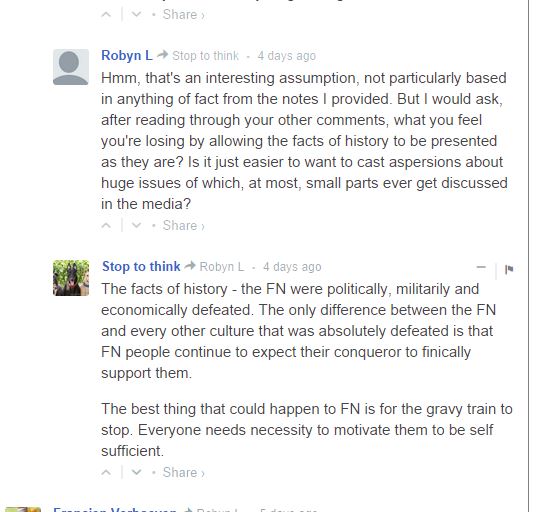
National Post Missing Women Sept 18 2014-11 - facts of history

The common misunderstandings of facts

Although, the 1876 Indian Act was used to brutally coerce government control of Indian economic and resource development and land use, Canada was formed through legal negotiations rather than war.

Treaties were agreements meant to sustain Indigenous rights and uses of land and resources equally with European newcomers. They are not invalid ancient history documents; there have been several additions since, right up to the current Harper Government.

The Indian Act outlawed First Nations from acting for their own economic development. This has only recently been somewhat revised and many reserves now generate their own monies in addition to the transfer funds they get from the ‘Indian Trust Fund’ which is overseen by Aboriginal Affairs and Northern Development Canada, (AANDC). They’re often referred to as ‘federal funds’, but that term should really be, ‘federally managed Indigenous funds’.

Must deny facts to retain right to argue

The monies that were/are supplied to this trust fund came from part of the resources taken off of their lands. Note to people who insist it was started with taxes: the Bank of Canada and the taxation system didn’t even exist at that time.

This fund is substantial, billions of dollars, and the Government of Canada still decides how those funds will be distributed to the bands.

The country of Canada, when unable to manage with the rest of the resources from land and taxes, has actually lived off of that First Nations trust fund from time to time, paying for things like general Canadian infrastructure and economic stimulus plans.

Indian Moneys Program: https://www.aadnc-aandc.gc.ca/eng/1445002892771/1445002960229#06
http://www.aadnc-aandc.gc.ca/eng/1100100032350/1100100032351
https://www.aadnc-aandc.gc.ca/eng/1426169199009/1426169236218
Indian Oil & Gas Cda
http://www.pgic-iogc.gc.ca/eng/1100110010002/1100110010005
Chapter 8 – Preservation of First Nations Capital Trust Funds
http://www.aadnc-aandc.gc.ca/eng/1382702626948/1382702680155
Appendix B – Rates of Interest on Capital and Revenue Accounts

This is only part of a rather large story, but writer, Elyse Bruce who regularly covers Indigenous affairs further speaks to the points.  If you follow her link, you will also get a picture as to why there is chronic under-funding to First Nation’s people who were made to live on reserves and into the Arctic regions to maintain Canadian territory:

…”the monies due the First Nations peoples from natural resources has been taken into consideration as part of First Nation revenues”.

…  “the First Nations Trust Fund isn’t the only money that belongs to First Nations peoples that is handled by the AANDC”.  

She’s referring to the fees for the licenses, permits and other instruments to individuals and organizations for exploration and development on First Nations land, and the Indian Moneys Suspense Accounts under the direction of the AANDC.

…”If the resource exploration and development projects weren’t on First Nations property, there wouldn’t be any need for AANDC to involve itself ergo the revenues generated from “licenses, permits and other instruments to individuals and organizations” is First Nations revenues, is it not”?

“In other words, there’s all kinds of money that belongs to First Nations peoples that isn’t part of the First Nations Trust Fund, (and yet) the AANDC controls all of it”.  

So where have all those extra funds been going?   Could it be, that Canada is in debt to the First Nations Trust Fund? First Nations have been asking for transparency of that account for years.

They’ve also been asking for autonomy in administration of their funds, education, and social services; however this has not been a successful effort.  This was very nearly accomplished with an agreement set to be signed in 2007, called the Kelowna Accord.  It was cancelled by the then next incoming Prime Minister, Stephen Harper.

One more note that begs sharing, in my opinion:

“Anyone crying that FN’s should disappear from the world and assimilate, might as well be advocating for Canada itself to be dissolved because that is the only way to dissolve the treaties. Like it or not, dissolving Canada puts us directly under international law. Like it or not, under international law, you must prove right of discovery. Like it or not, right of discovery belongs to FNs and Inuit under international law, meaning the lands and resources would revert to FN’s and Inuit, which is worth a lot more. Like it or not, this is why even Harper’s government has entered into Treaty as well as using Inuit right of discovery to secure Canadian jurisdiction over the Arctic’s vast resources”. –David King comment, from the Westcoast Native News, “A Short Note To Correct Canadian Misconceptions About Indians Living Off “Taxpayer Monies”, September 23, 2014.

Most, if not all of this, should be common knowledge to the average Canadian citizen, after all it’s their history too. Given the speed with which we can share information now, I feel cautious optimism that most Canadians will finally understand the issues and the reasons behind them.

These details are a huge missing piece of esteem building block for people of Indigenous ancestry. We don’t all have a full understanding of our own history. We deserve this. We deserve recognition for the stunning contributions of the Indigenous Peoples on behalf of Canada even while being purposely oppressed or denigrated for the consequences of that history.  Surely, this is worthy of respect; it’s certainly worthy of placement in all school history books.

Unfortunately, there will always be people who will continue to deny the worst of our history despite its evidence. There are citizens, leaders, and purveyors of history who say it’s time to just to move on. How do they propose successfully moving from point A to C, if we don’t acknowledge the hows and whys of point B?

Knowledge changes everything. All of Canada benefits when her history is fully known. The scars of that history can heal only if they’re truly and fully acknowledged; the fears that hold that back, hold us all back.  Those fears are based in the idea of losing something, but the facts show that there is only everything to gain.


Click to access sg0612_aboriginal_myth.pdf

RL

My boy – I will always hope that whatever your challenges are to be, you will always know that you are lovingly surrounded and supported by a thousand of your ancestors.  You are a great spirit, with the wisdom of the eagle and the heart of a warrior.

“Great spirits have always encountered violent opposition from mediocre minds.” -Albert Einstein.
Pathetic and Dense; You HAVE To Be an Indian

There comes those moments when you sit back and assess why you do what you do.  I’ve done this recently in response to the reactions on my posts and comments about Indigenous Peoples based issues.

I originally started writing to throw out my views on general life events.  I worked around what I might write and I settled on the concept that my son would know his mother as a multi-dimensional being.  For the day that he realizes I am an actual person, I want him to know what I stood for outside of “dinner’s ready and is your homework done”?  I want him to know what I learned about the entire human experience.

I wanted to fill in as much of his background for him, in order to spare him and other children in our family, any moment of the emptiness I felt while growing up. There was little knowledge of my family history beyond the shame of what we experienced and what was said to define us.  A number of those experiences were based in the fact that I was born an Indigenous person.

I’ve written about some of my childhood and what it was like to grow up facing some of the ugliness of people who had no desire to hide their disdain for Indigenous anything.  I was called names that I knew were about disparagement of my culture before I had any idea about the concept of racism.  I was only about four or five years old when I first recall being called some of those names:  savage, squaw, filthy redskin, whatever it was, I knew enough to know it wasn’t good.

That was far from the last time I’d be called those sorts of names and treated with equal disdain.  Those overt efforts to denigrate me didn’t end until I was in my teens.  It was most likely the fact that public awareness was growing around the concepts of political awareness and correctness.

It would be three decades before the same kind of voices and sneers would come at me again.  I suppose I could count my last posted column to be the first instance of the return events – which caused a loss of some followers of my blog and my Twitter account. The most recent occasion was this past weekend.   I wasn’t called a savage, dirty redskin or a filthy Indian this time; they went for my intelligence and mental stability levels before they finished off with a reference to my ancestry.

This foray back into the dark happened while I was engaged in an online conversation.  It was within the comments of a national newspaper about the current call for an inquiry into Canada’s missing and murdered Aboriginal women.  The comments began mostly as denials for any need for inquiry, because the recently published RCMP report seemed to have all the answers already, despite the many calls showing the disproportionate numbers of Aboriginal women as victims overall.

The reasons for denying an inquiry have been solidly reported already, so I won’t repeat them, but it didn’t take long for the conversation to move from that topic to how it was about time for First Nations to take control of their own lives, to get over the past, and to get off the backs of taxpayers.

In defense, I began in earnest to answer the questions and reply to the statements of derision as quickly as they were being posted.  With each question, I would get another question or asked about something completely unrelated – the old, deflect to another point to avoid having to admit first point trumped – tactic.

With every answer I gave came the demand for proof, and when I provided reference links to support my statements, I was hit with personal aspersions.  Four people at various points each let me know that I was unaware of what planet I lived on, that I was “dense”,  “dumb”, “pathetic”, a “nutter”, and finally in  summation:  “You HAVE to be an Indian”.

National Post  Missing Women Sept 18 2014-3aNow, I don’t have a problem with being “an Indian”, even the sort that man was insinuating; I don’t deny my moments of mental densities, but I survived the years four, ten, twelve and the three plus decades with heart and soul intact.

While, I mostly repelled the sting of those arrows, they did make me question whether or not I was subjecting myself and possibly my son to potential harm down the road. Was I going to lose more people within my friendship and supporter circles?

I am prepared for any lack of interest or opposition to my views, but I can still be surprised by who those contradictions may come from.  It is painful to find out that people you thought gave a damn about you actually didn’t.  It is saddening to learn that people you counted on didn’t really have a backbone of their own, let alone your back, and that even people you admired can walk away with each step feeling like a slap to the face.

Here’s the thing about that stronger constitution I now own – it takes a lot less time to get over the hurt of crossing paths with those sorts of people.  Now I realize I am losing nothing except future moments of wasted time.  Whatever our purpose was to that point, it was served and now, time to move on, God bless.

I wrote a while ago that this was my tap dance, and part of the song is my ancestry.  The fact that my ancestry happens to be tied to very real and important issues for my country matters.

I will continue to write of human experiences, of my own triumphs and failures; I will write about what I find humorous, and I will continue to write about affairs Indigenous.

In fact, my next post is going to be about the answers I gave that caused those biting heads to explode in that online discussion. The part about how taxpayers do not support First Nations people and in fact, why taxpayers should be saying a hell of a lot of thanks instead.

I hope you’ll stay tuned.

RL

Our Home and Native Braves

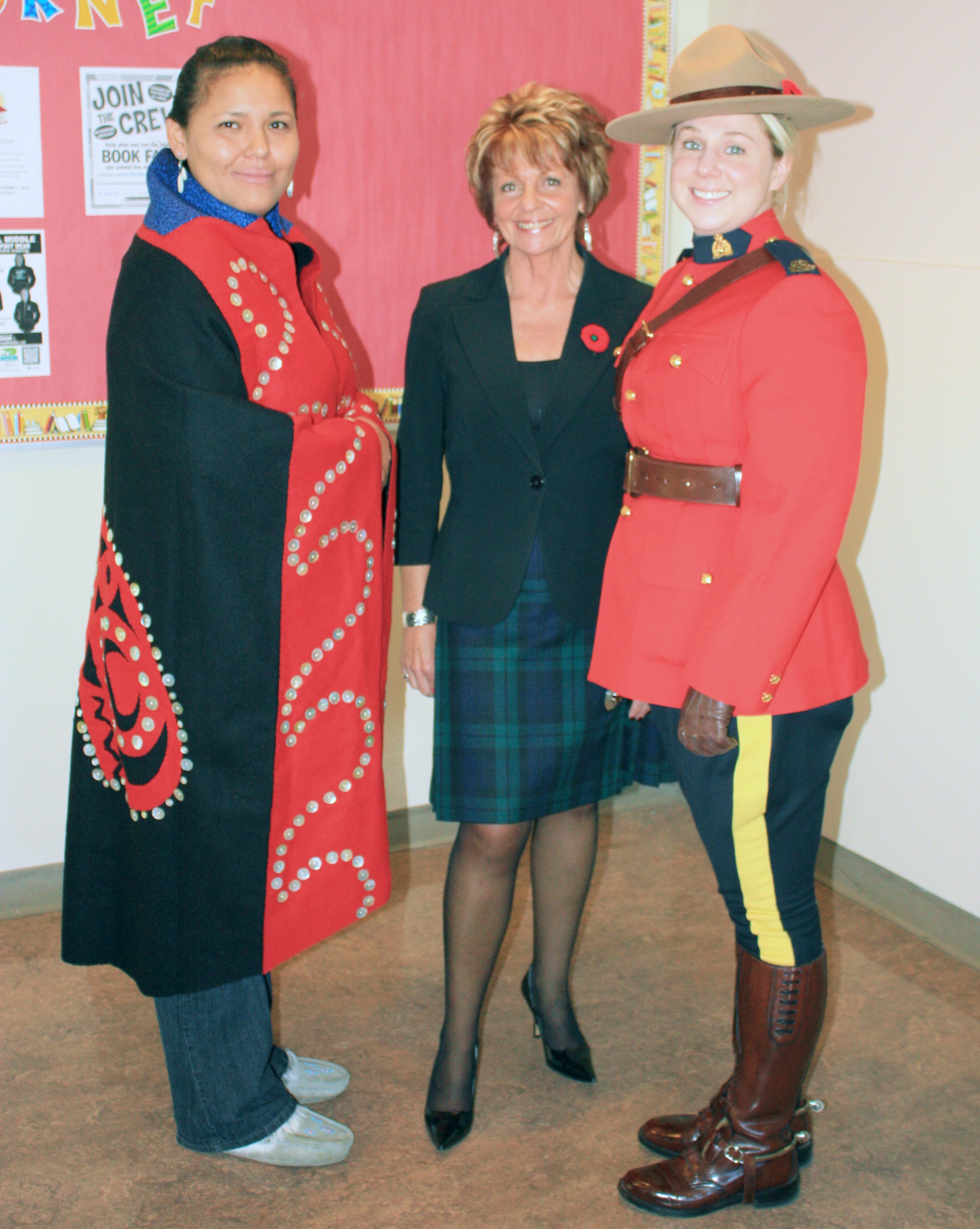
Andrea Hotomanie, Principal, Glenda Speight, Constable Erin McAvoy

Andrea Hotomanie, Principal, Glenda Speight, Constable Erin McAvoy

As Remembrance Day approaches, I am reminded of how profoundly I was moved by the Remembrance Day assembly at my son’s school last year. I found it particularly poignant for two reasons.

What I found initially striking was that the ceremony was presided over by all women, something I’d never seen before.  They were school Principal, Glenda Speight, RCMP Constable Erin McAvoy, impressive in her Red Serge, and Andrea Hotomanie, the district Aboriginal Support Worker.

Andrea Hotomanie was the second reason of note.  She stood up in recognition of the First Nations who serve and have served in the Canadian Military. She wore a magnificent button blanket around her shoulders.  It was the first time I had seen this kind of inclusion at any school remembrance assembly.  It brought me to tears.

It moved me so deeply because it was the first time I felt my grandfather and uncles included in these remembrances in a way that they hadn’t before.  It brought them, Cree warriors from Northern Alberta, faded from history for so many decades, up to the front too.  I felt they were being honored for the first time as servicemen and not as guests in the back of my mind, while all the other heroes were noted up on the screens and in the speeches. Between Andrea’s presence and my son nearby, this acknowledgement brought it all fully home to my heart.

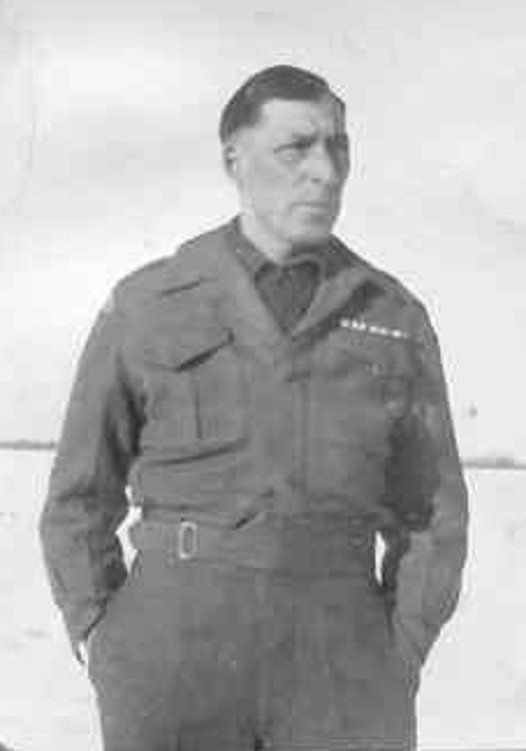
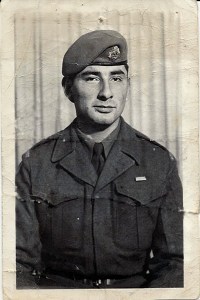
All those many years ago, there was never any doubt that at least three of my uncles would join the military from the time that, as young boys, they stared admiringly at the one photo of my grandfather in his uniform until they were all signed up and fitted into their own.

photo compilation by Robyn LawsonAlong with pride of nation and reverence for the uniform, there was another underlying and stirring reason to join up. Uncle Philip finally expressed it after I asked him why he always declared that his favorite job was being in the Canadian forces.  He said, “Respect”.  While he wore that uniform, it was the first time in his life that he was treated with honest to God respect, and it didn’t matter where he was in the world.  It was his greatest time of honor and pride.  I can’t say so for my grandfather or the other uncles, but I suspect they felt much the same.

Their presence at the Remembrance Day assembly that day was palpable to me, and I have no doubt that they were all there in full uniform.

There is a lot of history about Indigenous participation in the military and the details are available more than ever.  I would encourage anyone to look up that history sometime for some very interesting and enlightening reading.

For now, I would just like to say thank you to my family for their courage.  We will always be proud.  We will always remember.

In remembrance of:

Private John Joseph Baptiste Gray – WW1

Private John Joseph Baptiste Gray – WW1

Private Frank Joseph Gray – WW2

Private Frank Joseph Gray – WW2

Philip Gray Military Photo

Private Philip Sanford Gray – Korea

Private Larry Alexander Gray – Canadian post, Quebec

Private Larry Alexander Gray – Canadian post, Quebec

To an old friend serving in Afghanistan, Deputy Chief of Staff, John Valtonen, as always, thank you, and stay safe.

RL

readers digest logoOur Home and Native Braves was published October 30, 2013 on the Reader’s Digest community website:  http://www.readersdigest.ca/our-canada/community-blog/our-home-and-native-braves

Recommended link for Native military history:
A Commemorative History of Aboriginal People in the Canadian Military:
http://www.cmp-cpm.forces.gc.ca/dhh-dhp/pub/boo-bro/abo-aut/index-eng.asp

This SHOULD be Ancient History by Now! To the Thoughts Mostly Unspoken About First Nations

I hadn’t intended to immediately write anything about the Indigenous after my previous post.  I was leaning towards something funny.  I was in the mood for a ha ha, but life interfered again. I’d since learned even more about what goes on within the politics of “Native” life.  I know that I am far from the only one who was or is unaware of a lot of this information that is readily available, but rarely shared.

I received a great deal of positive comment and support on that ‘Half-Breed’ post, which I certainly appreciated.  I was expecting at least one comment of dissension, if not an onslaught.  Certain criticisms mean that there is still need for education, an opportunity to dispel a myth or two.

There was one critical thought, but it was given indirectly, written on the Facebook page of a mutual friend who had shared my story on his page.  The comment didn’t bother me to any great degree, and I doubt that its writer was the only person who felt like he did or something similar.  I’ve heard it said many times, that this topic just needs to go away. Actually, I can’t think of a group of people who would agree with that more than the people of Indigenous nations.

Response to post Half-Breed to Metis, My Return from a Savage Wilderness:

Anon.( for the sake of mutual friend):  The bogus multicultural self-identifying that happens in this country is ridiculous, especially when it comes to the inheritors of the first nations.           May 12 at 7:28am via mobile · Like

Then I recently read another blog that spoke to the Idle No More movement and Indigenous issues in general.  Her first reply was from someone who took issue with her post.

Response to post “Idle No More”, by Blogger Anne Thériault, The Belle Jar:

Carlos:  February 1, 2013 at 10:19 pm #

Let’s be real. There was no threat of Spence actually dying, what with all that fish broth she was consuming. No it’s not a full meal, but nutritious enough for her to survive. Also, just because the First Nations were here first does not preclude them from supporting themselves. How do you think that “the white people” survived when they got here? Exactly in the same way that the First Nations people did, hunting, fishing, gathering, and building their own shelters. The main difference is that the “white people” sought to advance and grow as a society, rather than try and piggy back on the work and efforts of others. There’s no reason why my tax dollars should go to fund the lives of those that do not have any motivation to work to support themselves, when the institutions that my tax dollars are SUPPOSED to go toward are so poorly underfunded. In all honesty, I have little sympathy for a group of people that have mismanaged the assistance has been given to them. Blogs like this that try to validate their claims of oppression absolutely drive me insane.  

REPLY 

Permit me to reply.

The lack of threat to Theresa Spence’s life notwithstanding, these are the kind of continual single-minded replies that completely ignore the actual facts and nuances of all the Indigenous issues as noted in Anne’s blog, and over all these many, many years.

Let’s break it down a bit. Let’s have a short look at some of the facts and nuances. To start, it’s fairly certain that most individuals and community bodies understand the enormous amount of work and time necessary to help people recover from abusive childhoods.  I think few today wouldn’t understand that many abused kids may require treatment even for the rest of their life to regain a life worth living.  Yet, despite the number of people who get that, there are too many with almost no understanding about how that same idea applies to the healing of the Indigenous . These are people dealing with the same kind of traumas -and so much more – applied to generation after generation of Indigenous families from birth to death.

A typical response to that is something like, “Hey, we’ve given you lots of money, you should all be better already”!  Why not try such an easy fix, in general, with all abuse victims?  I think most people agree that money alone does not solve everything.  There are all kinds of needs in response to life-altering events that need attending to:  physical and mental health, education, training, follow-up, and time.  I also have to wonder what exactly is the correct designated time period to get over it and assimilate?

Moving on from that issue, how many people regardless of ancestry would be able to “advance and grow as a society” like the “white people” if they don’t have the same advantages of the “white people” like deciding who can work on, or even sell, their own lands?

How’s this for some facts, that are by far not the only like them on the books, that would raise havoc for the rest of Canada? (courtesy of  Anne Thériault, The Belle Jar from CDN Dept. of Indian Affairs) :

  • “First Nations peoples have very little control over reserve land, and the Minister of Indian Affairs must approve any land sales or transfers.
  • First Nations people need to seek government approval for selling or bartering any crops, livestock and other products grown, reared or cultivated on reserve lands.   (Add in minerals and oil too.  There is far too much money in royalties and business taxes for the government to look at relinquishing them easily.  I also wonder who benefits the most from those taxes and royalties?  I wonder what the percentage of those taxes and royalties are paid back to the Natives in all those annual “handouts”?)
  • …if you’re an Indigenous Person, you’d better hope that the government doesn’t declare you to be “mentally incompetent”, as that means that the Minister can force you to sell, lease or mortgage your land as he sees fit.
  • Even a dead Indigenous person isn’t safe from the Minister; no wills drawn up on reserve lands are considered legally valid until the Minister approves them’.”

This kind of changes the overly accepted idea that the Indigenous simply chose the plan for a ‘welfare state’, doesn’t it?  If you still think there is a privileged existence on those reservations, or as status Aboriginal peoples, why don’t you ask to live as one for a week and see if you still feel that way?

Why are the people who feel the contentions are only about ‘status,’ or some other unfair representation, unable to get the message that no, the playing field to a decent life is not even.  Not even close.  That is the crux of the issue.  This is exacerbated by the fact that even many of the actual agreements, the Treaties, that were put in place have never been truly or fully honoured by the Canadian government.  It is these sort of issues that are going to take a lot of work to work out, which is why it has still to be worked out even after all these hundred some years.

I’d also like the people who demand that no more of “their” tax dollars be spent on these issues to tell me exactly what they think they’ve actually lost personally.  What exactly was their portion of ‘the wasted loss’?    I’ll bet these guys also think that “Natives” don’t pay any taxes at all either.  Better look that one up – because yes, we do.

As for all the mismanagement of funds by Band leaders, yes, there is room for improvement – with some bands, probably lots.  However, name any sort of business, government department, or even charitable organization that hasn’t had some mismanagement issue, even without the ‘advantage of full government oversight as required by the Indian Act’.

Don’t even try to compare any of that band mismanagement, perceived or real, to the billions lost by the very governments that require oversight of the Native funds.  Can you say $3.1 billion this year by the Harper government in one department alone?  Or how about all those advanced and educated senators recently in the news who cheated on their expenses?  Yes, interestingly, even one of them happened to be “Native”.  We’ve come at least some way, baby.

It’s also convenient for some complainers to continually overlook all the Indigenous groups that are working damned hard to overcome overwhelming and seemingly insurmountable problems to uplift and change life for all.  The point made about white society advancing and growing on its own seems to have missed the point entirely:  that ‘the whites’ initially advanced and grew as a society on the backs, resources, and guidance of the Natives, and in many ways continue to so today.   No, we wouldn’t say it was the sole way that society advanced, but that doesn’t negate the long, and again,  continuing role of that fact.

So, I’m sure we can all agree that it really is too bad, even deplorable, that Indigenous issues are still an issue.  These discussions should all be ancient history by now, but they’re not, and not because of some simple inconvenience like the Indigenous simply wanting to “piggy back on the work and efforts of others”.  In order to speak to such a large overall issue, one needs to have a far larger view and a handle on all of the facts and history.

Personally, I am very happy to know that there are plenty of people willing, able, working to get able, and actually working on this.  If we want an issue to go away, the first step to being of any useful help is learning just what the problem is.   So, instead of opinions based on reactions to headlines or chats, why not try to really learn about the subject?  Who knows, maybe then, even we all could help.

RL

Thanks to the Belle Jar blogsite for the Idle No More commentary, and the May 24, 2013 post in the Winnipeg Free Press on Native business partnerships with conventional industries.

http://bellejarblog.wordpress.com/2012/12/26/idle-no-more/#comments

DULCE ET DECORUM:  http://noraloreto.ca/the-indian-act-in-plain-english/

May 24, 2013 post in the Winnipeg Free Press on Native business partnerships with conventional industries.

First Nations Business Partnerships Exploding

http://www.winnipegfreepress.com/opinion/analysis/Industry-First-Nations-partnerships-exploding-204351481.html